Learn when German uses sein instead of haben in the Perfekt, with verbs of movement and change, plus the key strong verbs and their participles.
Most German verbs form the Perfekt with haben, but a smaller and very important group uses sein: Ich bin nach Berlin gefahren. Wir sind früh aufgestanden. Er ist zu Hause geblieben. If you use haben with these verbs, a German speaker will understand you, but it will sound wrong.
The good news is that the sein verbs follow clear ideas: they describe movement from one place to another, a change of state, or the verbs sein, bleiben and werden. This lesson explains those ideas, shows you how to decide, and gives you the irregular participles that you will need most often.
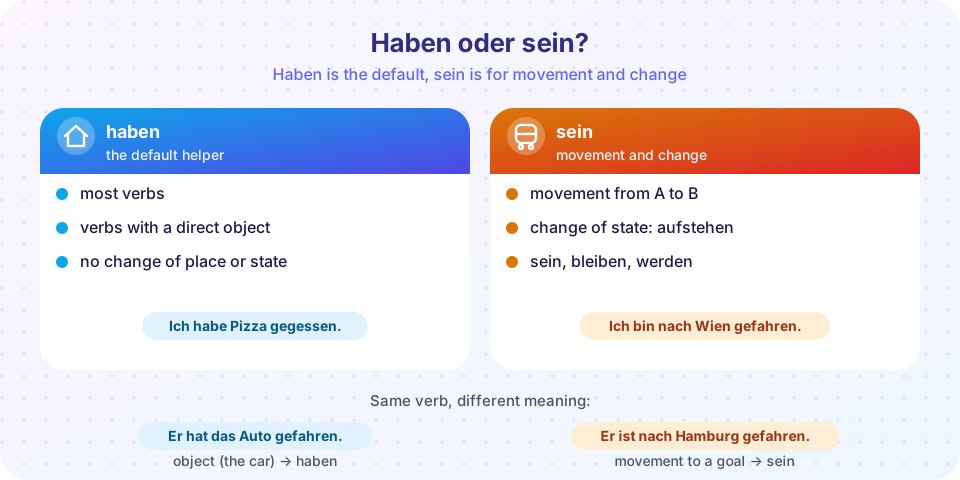
Caption: Haben is the default; sein is for movement to a goal, change of state, and the verbs sein, bleiben and werden.
Some verbs can use both helping verbs. The difference is meaning:
Ich bin nach Hamburg gefahren. (I traveled to Hamburg: movement to a goal, no object. Sein.)
Ich habe das Auto gefahren. (I drove the car: das Auto is a direct object. Haben.)
The same holds for fliegen: Er ist nach Rom geflogen but Er hat das Flugzeug geflogen. When a verb takes an accusative object, it takes haben. A shortcut: if you can say where you went to, use sein.
In standard German these three take haben: Ich habe gestanden / gesessen / gelegen. In southern Germany, Austria and Switzerland, speakers commonly say Ich bin gestanden / gesessen / gelegen. Both are normal in their regions; as a learner, use the standard forms with haben first.
If two participles share the same subject and the same helping verb, you only need the helping verb once: Ich bin aufgestanden und gleich gegangen.Ich habe gegessen und getrunken.
Strong verbs change their stem vowel. The table gives the infinitive, the third person present (to show stem changes), the simple past (you will meet it again in lesson 3) and the participle, with the helping verb where it is sein.
Read this short story. Notice which verbs use sein and which use haben.
Am Samstag bin ich um acht Uhr aufgestanden. Ich habe gefrühstückt und bin dann mit dem Zug nach Salzburg gefahren. Dort bin ich durch die Altstadt gelaufen und habe ein Eis gegessen. Am Abend bin ich müde nach Hause gekommen und sofort eingeschlafen.
Translation: On Saturday I got up at eight o'clock. I had breakfast and then went to Salzburg by train. There I walked through the old town and ate an ice cream. In the evening I came home tired and fell asleep right away.
"All verbs of motion take sein." Only when they describe movement to a goal or change of place without an object. Ich habe das Auto gefahren. uses haben.
"Sein verbs are always irregular." Many are strong, but reisen – gereist and passieren – passiert are regular.
"The English translation tells me the helping verb." "I have gone" and "I have eaten" look the same, but German uses sein for the first and haben for the second.
Test yourself: choose haben or sein for each sentence.
Haben or sein?
<style>:root{--ink:#1e1b4b;--mut:#475569;--acc:#6366f1;--bd:#c7d2fe}*{box-sizing:border-box}body{margin:0;padding:14px;font-family:system-ui,-apple-system,'Segoe UI',sans-serif;color:var(--ink);background:linear-gradient(135deg,#faf5ff,#eff6ff)}.card{background:#fff;border-radius:18px;box-shadow:0 8px 22px rgba(67,56,202,.15);padding:16px}button{font:inherit;cursor:pointer;border:0;border-radius:999px;padding:8px 14px;background:linear-gradient(135deg,#6366f1,#8b5cf6);color:#fff;font-weight:600}button.alt{background:#eef2ff;color:#3730a3}button:disabled{opacity:.5;cursor:default}.row{display:flex;gap:8px;flex-wrap:wrap;align-items:center;margin-top:10px}.mut{color:var(--mut);font-size:.9rem}</style><style>.q{font-size:1.15rem;font-weight:600;margin:6px 0 12px}.opts{display:flex;gap:10px;flex-wrap:wrap}.opts button{background:#fff;color:var(--ink);border:2px solid var(--bd);border-radius:14px;padding:10px 18px}.opts button.good{background:#ecfdf5;border-color:#10b981;color:#047857}.opts button.bad{background:#fef2f2;border-color:#ef4444;color:#b91c1c}.fb{min-height:2.6em;margin-top:10px;font-size:.95rem}</style><divclass="card"><divclass="mut"id="prog"></div><divclass="q"id="q"></div><divclass="opts"id="opts"></div><divclass="fb"id="fb"></div><divclass="row"><buttonid="nx"disabled>Next</button><spanclass="mut"id="sc"></span></div></div><script>var items=[{"q":"Ich ___ gestern nach Berlin gefahren. (fahren)","o":["haben","sein"],"a":1,"w":"Movement to a goal takes sein."},{"q":"Wir ___ Pizza gegessen. (essen)","o":["haben","sein"],"a":0,"w":"No movement or change: haben."},{"q":"Er ___ um sieben aufgestanden. (aufstehen)","o":["haben","sein"],"a":1,"w":"A change of state takes sein."},{"q":"Sie ___ ein Buch gelesen. (lesen)","o":["haben","sein"],"a":0,"w":"Lesen has an object: haben."},{"q":"Ich ___ zu Hause geblieben. (bleiben)","o":["haben","sein"],"a":1,"w":"Bleiben always takes sein."},{"q":"Wir ___ das Auto gefahren. (fahren, with an object)","o":["haben","sein"],"a":0,"w":"A direct object (das Auto) means haben."},{"q":"Der Zug ___ pünktlich angekommen. (ankommen)","o":["haben","sein"],"a":1,"w":"Arriving is movement to a goal."},{"q":"Ihr ___ Kaffee getrunken. (trinken)","o":["haben","sein"],"a":0,"w":"Trinken has an object: haben."},{"q":"Das Kind ___ eingeschlafen. (einschlafen)","o":["haben","sein"],"a":1,"w":"Falling asleep is a change of state."},{"q":"Sie ___ nach Rom geflogen. (fliegen)","o":["haben","sein"],"a":1,"w":"Movement to a goal: sein."},{"q":"Ich ___ meine Oma angerufen. (anrufen)","o":["haben","sein"],"a":0,"w":"Meine Oma is the object: haben."},{"q":"Es ___ kalt geworden. (werden)","o":["haben","sein"],"a":1,"w":"Werden always takes sein."}];var i=0,score=0,answered=false;functionshow(){var it=items[i];answered=false;
document.getElementById('prog').textContent='Question '+(i+1)+' of '+items.length;
document.getElementById('q').textContent=it.q;
document.getElementById('fb').textContent='';
document.getElementById('nx').disabled=true;var box=document.getElementById('opts');box.innerHTML='';
it.o.forEach(function(t,k){var b=document.createElement('button');b.textContent=t;
b.onclick=function(){if(answered)return;answered=true;var ok=k===it.a;if(ok)score++;
b.className=ok?'good':'bad';if(!ok){box.children[it.a].className='good';}
document.getElementById('fb').textContent=(ok?'Correct. ':'Not quite. ')+(it.w||'');
document.getElementById('sc').textContent='Score: '+score+' / '+(i+1);
document.getElementById('nx').disabled=false;
document.getElementById('nx').textContent=(i===items.length-1)?'Start again':'Next';};
box.appendChild(b);});}
document.getElementById('nx').onclick=function(){if(i===items.length-1){i=0;score=0;document.getElementById('sc').textContent='';}else{i++;}show();};show();</script>
Then fill in participles and helping verbs.
Perfekt with sein
<style>:root{--ink:#1e1b4b;--mut:#475569;--acc:#6366f1;--bd:#c7d2fe}*{box-sizing:border-box}body{margin:0;padding:14px;font-family:system-ui,-apple-system,'Segoe UI',sans-serif;color:var(--ink);background:linear-gradient(135deg,#faf5ff,#eff6ff)}.card{background:#fff;border-radius:18px;box-shadow:0 8px 22px rgba(67,56,202,.15);padding:16px}button{font:inherit;cursor:pointer;border:0;border-radius:999px;padding:8px 14px;background:linear-gradient(135deg,#6366f1,#8b5cf6);color:#fff;font-weight:600}button.alt{background:#eef2ff;color:#3730a3}button:disabled{opacity:.5;cursor:default}.row{display:flex;gap:8px;flex-wrap:wrap;align-items:center;margin-top:10px}.mut{color:var(--mut);font-size:.9rem}</style><style>.q{display:flex;gap:8px;align-items:center;flex-wrap:wrap;padding:8px 0;border-bottom:1px solid #eef2ff;font-size:1.05rem}input{font:inherit;padding:6px 10px;border:2px solid var(--bd);border-radius:10px;width:9em}input.ok{border-color:#10b981;background:#ecfdf5}input.no{border-color:#ef4444;background:#fef2f2}.h{font-size:.85rem;color:var(--mut)}</style><divclass="card"><divid="list"></div><divclass="row"><buttonid="chk">Check answers</button><buttonclass="alt"id="rev">Show answers</button><spanid="score"class="mut"></span></div><divclass="mut"style="margin-top:8px">Capitals do not matter. Type ä ö ü ß, or use ae oe ue ss.</div></div><script>var items=[{"s":"Ich ___ nach Hause gegangen.","a":"bin"},{"s":"Du ___ spät gekommen.","a":"bist"},{"s":"Sie ist nach Wien ___.","a":"gefahren","h":"fahren"},{"s":"Wir sind zu Fuß ___.","a":"gelaufen","h":"laufen"},{"s":"Ihr ___ früh aufgestanden.","a":"seid"},{"s":"Er ist zu Hause ___.","a":"geblieben","h":"bleiben"},{"s":"Ich bin in Rom ___.","a":"gewesen","h":"sein"},{"s":"Sie sind nach Italien ___.","a":"geflogen","h":"fliegen"},{"s":"Was ___ passiert?","a":"ist"},{"s":"Der Zug ist um zehn ___.","a":"abgefahren","h":"abfahren"}];functionnorm(s){return s.toLowerCase().trim().replace(/\s+/g,' ').replace(/ae/g,'ä').replace(/oe/g,'ö').replace(/ue/g,'ü').replace(/ss/g,'ß');}functionnormAns(s){returnnorm(s).replace(/ß/g,'ß');}var list=document.getElementById('list');
items.forEach(function(it,n){var d=document.createElement('div');d.className='q';var parts=it.s.split('___');
d.appendChild(document.createTextNode(parts[0]));var inp=document.createElement('input');inp.id='i'+n;inp.setAttribute('aria-label','Answer '+(n+1));d.appendChild(inp);
d.appendChild(document.createTextNode(parts[1]||''));if(it.h){var h=document.createElement('span');h.className='h';h.textContent='('+it.h+')';d.appendChild(h);}
list.appendChild(d);});functionok(it,v){var arr=Array.isArray(it.a)?it.a:[it.a];var x=normAns(v);return arr.some(function(a){returnnormAns(a)===x;});}
document.getElementById('chk').onclick=function(){var right=0;
items.forEach(function(it,n){var e=document.getElementById('i'+n);var g=ok(it,e.value);e.className=g?'ok':'no';if(g)right++;});
document.getElementById('score').textContent=right+' of '+items.length+' correct';};
document.getElementById('rev').onclick=function(){
items.forEach(function(it,n){var e=document.getElementById('i'+n);e.value=Array.isArray(it.a)?it.a[0]:it.a;e.className='ok';});};</script>
And a deck of the sein verbs with their participles.
Verbs with sein
<style>:root{--ink:#1e1b4b;--mut:#475569;--acc:#6366f1;--bd:#c7d2fe}*{box-sizing:border-box}body{margin:0;padding:14px;font-family:system-ui,-apple-system,'Segoe UI',sans-serif;color:var(--ink);background:linear-gradient(135deg,#faf5ff,#eff6ff)}.card{background:#fff;border-radius:18px;box-shadow:0 8px 22px rgba(67,56,202,.15);padding:16px}button{font:inherit;cursor:pointer;border:0;border-radius:999px;padding:8px 14px;background:linear-gradient(135deg,#6366f1,#8b5cf6);color:#fff;font-weight:600}button.alt{background:#eef2ff;color:#3730a3}button:disabled{opacity:.5;cursor:default}.row{display:flex;gap:8px;flex-wrap:wrap;align-items:center;margin-top:10px}.mut{color:var(--mut);font-size:.9rem}</style><style>.fc{height:150px;display:flex;align-items:center;justify-content:center;text-align:center;font-size:1.5rem;font-weight:700;border-radius:18px;cursor:pointer;padding:12px;user-select:none}.front{background:linear-gradient(135deg,#6366f1,#8b5cf6);color:#fff}.back{background:#fff;color:var(--ink);border:2px solid var(--bd)}</style><divclass="card"><divid="fc"class="fc front"tabindex="0"role="button"aria-label="Flash card, press to flip"></div><divclass="mut"id="cnt"style="margin-top:8px"></div><divclass="row"><buttonclass="alt"id="prev">Back</button><buttonid="flip">Flip</button><buttonclass="alt"id="next">Next</button><buttonclass="alt"id="shuf">Shuffle</button><buttonclass="alt"id="say">Listen</button></div><divclass="mut"id="note"style="margin-top:8px">Click the card to flip it. Listen uses your browser's voice if it is available.</div></div><script>var cards=[["gehen","ist gegangen (went)"],["kommen","ist gekommen (came)"],["fahren","ist gefahren (traveled)"],["fliegen","ist geflogen (flew)"],["laufen","ist gelaufen (ran, walked)"],["reisen","ist gereist (traveled)"],["ankommen","ist angekommen (arrived)"],["aufstehen","ist aufgestanden (got up)"],["einschlafen","ist eingeschlafen (fell asleep)"],["bleiben","ist geblieben (stayed)"],["werden","ist geworden (became)"],["sein","ist gewesen (was, has been)"],["passieren","ist passiert (happened)"]];var i=0,showBack=false;var fc=document.getElementById('fc');functiondraw(){var c=cards[i];fc.textContent=showBack?c[1]:c[0];fc.className='fc '+(showBack?'back':'front');document.getElementById('cnt').textContent='Card '+(i+1)+' of '+cards.length;}functionflip(){showBack=!showBack;draw();}
fc.onclick=flip;fc.onkeydown=function(e){if(e.key==='Enter'||e.key===' '){e.preventDefault();flip();}};
document.getElementById('flip').onclick=flip;
document.getElementById('next').onclick=function(){i=(i+1)%cards.length;showBack=false;draw();};
document.getElementById('prev').onclick=function(){i=(i-1+cards.length)%cards.length;showBack=false;draw();};
document.getElementById('shuf').onclick=function(){for(var k=cards.length-1;k>0;k--){var r=Math.floor(Math.random()*(k+1));var t=cards[k];cards[k]=cards[r];cards[r]=t;}i=0;showBack=false;draw();};
document.getElementById('say').onclick=function(){try{var u=newSpeechSynthesisUtterance(cards[i][0]);u.lang='de-DE';window.speechSynthesis.cancel();window.speechSynthesis.speak(u);}catch(e){document.getElementById('note').textContent='Speech is not available in this preview.';}};draw();</script>