Count in German, tell time the formal and everyday way (halb acht, Viertel nach), and say days, months and dates, with a number converter and a live clock.
Numbers, the clock and the calendar are the vocabulary of daily life. You need them for prices, appointments, train times, phone numbers and birthdays. German numbers follow a clear system once you see it, and German clock time has two styles: a precise one for timetables and an everyday one for talking with friends.
This lesson gives you both, plus the days of the week, the months and how to say a full date. By the end you will be able to read a timetable, ask what time something starts and say when your birthday is.
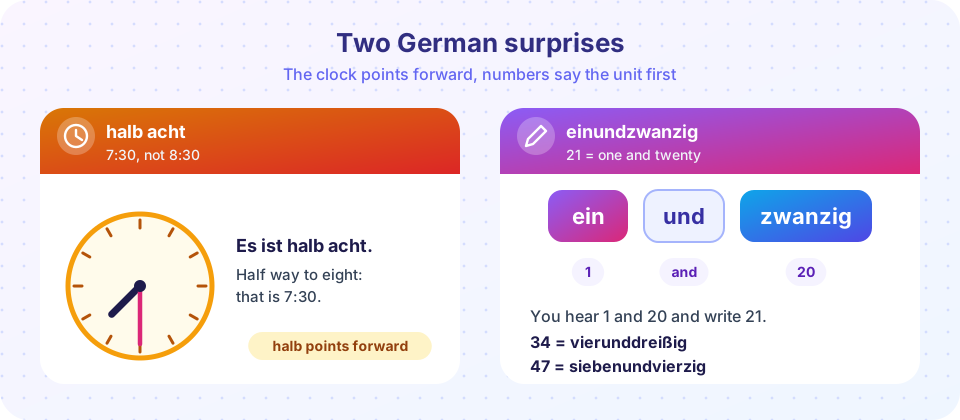
Caption: Two German surprises: halb acht means 7:30, and 21 is said as one-and-twenty.
Watch the spelling changes: 16 is sechzehn (not sechszehn) and 17 is siebzehn (not siebenzehn). The numbers 13 to 19 are built from the unit plus zehn, like English "thir-teen".
Two details for the ear. Zwei and drei sound alike on a bad phone line, so many Germans say zwo for 2 when they read out phone numbers. And eins loses its s whenever something follows it: ein Euro, eine Stunde, einundzwanzig.
The tens are zwanzig (20), dreißig (30), vierzig (40), fünfzig (50), sechzig (60), siebzig (70), achtzig (80) and neunzig (90). Notice dreißig with ß, and that 60 and 70 drop letters: sechzig, siebzig.
For numbers in between, German says the unit first, then und, then the ten, all written as one word:
21 = einundzwanzig (one and twenty)
34 = vierunddreißig (four and thirty)
99 = neunundneunzig
A good habit: when you hear a number, write the digits in the order you hear them, then swap. For 47 you hear sieben, then vierzig: write the 7, then put the 4 in front.
1,000,000 = eine Million (a separate word, with a capital letter)
Inside a long number everything is one word. No und appears between the hundreds and the rest, only inside the units-and-tens part: 123 = einhundertdreiundzwanzig.
The converter below follows these rules exactly. Try your own phone number, a year or a price and watch how the pieces fit together.
Python
German number converter
UNITS =["null","eins","zwei","drei","vier","fünf","sechs","sieben","acht","neun","zehn","elf","zwölf","dreizehn","vierzehn","fünfzehn","sechzehn","siebzehn","achtzehn","neunzehn"]
TENS ={2:"zwanzig",3:"dreißig",4:"vierzig",5:"fünfzig",6:"sechzig",7:"siebzig",8:"achtzig",9:"neunzig"}defbelow_100(n, final=True):if n <20:# "eins" becomes "ein" when something follows itreturn"ein"if(n ==1andnot final)else UNITS[n]
tens, unit =divmod(n,10)if unit ==0:return TENS[tens]return("ein"if unit ==1else UNITS[unit])+"und"+ TENS[tens]defbelow_1000(n, final=True):
hundreds, rest =divmod(n,100)
word =""if hundreds:
word =("ein"if hundreds ==1else UNITS[hundreds])+"hundert"if rest:
word += below_100(rest, final)return word
defzahl(n):"""Write a number from 0 to 999,999 in German."""if n ==0:return"null"
thousands, rest =divmod(n,1000)
word =""if thousands:
word = below_1000(thousands, final=False)+"tausend"if rest:
word += below_1000(rest)return word
# Change this list and run againfor n in[1,13,21,99,100,101,345,1000,1989,2026,12345,999999]:print(n,"=", zahl(n))
Press Run (or Ctrl + Enter) to see the result here.
Program input · what you'd type while the program runs
Type the answers before you press Run, one per line. Each time the program reads a line (with input()), it gets the next line from this box.
The everyday style uses a 12-hour clock and these patterns, here for the hour 7 going to 8:
Time
Everyday German
Meaning of the pattern
7:00
sieben Uhr
exactly seven
7:05
fünf nach sieben
five past
7:10
zehn nach sieben
ten past
7:15
Viertel nach sieben
a quarter past
7:20
zwanzig nach sieben
twenty past
7:25
fünf vor halb acht
five before half eight
7:30
halb acht
half way to eight
7:35
fünf nach halb acht
five after half eight
7:40
zwanzig vor acht
twenty to eight
7:45
Viertel vor acht
a quarter to eight
7:50
zehn vor acht
ten to eight
7:55
fünf vor acht
five to eight
The special rule is halb: it always points to the next hour. So halb acht is 7:30, not 8:30. English speakers get this wrong for weeks. Some regions say dreiviertel acht for 7:45, but Viertel vor acht works everywhere.
Move the sliders in this clock and read both styles.
The German clock
<style>:root{--ink:#1e1b4b;--mut:#475569;--bd:#c7d2fe}*{box-sizing:border-box}body{margin:0;padding:14px;font-family:system-ui,-apple-system,'Segoe UI',sans-serif;color:var(--ink);background:linear-gradient(135deg,#faf5ff,#eff6ff)}.card{background:#fff;border-radius:18px;box-shadow:0 8px 22px rgba(67,56,202,.15);padding:16px}.wrap{display:flex;gap:18px;flex-wrap:wrap;align-items:center}label{display:block;margin:6px 0;font-weight:600}input[type=range]{width:100%;accent-color:#6366f1}.out{background:#eef2ff;border-radius:12px;padding:8px 12px;margin:8px 0;font-size:1.05rem}.out b{color:#4338ca}.mut{color:var(--mut);font-size:.85rem}</style><divclass="card"><divclass="wrap"><svgid="clk"viewBox="0 0 200 200"width="190"height="190"role="img"aria-label="Analog clock"></svg><divstyle="flex:1;min-width:230px"><label>Hour: <spanid="hv"></span><inputtype="range"id="h"min="0"max="23"value="7"></label><label>Minute: <spanid="mv"></span><inputtype="range"id="m"min="0"max="55"step="5"value="30"></label><divclass="out">Official: <bid="off"></b></div><divclass="out">Everyday: <bid="eve"></b></div><divclass="mut"id="tip"></div></div></div></div><script>varU=["null","ein","zwei","drei","vier","fünf","sechs","sieben","acht","neun","zehn","elf","zwölf","dreizehn","vierzehn","fünfzehn","sechzehn","siebzehn","achtzehn","neunzehn"];varT=["","","zwanzig","dreißig","vierzig","fünfzig"];functionnum(n){if(n<20)returnU[n];var t=Math.floor(n/10),u=n%10;return u===0?T[t]:(u===1?"ein":U[u])+"und"+T[t];}functione(n){return n===1?"eins":U[n];}functionofficial(h,m){return"Es ist "+num(h)+" Uhr"+(m?" "+num(m):"")+".";}functioneveryday(h,m){var a=h%12===0?12:h%12, b=(a%12)+1;switch(m){case0:return"Es ist "+U[a]+" Uhr.";case5:return"Es ist fünf nach "+e(a)+".";case10:return"Es ist zehn nach "+e(a)+".";case15:return"Es ist Viertel nach "+e(a)+".";case20:return"Es ist zwanzig nach "+e(a)+".";case25:return"Es ist fünf vor halb "+e(b)+".";case30:return"Es ist halb "+e(b)+".";case35:return"Es ist fünf nach halb "+e(b)+".";case40:return"Es ist zwanzig vor "+e(b)+".";case45:return"Es ist Viertel vor "+e(b)+".";case50:return"Es ist zehn vor "+e(b)+".";default:return"Es ist fünf vor "+e(b)+".";}}functionpad(n){return(n<10?"0":"")+n;}functiondraw(){var h=+document.getElementById('h').value,m=+document.getElementById('m').value;
document.getElementById('hv').textContent=pad(h)+":"+pad(m);
document.getElementById('mv').textContent=m+" min";
document.getElementById('off').textContent=official(h,m);
document.getElementById('eve').textContent=everyday(h,m);
document.getElementById('tip').textContent=(m>=25&&m<=35)?"Remember: halb points forward to the next hour.":"Move the minute slider to 25, 30 or 35 to see halb.";var ha=(h%12)*30+m*0.5, ma=m*6, s='<circle cx="100" cy="100" r="94" fill="#fff" stroke="#6366f1" stroke-width="5"/>';for(var i=0;i<12;i++){var r=i*30*Math.PI/180;s+='<line x1="'+(100+80*Math.sin(r))+'" y1="'+(100-80*Math.cos(r))+'" x2="'+(100+88*Math.sin(r))+'" y2="'+(100-88*Math.cos(r))+'" stroke="#a78bfa" stroke-width="3"/>';}
s+='<line x1="100" y1="100" x2="100" y2="52" stroke="#1e1b4b" stroke-width="6" stroke-linecap="round" transform="rotate('+ha+' 100 100)"/>';
s+='<line x1="100" y1="100" x2="100" y2="28" stroke="#ec4899" stroke-width="4" stroke-linecap="round" transform="rotate('+ma+' 100 100)"/>';
s+='<circle cx="100" cy="100" r="6" fill="#1e1b4b"/>';
document.getElementById('clk').innerHTML=s;}
document.getElementById('h').oninput=draw;document.getElementById('m').oninput=draw;draw();</script>
To ask the time, use Wie spät ist es? or Wie viel Uhr ist es? To ask when something happens, use Wann: Wann beginnt der Film? — Um acht Uhr. The word um means "at" with clock times.
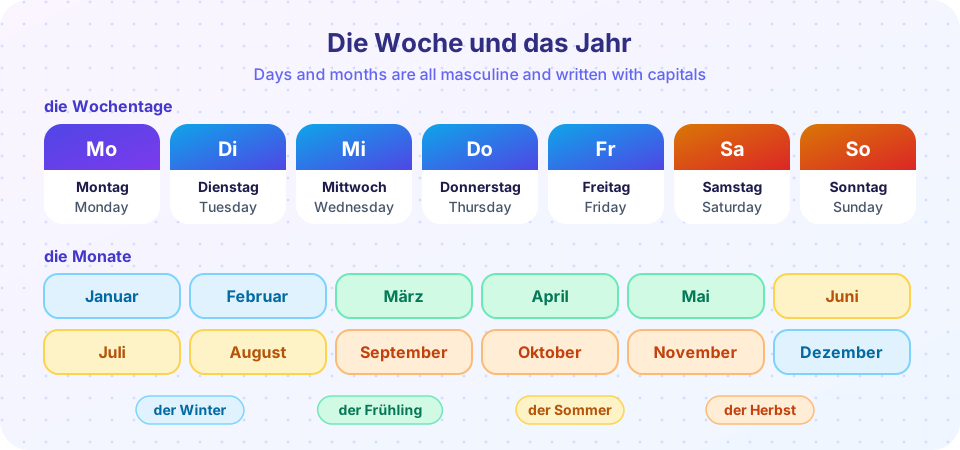
Caption: All days and months are masculine in German: der Montag, der Mai, der Dezember.
The days: Montag, Dienstag, Mittwoch, Donnerstag, Freitag, Samstag (in some northern and eastern regions Sonnabend), Sonntag. The week starts on Monday in German calendars. To say "on Monday", use am: am Montag. For "every Monday" say montags or jeden Montag.
The months: Januar, Februar, März, April, Mai, Juni, Juli, August, September, Oktober, November, Dezember. Use im: im Mai. Seasons: der Frühling (spring), der Sommer, der Herbst (autumn), der Winter, also with im: im Winter.
Parts of the day: der Morgen, der Vormittag, der Mittag, der Nachmittag, der Abend, die Nacht. Say am Morgen, am Mittag, am Abend, but in der Nacht. Adverbs are handy: morgens, mittags, abends, nachts. Do not confuse morgen (tomorrow) with der Morgen (the morning).
Dates use ordinal numbers: erste (1st), zweite, dritte, vierte, ... up to 19 add -te to the number; from 20 on add -ste. Two irregular ones: erste, dritte, and siebte (not siebente in modern speech).
In writing you put a dot after the number: 14. November. The dot means "the 14th".
Heute ist der 14. November. — der vierzehnte November
Ich habe am 3. Oktober Geburtstag. — am dritten Oktober
Wann hast du Geburtstag? — Am zwölften Mai.
Numeric dates run day, month, year: 14.11.2026. A letter often starts with the place and the date: Berlin, den 14. November 2026.
Check your numbers and the date with gap-fill sentences.
Numbers, time and dates
<style>:root{--ink:#1e1b4b;--mut:#475569;--acc:#6366f1;--bd:#c7d2fe}*{box-sizing:border-box}body{margin:0;padding:14px;font-family:system-ui,-apple-system,'Segoe UI',sans-serif;color:var(--ink);background:linear-gradient(135deg,#faf5ff,#eff6ff)}.card{background:#fff;border-radius:18px;box-shadow:0 8px 22px rgba(67,56,202,.15);padding:16px}button{font:inherit;cursor:pointer;border:0;border-radius:999px;padding:8px 14px;background:linear-gradient(135deg,#6366f1,#8b5cf6);color:#fff;font-weight:600}button.alt{background:#eef2ff;color:#3730a3}button:disabled{opacity:.5;cursor:default}.row{display:flex;gap:8px;flex-wrap:wrap;align-items:center;margin-top:10px}.mut{color:var(--mut);font-size:.9rem}</style><style>.q{display:flex;gap:8px;align-items:center;flex-wrap:wrap;padding:8px 0;border-bottom:1px solid #eef2ff;font-size:1.05rem}input{font:inherit;padding:6px 10px;border:2px solid var(--bd);border-radius:10px;width:9em}input.ok{border-color:#10b981;background:#ecfdf5}input.no{border-color:#ef4444;background:#fef2f2}.h{font-size:.85rem;color:var(--mut)}</style><divclass="card"><divid="list"></div><divclass="row"><buttonid="chk">Check answers</button><buttonclass="alt"id="rev">Show answers</button><spanid="score"class="mut"></span></div><divclass="mut"style="margin-top:8px">Capitals do not matter. Type ä ö ü ß, or use ae oe ue ss.</div></div><script>var items=[{"s":"Es ist 8:15. Es ist ___ nach acht.","a":"Viertel"},{"s":"Es ist 7:45. Es ist Viertel ___ acht.","a":"vor"},{"s":"21 = ___zwanzig (the unit first, then und)","a":"einund"},{"s":"34 = vier___dreißig","a":"und"},{"s":"Mein Geburtstag ist ___ Mai.","a":"im"},{"s":"Ich habe ___ Montag frei.","a":"am"},{"s":"Der Film beginnt ___ acht Uhr.","a":"um"},{"s":"Es ist 7:30. Es ist ___ acht.","a":"halb"},{"s":"Heute ist der ___ Oktober. (3rd)","a":"dritte"}];functionnorm(s){return s.toLowerCase().trim().replace(/\s+/g,' ').replace(/ae/g,'ä').replace(/oe/g,'ö').replace(/ue/g,'ü').replace(/ss/g,'ß');}functionnormAns(s){returnnorm(s).replace(/ß/g,'ß');}var list=document.getElementById('list');
items.forEach(function(it,n){var d=document.createElement('div');d.className='q';var parts=it.s.split('___');
d.appendChild(document.createTextNode(parts[0]));var inp=document.createElement('input');inp.id='i'+n;inp.setAttribute('aria-label','Answer '+(n+1));d.appendChild(inp);
d.appendChild(document.createTextNode(parts[1]||''));if(it.h){var h=document.createElement('span');h.className='h';h.textContent='('+it.h+')';d.appendChild(h);}
list.appendChild(d);});functionok(it,v){var arr=Array.isArray(it.a)?it.a:[it.a];var x=normAns(v);return arr.some(function(a){returnnormAns(a)===x;});}
document.getElementById('chk').onclick=function(){var right=0;
items.forEach(function(it,n){var e=document.getElementById('i'+n);var g=ok(it,e.value);e.className=g?'ok':'no';if(g)right++;});
document.getElementById('score').textContent=right+' of '+items.length+' correct';};
document.getElementById('rev').onclick=function(){
items.forEach(function(it,n){var e=document.getElementById('i'+n);e.value=Array.isArray(it.a)?it.a[0]:it.a;e.className='ok';});};</script>
Finally, see how long German number words are. This plot counts the letters in the words for 1 to 100, using the converter from above.
Python
How long are German number words?
import matplotlib.pyplot as plt
plt.rcParams.update({"figure.facecolor":"#faf5ff","axes.facecolor":"#ffffff","axes.edgecolor":"#c7d2fe","axes.spines.top":False,"axes.spines.right":False,"axes.grid":True,"grid.color":"#eef2ff","axes.prop_cycle": plt.cycler(color=["#6366f1","#ec4899","#f59e0b","#14b8a6","#38bdf8"]),"font.size":12})
UNITS =["null","eins","zwei","drei","vier","fünf","sechs","sieben","acht","neun","zehn","elf","zwölf","dreizehn","vierzehn","fünfzehn","sechzehn","siebzehn","achtzehn","neunzehn"]
TENS ={2:"zwanzig",3:"dreißig",4:"vierzig",5:"fünfzig",6:"sechzig",7:"siebzig",8:"achtzig",9:"neunzig"}defzahl(n):if n ==100:return"hundert"if n <20:return UNITS[n]
tens, unit =divmod(n,10)if unit ==0:return TENS[tens]return("ein"if unit ==1else UNITS[unit])+"und"+ TENS[tens]
numbers =list(range(1,101))
lengths =[len(zahl(n))for n in numbers]
longest =max(numbers, key=lambda n:len(zahl(n)))
plt.figure(figsize=(9,4.4))
plt.bar(numbers, lengths, color="#6366f1", alpha=0.85)
plt.annotate(f"{longest}: {zahl(longest)}\n({len(zahl(longest))} letters)",
xy=(longest,len(zahl(longest))), xytext=(40,len(zahl(longest))+2),
arrowprops=dict(arrowstyle="->", color="#ec4899"), color="#1e1b4b")
plt.ylim(0,len(zahl(longest))+4)
plt.title("Letters in the German word for each number, 1 to 100")
plt.xlabel("Number")
plt.ylabel("Letters in the word")
plt.show()
Press Run (or Ctrl + Enter) to see the result here.
Program input · what you'd type while the program runs
Type the answers before you press Run, one per line. Each time the program reads a line (with input()), it gets the next line from this box.