


















Lesson 10 of 50 · Sounds, Greetings and Basics
Numbers, days and time
Count in German from 0 to 1,000, learn the odd 'one-and-twenty' order, the days and months, dates, and how to tell the time with halb and Viertel.
Numbers, days and clock times are the glue of daily life: prices, phone numbers, appointments, train departures, birthdays. German numbers follow a tidy system with one big surprise (the units come before the tens), and German clock time has one famous trap: halb drei does not mean half past three. By the end of this lesson you can count, say a price, read a date, name the days and months, and tell the time the way Germans do.
What you will learn
- the numbers from 0 to 1,000 and beyond
- the "one-and-twenty" order (einundzwanzig) and the irregular numbers
- the days of the week, the months and the seasons
- how to say dates and prices
- how to tell the time, formally and informally
Key terms
Grundzahl: a cardinal number (one, two, three). Ordnungszahl: an ordinal number (first, second, third). halb: half; in time expressions it means "half way to the next hour". Uhr: clock, o'clock.
Counting from 0 to 20
| 0 | null | 7 | sieben | 14 | vierzehn |
|---|---|---|---|---|---|
| 1 | eins | 8 | acht | 15 | fünfzehn |
| 2 | zwei | 9 | neun | 16 | sechzehn |
| 3 | drei | 10 | zehn | 17 | siebzehn |
| 4 | vier | 11 | elf | 18 | achtzehn |
| 5 | fünf | 12 | zwölf | 19 | neunzehn |
| 6 | sechs | 13 | dreizehn | 20 | zwanzig |
Say them aloud: null (nool), eins (ines), zwei (tsvy), drei (dry), vier (feer), fünf (fünf), sechs (zex), sieben (ZEE-ben), acht (akht), neun (noyn), zehn (tsayn), elf (elf), zwölf (tsvölf). Pay attention to the vowels: drei is "dry" and neun is "noyn". On the phone, zwei is often said zwo to avoid confusion with drei.
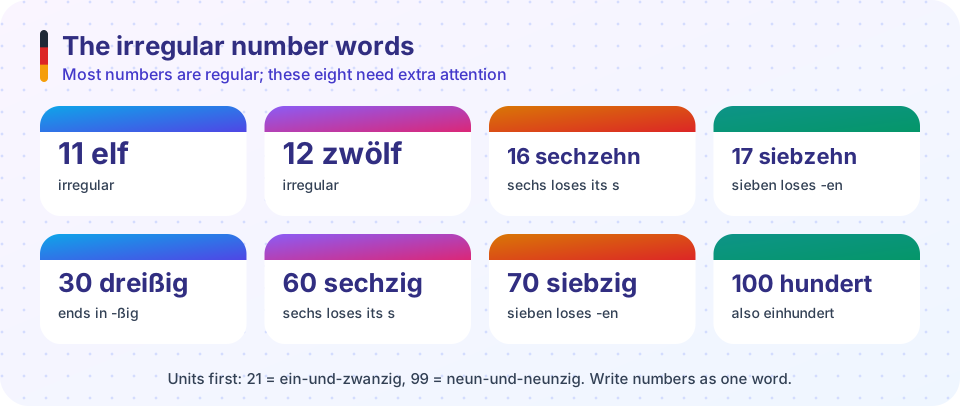
From 13 to 19 the pattern is "unit + -zehn", but two of them are spelled irregularly: sechzehn (not sechszehn) and siebzehn (not siebenzehn). They lose the final -s and -en, respectively.
The tens and the one-and-twenty order
| 20 | zwanzig | 60 | sechzig |
|---|---|---|---|
| 30 | dreißig | 70 | siebzig |
| 40 | vierzig | 80 | achtzig |
| 50 | fünfzig | 90 | neunzig |
Note the irregular ones: dreißig (30) ends in -ßig, not -zig; sechzig and siebzig also lose letters. Also zwanzig is not zweizig.
To make a number between 21 and 99, you say the unit first, then und (and), then the ten, all in one word: 21 = einundzwanzig (literally "one-and-twenty"), 34 = vierunddreißig, 57 = siebenundfünfzig, 99 = neunundneunzig. Notice that "eins" becomes "ein" inside the word. This is like old English "four-and-twenty blackbirds". It takes practice: when you hear a number like sechsundvierzig, you must wait for the end to know whether it is 64 or 46. Write down numbers you hear, and slowly the order will become natural.
Hundreds, thousands and beyond
- 100 hundert or einhundert; 101 hunderteins; 123 hundertdreiundzwanzig; 200 zweihundert; 999 neunhundertneunundneunzig.
- 1,000 tausend or eintausend; 2,500 zweitausendfünfhundert; 21,000 einundzwanzigtausend.
- 1,000,000 eine Million (a feminine noun, so it takes eine); 2,000,000 zwei Millionen.
German writes long numbers as one word, with no spaces and no "and" between hundreds and tens: zweihundertvierundfünfzig (254). In figures, German uses a decimal comma and a dot or space for thousands, the opposite of English: 3,5 is "three and a half" (drei Komma fünf), and 1.000 or 1 000 is one thousand. Years are said in two ways: neunzehnhundertneunundneunzig (1999) in the 20th century, and zweitausendfünfundzwanzig (2025) for the 21st. Everyday speech says "twenty-twenty-five" more rarely than English.
A price: 2,50 € is zwei Euro fünfzig; 0,99 € is neunundneunzig Cent. Telephone numbers are usually read in pairs or in single digits.
Days, months and seasons
All days and months are masculine: der Montag, der Mai.
| Day | Respelling |
|---|---|
| Montag | MOHN-tahk |
| Dienstag | DEENS-tahk |
| Mittwoch | MIT-vokh |
| Donnerstag | DON-ners-tahk |
| Freitag | FRY-tahk |
| Samstag (Sonnabend in the north and east) | ZAMS-tahk |
| Sonntag | ZON-tahk |
The twelve months: Januar (Jänner in Austria), Februar, März, April, Mai, Juni, Juli, August, September, Oktober, November, Dezember. The four seasons: der Frühling (spring), der Sommer (summer), der Herbst (autumn), der Winter (winter).
The week starts on Monday in German calendars. "On Monday" is am Montag; "in May" is im Mai; "on Mondays" (every Monday) is montags. Say "today" heute, "yesterday" gestern, "tomorrow" morgen, and note that der Morgen (morning) and morgen (tomorrow) are different words with the same spelling; the capital letter tells you which is a noun.
Dates are written day.month.year with dots: 14.11.2026 is "the fourteenth of November". To say a date you use ordinal numbers: der vierzehnte November. Ordinals 1 to 19 end in -te (zweite, vierte, fünfte), but 1st = erste, 3rd = dritte, 7th = siebte, 8th = achte; from 20 on they end in -ste: zwanzigste, einunddreißigste. In figures, an ordinal gets a dot: Heute ist der 14. November. Birthdays: Ich habe am 3. Mai Geburtstag (my birthday is on May 3).
Telling the time
To ask: Wie spät ist es? (How late is it?) or Wie viel Uhr ist es? To answer: Es ist drei Uhr. To ask when: Um wie viel Uhr? To answer: Um acht Uhr.
German has two styles.
The official 24-hour style is used for timetables, appointments, TV, radio and announcements: vierzehn Uhr dreißig (14:30), zwanzig Uhr fünfzehn (20:15), null Uhr zehn (00:10).
The everyday 12-hour style uses halves, quarters and "past/to":
| Time | German | How it works |
|---|---|---|
| 3:00 | drei Uhr | hour + Uhr |
| 3:05 | fünf nach drei | five past three |
| 3:10 | zehn nach drei | ten past three |
| 3:15 | Viertel nach drei | quarter past three |
| 3:20 | zwanzig nach drei | twenty past three |
| 3:25 | fünf vor halb vier | five before half-to-four |
| 3:30 | halb vier | half way to four |
| 3:35 | fünf nach halb vier | five after half-to-four |
| 3:40 | zwanzig vor vier | twenty to four |
| 3:45 | Viertel vor vier | quarter to four |
| 3:55 | fünf vor vier | five to four |
The famous trap is halb vier = 3:30, not 4:30. German "half" points to the next hour: you are half way to four. If you say halb drei to mean 3:30 by mistake, you will arrive an hour early. Regionally you will also hear Viertel vier (3:15) and dreiviertel vier (3:45) in parts of eastern and southern Germany; you can ignore these, but recognize them.
Parts of the day: der Morgen (morning), der Vormittag (late morning), der Mittag (midday), der Nachmittag (afternoon), der Abend (evening), die Nacht (night). Use am with them: am Morgen, am Abend, but in der Nacht.
Numbers in real life
Numbers become automatic only when you use them for real things. Try reading prices aloud in shops and online: 3,50 € is drei Euro fünfzig, and 12,99 € is zwölf Euro neunundneunzig. Say the numbers of buses, trains and house numbers: Linie fünfundzwanzig, Gleis sieben, Hausnummer dreiundvierzig. Say your phone number in pairs or one digit at a time and practice zwei versus drei, which sound similar on the telephone. Say dates, such as your birthday: Ich habe am dritten Mai Geburtstag. Practice the clock whenever you look at it: Es ist Viertel nach drei. Listening practice is also useful: German train announcements and radio traffic reports are full of numbers and times, and you do not need to understand every word. If you can catch just the numbers, you are already extracting meaning from real German.
Common misconceptions
"halb drei is 3:30." It is 2:30. Half to three.
"The decimal point is a dot." German uses a comma for decimals and a dot (or space) for thousands.
"fünfundzwanzig means 52." It means 25: the unit comes first. zweiundfünfzig is 52.
"sechszehn and siebenzehn." The correct forms are sechzehn and siebzehn.
Try it
Press Run (or Ctrl + Enter) to see the result here.
Program input · what you'd type while the program runs
Type the answers before you press Run, one per line. Each time the program reads a line (with input()), it gets the next line from this box.
Press Run (or Ctrl + Enter) to see the result here.
Program input · what you'd type while the program runs
Type the answers before you press Run, one per line. Each time the program reads a line (with input()), it gets the next line from this box.
Check your understanding
Quick check · 6 questions
of 6 answered You scored / 6 · perfect!
-
1. What is 'einundzwanzig'?
The unit comes first: ein + und + zwanzig = 21. -
2. What time is 'halb vier'?
halb vier means half way to four, i.e. 3:30. -
3. Which spelling is correct for 16?
sechzehn loses the s of sechs. Likewise siebzehn (17) and sechzig (60). -
4. Which is correct for 'on Monday'?
Days take am: am Montag, am Freitag. -
5. How do you write one and a half in German figures?
German uses a decimal comma: 1,5 (eins Komma fünf). -
6. What is 'Viertel vor vier'?
A quarter before four is 3:45.
Summary
- Numbers: null to zwölf are learned by heart; 13 to 19 add -zehn (sechzehn, siebzehn are irregular).
- Two-digit numbers put the units first: einundzwanzig = 21; write numbers as one word.
- Days and months are masculine; use am Montag, im Mai; dates use ordinals and dots (14.11.).
- Everyday time uses nach, vor, Viertel and halb; halb vier is 3:30.
- Decimals use a comma; thousands use a dot or space.
Next: Chapter 2 review
Track your progress
Create a free account to tick off lessons and pick up where you left off on any device.
of German for Beginners lessons completed