


















Lesson 28 of 50 · Daily Life and Questions
Daily Routine: Separable and Reflexive Verbs
Describe your day in German with separable verbs like aufstehen and reflexive verbs like sich duschen, plus frequency words and a verb conjugator.
Ask a German speaker about their day and you will hear two kinds of verbs again and again. The first kind splits in two: Ich stehe um sieben Uhr auf. The second kind needs a little pronoun that points back to the speaker: Ich dusche mich. Both belong to the vocabulary of daily routines, and both follow clear rules.
In this lesson you will meet separable verbs, learn how to tell them from inseparable ones, use reflexive verbs with accusative and dative pronouns, and add frequency words such as immer and manchmal. Then you will write a short routine of your own.
What you will learn
- how separable verbs split and where each part goes
- how to recognize inseparable prefixes
- the reflexive pronouns in the accusative and the dative
- frequency words and their position
- how to describe a complete daily routine
Key terms
- das trennbare Verb (separable verb): aufstehen, einkaufen, fernsehen.
- die Vorsilbe (prefix): the part at the front, such as auf- or an-.
- das Reflexivpronomen (reflexive pronoun): mich, dich, sich, uns, euch.
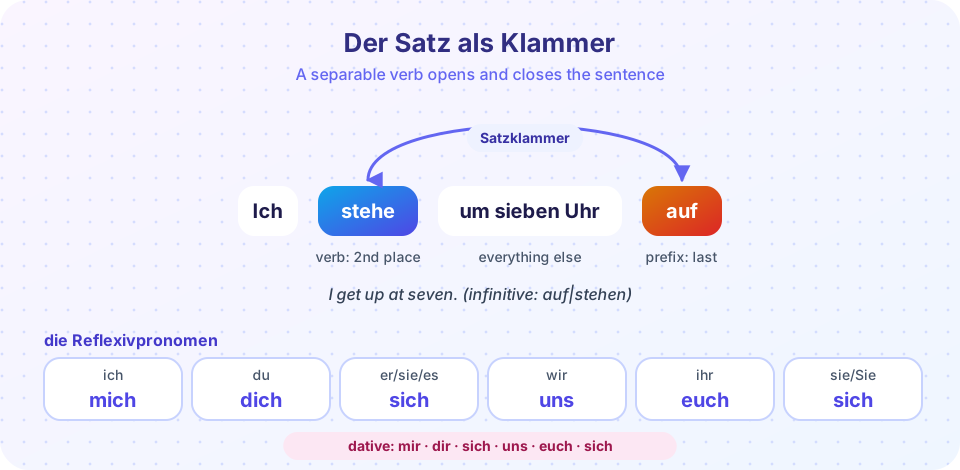
- die Satzklammer (sentence bracket): the verb in second place plus the prefix at the end.
- das Häufigkeitsadverb (frequency adverb): immer, oft, manchmal, nie.
Separable verbs
Many German verbs have a prefix that can separate from the stem. In the infinitive the verb is in one piece: aufstehen (to get up). In a normal statement, the conjugated stem takes the second position and the prefix moves to the end of the clause:
- Ich stehe um sieben Uhr auf. (I get up at seven.)
- Der Film fängt um acht an. (The film starts at eight.)
- Wir kaufen am Samstag ein. (We shop on Saturday.)
Think of the sentence as a bracket. The conjugated verb opens it, the prefix closes it, and everything else (time, place, objects) sits in the middle.
Common separable verbs
| Infinitive | Meaning | Example |
|---|---|---|
| aufstehen | get up | Ich stehe früh auf. |
| anfangen | begin | Der Kurs fängt um neun an. |
| einkaufen | shop | Sie kauft im Supermarkt ein. |
| fernsehen | watch TV | Wir sehen abends fern. |
| anrufen | phone | Ich rufe meine Mutter an. |
| abholen | pick up | Er holt mich ab. |
| ankommen | arrive | Der Zug kommt um zehn an. |
| mitkommen | come along | Kommst du mit? |
| aufräumen | tidy up | Ich räume das Zimmer auf. |
| einschlafen | fall asleep | Das Kind schläft ein. |
Some stems change like any other present-tense verb: du siehst fern, er fährt ab, sie schläft ein, er fängt an. The irregular vowel stays in the stem, and the prefix goes to the end.
Separable or not?
Not every prefix separates. The inseparable prefixes are be-, ge-, er-, ver-, zer-, ent-, emp- and miss-. These verbs never split: Der Film beginnt um acht. (beginnen never splits, while its synonym anfangen does), Ich verstehe das., Er bekommt ein Paket.
A reliable test is stress. In a separable verb the prefix is stressed: AUFstehen, EINkaufen, ANkommen. In an inseparable verb the stem is stressed: verSTEhen, beKOMmen. When you hear a verb, listen for where the stress falls.
A small group, such as übersetzen or umfahren, can be both, with different meanings. You will meet them later; for now, learn each verb with its example sentence.
Reflexive verbs
A reflexive verb uses a pronoun that refers back to the subject. In English you only say "I wash" or "I wash myself" when you want emphasis. In German the reflexive pronoun is required with many everyday verbs.
| Subject | Accusative reflexive | Dative reflexive |
|---|---|---|
| ich | mich | mir |
| du | dich | dir |
| er/sie/es | sich | sich |
| wir | uns | uns |
| ihr | euch | euch |
| sie/Sie | sich | sich |
The forms are the ordinary object pronouns you already know (mich, dich, uns, euch and mir, dir). The only new word is sich, which is used for the third person, singular and plural, and also for the formal Sie.
Accusative reflexive: the pronoun is the object
- Ich dusche mich. (I take a shower.) In everyday speech Ich dusche alone is also very common.
- Du wäschst dich. (You wash.)
- Sie freut sich auf das Wochenende. (She is looking forward to the weekend.)
- Wir treffen uns um acht. (We meet at eight.)
- Er setzt sich an den Tisch. (He sits down at the table.)
- Beeil dich! (Hurry up!)
Many reflexive verbs have no English twin: sich freuen (to be glad), sich beeilen (to hurry), sich erinnern (to remember), sich entspannen (to relax), sich ausruhen (to rest, a separable-reflexive combination: Ich ruhe mich aus.).
Dative reflexive: with a body part or clothing
When the action is done to a body part that is the direct object, the reflexive pronoun is in the dative and the body part takes die/der/das instead of mein:
- Ich putze mir die Zähne. (I brush my teeth.)
- Er wäscht sich die Hände. (He washes his hands.)
- Wir kämmen uns die Haare. (We comb our hair.)
- Ich ziehe mir die Jacke an. (I put on my jacket: sich etwas anziehen.)
Compare Ich wasche mich (accusative, I wash myself) with Ich wasche mir die Hände (dative, I wash my hands). The second has another object, so the pronoun moves to the dative.
Where does the pronoun go?
In a main clause the reflexive pronoun follows the verb, or follows the subject if the subject comes after the verb: Ich dusche mich. Am Morgen dusche ich mich. If a time word comes first, the verb is still second and the subject follows, as in any statement.
Frequency words
Frequency adverbs say how often you do something. In a main clause they usually stand right after the verb and its subject, before the prefix of a separable verb:
| German | Meaning |
|---|---|
| immer | always |
| meistens | usually |
| oft | often |
| manchmal | sometimes |
| selten | rarely |
| nie | never |
- Ich stehe immer um sechs Uhr auf.
- Wir sehen manchmal am Abend fern.
- Sie ruft ihre Oma selten an.
The questions Wie oft ...? (how often) and Was machst du am Morgen? (what do you do in the morning) call for these answers.
A day in German
Read Anna's day. Notice the separable verbs (bold prefixes at the end) and the reflexive pronouns.
Ich stehe jeden Tag um halb sieben auf. Zuerst dusche ich mich und ziehe mich an. Dann frühstücke ich: Ich esse ein Brötchen und trinke einen Kaffee. Um Viertel nach sieben verlasse ich das Haus. Die Straßenbahn kommt um zehn nach sieben an. Um acht Uhr fängt die Arbeit an. Mittags esse ich in der Kantine. Nach der Arbeit kaufe ich oft im Supermarkt ein. Abends koche ich, rufe meine Freundin an und sehe manchmal fern. Um zehn Uhr ziehe ich mich aus und gehe ins Bett.
Translation: I get up at half past six every day. First I shower and get dressed. Then I have breakfast: I eat a roll and drink a coffee. At a quarter past seven I leave the house. The tram arrives at ten past seven. At eight the work starts. At noon I eat in the canteen. After work I often do the shopping at the supermarket. In the evening I cook, call my friend and sometimes watch TV. At ten o'clock I get undressed and go to bed.
Useful meal words: das Frühstück (breakfast), das Mittagessen (lunch), das Abendessen (dinner), and the verbs frühstücken and kochen. Note also ins Bett gehen (go to bed) and schlafen gehen (go to sleep).
Common misconceptions
- "The prefix stays attached in the present tense." In main clauses it splits and goes to the end. It stays attached in the infinitive and in subordinate clauses.
- "Every verb with a prefix splits." Verbs with be-, ver-, ent-, er-, ge- do not.
- "I can say Ich wasche meine Hände with no problems." It is understandable, but natural German prefers Ich wasche mir die Hände.
Try it
This helper conjugates separable verbs for all persons and builds example sentences. It shows how the stem changes and where the prefix lands.
Press Run (or Ctrl + Enter) to see the result here.
Program input · what you'd type while the program runs
Type the answers before you press Run, one per line. Each time the program reads a line (with input()), it gets the next line from this box.
Fill the gaps in these routine sentences. Remember the prefix goes to the end.
Finally, flip through the routine vocabulary.
Check your understanding
Quick check · 5 questions
of 5 answered You scored / 5 · perfect!
-
1. Which sentence is correct?
The verb is in second place and the separable prefix goes to the end of the clause. -
2. Which verb does NOT separate?
Ver- is an inseparable prefix: Ich verstehe das. -
3. Fill in the reflexive pronoun: 'Wir treffen ___ um acht.'
The reflexive pronoun for wir is uns. -
4. Which form is correct for brushing your teeth?
With a body part as the object, the reflexive pronoun is dative: mir. -
5. Where does 'immer' normally go?
Frequency adverbs usually follow the verb and subject; the prefix stays at the end.
Summary
- Separable verbs split in main clauses: the verb is second, the prefix is last.
- Be-, ge-, er-, ver-, zer-, ent-, emp-, miss- are inseparable.
- Reflexive pronouns: mich, dich, sich, uns, euch, sich; the dative forms are mir, dir for ich and du.
- Use the dative reflexive when a body part or clothing is the object: Ich putze mir die Zähne.
- Immer, oft, manchmal, selten, nie stand after the verb and subject.
Next: Chapter 5 review
Track your progress
Create a free account to tick off lessons and pick up where you left off on any device.
of German for Beginners lessons completed