Get the big picture of German past tenses: the spoken Perfekt, the written Präteritum, the Plusquamperfekt, and a map of Chapter 6.
So far you have talked about the present: what you do every day, what you like, what time it is. Chapter 6 opens the door to the past. You will learn to say what you did yesterday, where you went on holiday and what you ate for lunch. That is the point where a beginner starts to sound like a real speaker, because people talk about the past all the time.
German is friendlier here than its reputation suggests. English has simple past ("I ate"), present perfect ("I have eaten") and several more forms that are hard to choose between. In spoken German, one tense does almost all the work: the Perfekt. Learn it well and you can tell nearly any story.
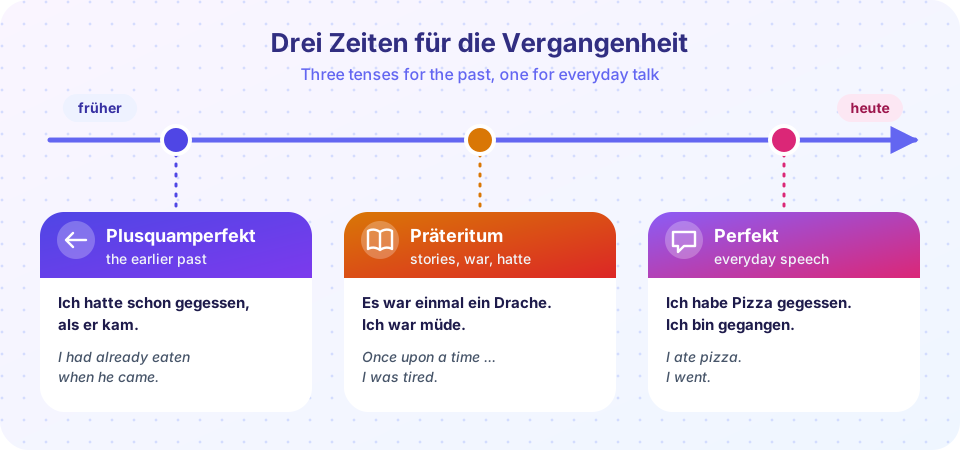
Caption: Three tenses for the past, but one of them (the Perfekt) does most of the spoken work.
newspapers, novels, fairy tales; also sein, haben and modal verbs in speech
Ich war müde. Es war einmal ...
Plusquamperfekt
hatte/war + Partizip II
an event before another past event
Ich hatte schon gegessen, als er kam.
Do not worry that there are three. In this chapter you will learn the Perfekt thoroughly, the Präteritum of only a handful of verbs, and you will simply recognize the Plusquamperfekt. That is exactly the proportion that native speakers use in conversation.
Many beginner courses teach the Präteritum first because it looks like the English simple past. That is a mistake for conversation. If you ask a German where he was last weekend, he will answer with the Perfekt: Ich bin nach Hamburg gefahren. The Präteritum of fahren, fuhr, would sound bookish in that sentence.
There is a regional pattern, too. In southern Germany, Austria and Switzerland, speakers use the Perfekt almost exclusively in speech. In the north, the Präteritum is a little more common in speech, especially with certain verbs. Either way, the Perfekt is always safe.
The big difference is word order. In the Perfekt, the helping verb stays in second place and the participle jumps to the very end of the clause. English keeps both together: "I have eaten pizza." German splits them: Ich habe Pizza gegessen. Everything else (time, place, object) goes in the middle. This is the same bracket pattern you saw with separable verbs in the last chapter, and it is the key to German sentence structure.
A second difference is time words. German often uses gestern, letzte Woche, vor zwei Tagen, schon, noch nicht with the Perfekt. For example: Ich habe heute noch nicht gefrühstückt. (I have not had breakfast yet today.) The tense itself is less important than the time word, because the Perfekt also covers things English would put in the present perfect.
Warm up with ten key forms from the chapter. Say each one aloud and try to produce the German before you flip.
Chapter 6 warm-up cards
<style>:root{--ink:#1e1b4b;--mut:#475569;--acc:#6366f1;--bd:#c7d2fe}*{box-sizing:border-box}body{margin:0;padding:14px;font-family:system-ui,-apple-system,'Segoe UI',sans-serif;color:var(--ink);background:linear-gradient(135deg,#faf5ff,#eff6ff)}.card{background:#fff;border-radius:18px;box-shadow:0 8px 22px rgba(67,56,202,.15);padding:16px}button{font:inherit;cursor:pointer;border:0;border-radius:999px;padding:8px 14px;background:linear-gradient(135deg,#6366f1,#8b5cf6);color:#fff;font-weight:600}button.alt{background:#eef2ff;color:#3730a3}button:disabled{opacity:.5;cursor:default}.row{display:flex;gap:8px;flex-wrap:wrap;align-items:center;margin-top:10px}.mut{color:var(--mut);font-size:.9rem}</style><style>.fc{height:150px;display:flex;align-items:center;justify-content:center;text-align:center;font-size:1.5rem;font-weight:700;border-radius:18px;cursor:pointer;padding:12px;user-select:none}.front{background:linear-gradient(135deg,#6366f1,#8b5cf6);color:#fff}.back{background:#fff;color:var(--ink);border:2px solid var(--bd)}</style><divclass="card"><divid="fc"class="fc front"tabindex="0"role="button"aria-label="Flash card, press to flip"></div><divclass="mut"id="cnt"style="margin-top:8px"></div><divclass="row"><buttonclass="alt"id="prev">Back</button><buttonid="flip">Flip</button><buttonclass="alt"id="next">Next</button><buttonclass="alt"id="shuf">Shuffle</button><buttonclass="alt"id="say">Listen</button></div><divclass="mut"id="note"style="margin-top:8px">Click the card to flip it. Listen uses your browser's voice if it is available.</div></div><script>var cards=[["Ich habe gegessen.","I ate. / I have eaten."],["Ich bin gegangen.","I went. / I have gone."],["Was hast du gestern gemacht?","What did you do yesterday?"],["Ich war müde.","I was tired."],["Ich hatte Hunger.","I was hungry."],["gestern","yesterday"],["vorgestern","the day before yesterday"],["letzte Woche","last week"],["schon","already"],["noch nicht","not yet"],["Es war einmal ...","Once upon a time ..."]];var i=0,showBack=false;var fc=document.getElementById('fc');functiondraw(){var c=cards[i];fc.textContent=showBack?c[1]:c[0];fc.className='fc '+(showBack?'back':'front');document.getElementById('cnt').textContent='Card '+(i+1)+' of '+cards.length;}functionflip(){showBack=!showBack;draw();}
fc.onclick=flip;fc.onkeydown=function(e){if(e.key==='Enter'||e.key===' '){e.preventDefault();flip();}};
document.getElementById('flip').onclick=flip;
document.getElementById('next').onclick=function(){i=(i+1)%cards.length;showBack=false;draw();};
document.getElementById('prev').onclick=function(){i=(i-1+cards.length)%cards.length;showBack=false;draw();};
document.getElementById('shuf').onclick=function(){for(var k=cards.length-1;k>0;k--){var r=Math.floor(Math.random()*(k+1));var t=cards[k];cards[k]=cards[r];cards[r]=t;}i=0;showBack=false;draw();};
document.getElementById('say').onclick=function(){try{var u=newSpeechSynthesisUtterance(cards[i][0]);u.lang='de-DE';window.speechSynthesis.cancel();window.speechSynthesis.speak(u);}catch(e){document.getElementById('note').textContent='Speech is not available in this preview.';}};draw();</script>
Match infinitives with their participles. Many of these are irregular, so notice which ones surprise you.
Infinitive and participle
<style>:root{--ink:#1e1b4b;--mut:#475569;--acc:#6366f1;--bd:#c7d2fe}*{box-sizing:border-box}body{margin:0;padding:14px;font-family:system-ui,-apple-system,'Segoe UI',sans-serif;color:var(--ink);background:linear-gradient(135deg,#faf5ff,#eff6ff)}.card{background:#fff;border-radius:18px;box-shadow:0 8px 22px rgba(67,56,202,.15);padding:16px}button{font:inherit;cursor:pointer;border:0;border-radius:999px;padding:8px 14px;background:linear-gradient(135deg,#6366f1,#8b5cf6);color:#fff;font-weight:600}button.alt{background:#eef2ff;color:#3730a3}button:disabled{opacity:.5;cursor:default}.row{display:flex;gap:8px;flex-wrap:wrap;align-items:center;margin-top:10px}.mut{color:var(--mut);font-size:.9rem}</style><style>.cols{display:grid;grid-template-columns:1fr 1fr;gap:10px}.it{padding:10px 12px;border-radius:12px;background:#fff;border:2px solid var(--bd);cursor:pointer;font-weight:600;text-align:center}.it.sel{border-color:#6366f1;background:#eef2ff}.it.done{border-color:#10b981;background:#ecfdf5;color:#047857;cursor:default}.it.bad{border-color:#ef4444;background:#fef2f2}</style><divclass="card"><divclass="mut">Click a German item, then its English match.</div><divclass="cols"style="margin-top:10px"><divid="L"></div><divid="R"></div></div><divclass="row"><buttonclass="alt"id="again">Shuffle again</button><spanid="msg"class="mut"></span></div></div><script>var pairs=[["essen","gegessen"],["trinken","getrunken"],["sehen","gesehen"],["schreiben","geschrieben"],["gehen","gegangen"],["kommen","gekommen"],["bringen","gebracht"],["wissen","gewusst"]];var left=null,solved=0;functionshuffle(a){a=a.slice();for(var k=a.length-1;k>0;k--){var r=Math.floor(Math.random()*(k+1));var t=a[k];a[k]=a[r];a[r]=t;}return a;}functionbuild(){
solved=0;left=null;document.getElementById('msg').textContent='';varL=document.getElementById('L'),R=document.getElementById('R');L.innerHTML='';R.innerHTML='';var idx=pairs.map(function(_,k){return k;});shuffle(idx).forEach(function(k){L.appendChild(mk(pairs[k][0],k,'L'));});shuffle(idx).forEach(function(k){R.appendChild(mk(pairs[k][1],k,'R'));});}functionmk(text,k,side){var d=document.createElement('div');d.className='it';d.textContent=text;d.style.marginBottom='8px';d.dataset.k=k;d.dataset.side=side;
d.onclick=function(){if(d.classList.contains('done'))return;if(side==='L'){document.querySelectorAll('#L .it').forEach(function(e){e.classList.remove('sel');});d.classList.add('sel');left=d;return;}if(!left)return;if(left.dataset.k===d.dataset.k){left.className='it done';d.className='it done';left=null;solved++;if(solved===pairs.length)document.getElementById('msg').textContent='All matched. Well done!';}else{d.classList.add('bad');setTimeout(function(){d.classList.remove('bad');},500);}};return d;}
document.getElementById('again').onclick=build;build();</script>