


















Lesson 13 of 50 · Cases and Articles
Gender and the nominative case
Learn how German noun gender works, the word-ending clues that predict der, die or das, the nominative articles, and the verb sein.
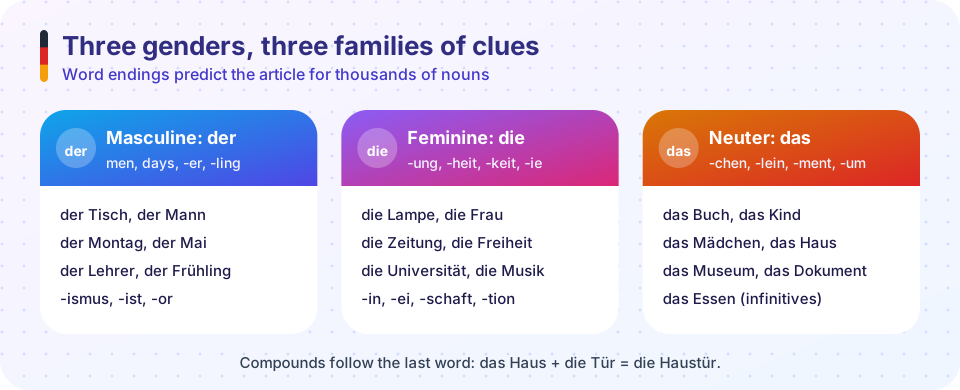
Every German noun belongs to one of three genders: masculine (der), feminine (die) or neuter (das). The gender is a property of the word, not of the thing: a table is masculine, a lamp is feminine, a book is neuter, and a girl, surprisingly, is neuter. There is no way to derive the gender from the meaning in every case, but there are strong clues in the word ending, and a few habits will make it a lot easier. In this lesson you will learn those clues, the definite and indefinite articles in the nominative case (the case of the subject), and the most important verb in German, sein (to be).
What you will learn
- the three genders and why you must learn each noun with its article
- word-ending clues for masculine, feminine and neuter nouns
- the nominative forms: der/die/das, ein/eine/ein and kein
- how pronouns er, sie, es replace nouns
- the verb sein and the question patterns Was ist das? and Wer ist das?
Key terms
Nominative: the case of the subject, and of the noun after sein. Definite article: der, die, das ("the"). Indefinite article: ein, eine, ein ("a, an"). Pronoun: a word that replaces a noun: er (he, it), sie (she, it), es (it).
Learn the article with the noun
Because gender is unpredictable in many words, the single best habit is to learn every noun with its article, as one unit: der Tisch, die Lampe, das Buch. Never write "Tisch = table". Write "der Tisch = table". Use colors if it helps: blue for der, red for die, green for das. Review them aloud, and always say the article first.
Some nouns follow natural gender: der Mann (man), die Frau (woman), der Vater (father), die Mutter (mother), der Bruder (brother), die Schwester (sister), der Hahn (rooster), die Kuh (cow). But even here there are surprises: das Mädchen (girl) and das Fräulein are neuter, because every noun ending in -chen or -lein (diminutives) is neuter. And das Kind (child) is neuter whatever the sex.
Clues from word endings
Endings are your best friends. They are not perfect but they cover many thousands of nouns.
Masculine (der) is typical for:
| Clue | Examples |
|---|---|
| days, months, seasons | der Montag, der Mai, der Sommer |
| weather and directions | der Regen, der Schnee, der Wind, der Norden |
| -er (people who do something) | der Lehrer, der Fahrer, der Computer |
| -ling | der Frühling, der Lehrling |
| -ismus | der Tourismus, der Optimismus |
| -ist, -ent, -ant | der Tourist, der Student, der Elefant |
| -or | der Motor, der Doktor |
| alcoholic drinks | der Wein, der Sekt, der Whisky (exception: das Bier) |
Feminine (die) is typical for:
| Clue | Examples |
|---|---|
| -ung | die Zeitung, die Wohnung, die Übung |
| -heit, -keit | die Gesundheit, die Freiheit, die Möglichkeit |
| -schaft | die Freundschaft, die Gesellschaft |
| -tion, -tät, -ik, -ie | die Nation, die Universität, die Musik, die Familie |
| -ei | die Bäckerei, die Polizei |
| -in (female persons) | die Lehrerin, die Studentin |
| most nouns ending in -e | die Lampe, die Katze, die Straße, die Blume |
Neuter (das) is typical for:
| Clue | Examples |
|---|---|
| -chen, -lein | das Mädchen, das Brötchen, das Fräulein |
| -ment, -um | das Dokument, das Instrument, das Museum |
| Ge- | das Gebäude, das Gemüse |
| infinitives used as nouns | das Essen (the food), das Leben (life), das Lernen |
| metals and elements | das Gold, das Silber, das Eisen |
| young beings | das Baby, das Kind, das Kalb |
Exceptions exist. der Name, der Junge (boy), der Käse (cheese) and das Ende (end) end in -e but are not feminine. die Butter ends in -er but is feminine. Treat the endings as strong hints, not laws.
A very useful rule for compounds: the last part decides the gender. das Haus (house) + die Tür (door) = die Haustür. der Käse + das Brot = das Käsebrot. die Schule + der Bus = der Schulbus. Since German builds new words from old ones, this rule helps you guess hundreds of nouns. Also, noun plurals always use die in the nominative and accusative, no matter the gender.
Nominative articles
The nominative is the case of the subject: the noun that does or is something. It also follows sein (to be). Here are the definite article (the) and the indefinite article (a, an):
| Masculine | Feminine | Neuter | Plural | |
|---|---|---|---|---|
| the | der Tisch | die Lampe | das Buch | die Bücher |
| a, an | ein Tisch | eine Lampe | ein Buch | — (no article) |
| no, not a | kein Tisch | keine Lampe | kein Buch | keine Bücher |
Notice: ein has no ending for masculine and neuter, -e for feminine, and there is no plural of ein, because "a" cannot be plural. Say "Ich habe Bücher" (I have books) without any article. kein- is the negative ("not a", "no") and takes the same endings as ein, plus a plural: keine. The same endings are used for the possessives mein-, dein- (my, your): mein Tisch, meine Lampe, mein Buch, meine Bücher.
Pronouns follow the grammatical gender
In English, "it" replaces every thing. German pronouns follow the gender of the noun:
- Der Tisch ist neu. Er ist schön. (The table is new. It is beautiful.)
- Die Lampe ist neu. Sie ist schön.
- Das Buch ist neu. Es ist schön.
- Die Bücher sind neu. Sie sind schön. (They are beautiful.)
So er can mean "he" or "it", sie can mean "she", "it" or "they", and es means "it". This is why you need the gender: it also drives the pronoun.
The verb sein
Sein (to be) is irregular, and you must know it by heart:
| Person | Form | Example |
|---|---|---|
| ich | bin | Ich bin Student. |
| du | bist | Du bist müde. (tired) |
| er / sie / es | ist | Das ist ein Tisch. |
| wir | sind | Wir sind Freunde. |
| ihr | seid | Ihr seid spät. |
| sie / Sie | sind | Sie sind Ärztin. |
Use sein to describe and identify: Das ist ein Buch. (That is a book.) Der Apfel ist rot. (The apple is red.) Ich bin müde. (I am tired.) Use Was ist das? to ask "What is this?" and Wer ist das? to ask "Who is this?". The answer to both begins with Das ist ... for singular and Das sind ... for plural: Das ist ein Tisch. Das sind Stühle.
Mini dialogue:
A: Was ist das? — What is that? B: Das ist eine Lampe. — That is a lamp. A: Und das? — And that? B: Das ist ein Buch. Es ist mein Buch. — That is a book. It is my book. A: Wer ist das? — Who is that? B: Das ist meine Schwester. Sie heißt Anna. — That is my sister. She is called Anna.
Strategies for remembering genders
Because gender is not predictable from meaning, you need a system. Here are four that work. First, color-code: write masculine nouns in blue, feminine in red and neuter in green in your notes and flashcards. Second, use endings: group new nouns by their endings, so that -ung, -heit, -keit become one mental box of feminine nouns. Third, learn in phrases: der große Tisch or ein neues Buch attach the gender to a picture and a rhythm. Fourth, review with spacing: look at each new noun after a day, a week and a month. Most of all, avoid translating gender from another language, even if you know French or Spanish: die Sonne (the sun) is feminine, while in Spanish el sol is masculine. Treat the article as part of the word itself, and it will soon feel like an ordinary spelling detail.
Common misconceptions
"A girl must be feminine." das Mädchen is neuter because of its -chen ending.
"it always translates to es." es only replaces neuter nouns. A table is er, a lamp is sie.
"The plural has its own article." The plural is always die in the nominative.
"Ending rules always work." They are strong clues with exceptions, such as der Name and die Butter.
Try it
Press Run (or Ctrl + Enter) to see the result here.
Program input · what you'd type while the program runs
Type the answers before you press Run, one per line. Each time the program reads a line (with input()), it gets the next line from this box.
Check your understanding
Quick check · 6 questions
of 6 answered You scored / 6 · perfect!
-
1. What is the gender of 'das Mädchen'?
Nouns ending in -chen are neuter, so 'girl' is neuter. -
2. Which article fits 'Zeitung'?
Nouns ending in -ung are feminine: die Zeitung. -
3. What is the pronoun for 'der Tisch'?
Pronouns follow the grammatical gender: der Tisch is masculine, so er. -
4. What is the gender of the compound 'Haustür' (Haus + Tür)?
The last word decides the gender: die Tür, so die Haustür. -
5. Which form is correct?
ich bin, du bist, er ist. -
6. What does 'keine Lampe' mean?
kein- is the negative article: keine Lampe = no lamp.
Summary
- Learn every noun with its article; gender is a property of the word, not of the thing.
- Endings are strong clues: -ung, -heit, -keit, -schaft, -tion, -tät, -ik, -ie, -ei, -in are feminine; -er, -ling, -ismus, -ist are masculine; -chen, -lein, -ment, -um are neuter.
- In compounds the last word decides the gender.
- Nominative: der/die/das/die; ein/eine/ein; kein/keine/kein/keine.
- Pronouns follow gender: er, sie, es; plural sie.
- Sein: ich bin, du bist, er/sie/es ist, wir sind, ihr seid, sie/Sie sind.
Next: The accusative case
Track your progress
Create a free account to tick off lessons and pick up where you left off on any device.
of German for Beginners lessons completed