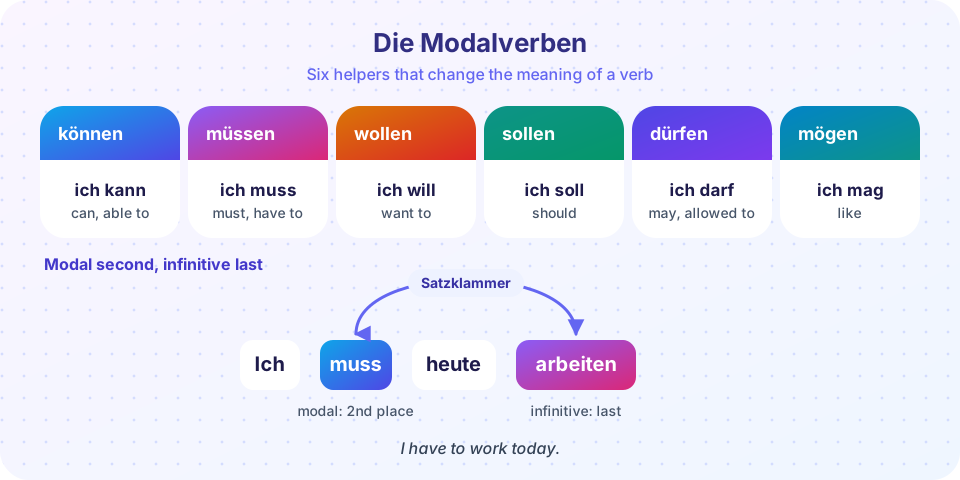
Learn the six German modal verbs and möchte: their present-tense forms, their meanings, word order with the infinitive at the end, and common traps.
Ich kann Deutsch sprechen. Ich muss jeden Tag üben. Ich will fließend sprechen. Modal verbs are the little helpers that say how you feel about an action: whether you can do it, must do it, want to do it, are allowed to do it, should do it, or like to do it. They are among the most frequent verbs in German, so learning them early pays off immediately.
German has six modal verbs, plus the very useful möchte (would like). They all follow the same sentence pattern: the modal is conjugated in second place, and the main verb stays in the infinitive at the end of the clause. You already know this bracket pattern from the Perfekt and from separable verbs, and it is about to become even more important.
Caption: Six modal verbs with their ich forms, and the bracket pattern: modal second, infinitive last.
Modal verbs are irregular in the singular. The ich and er/sie/es forms are always identical and have no ending:
können
müssen
wollen
sollen
dürfen
mögen
möchten
ich
kann
muss
will
soll
darf
mag
möchte
du
kannst
musst
willst
sollst
darfst
magst
möchtest
er/sie/es
kann
muss
will
soll
darf
mag
möchte
wir
können
müssen
wollen
sollen
dürfen
mögen
möchten
ihr
könnt
müsst
wollt
sollt
dürft
mögt
möchtet
sie/Sie
können
müssen
wollen
sollen
dürfen
mögen
möchten
The plural forms are regular: infinitive in wir and sie, stem plus -t in ihr. The umlaut is lost in the singular of können, müssen, dürfen, mögen: kann (not känn). Learn the ich forms as a chain: kann, muss, will, soll, darf, mag.
Ich will nach Berlin fahren. (I want to go to Berlin.)
Sie wollen ein Haus kaufen. (They want to buy a house.)
Wollen can sound blunt when you order or ask for something: Ich will einen Kaffee sounds like a demand. In a café, say Ich möchte einen Kaffee instead.
The modal verb is conjugated and takes second place. The main verb goes to the end as an infinitive. Everything else (time, place, objects, nicht) stays in the middle:
Ich muss heute früh aufstehen.
Morgen kann ich nicht kommen.
Wir wollen am Samstag im Supermarkt einkaufen.
Kannst du mir bitte helfen?
Was möchten Sie trinken?
Notice two things. First, a separable verb stays in one piece at the end: Ich will früh aufstehen, not Ich will früh stehen auf. Second, nicht usually stands before the infinitive: Ich kann heute nicht kommen.
When the meaning is obvious, the infinitive can be left out: Ich muss nach Hause. (go is understood), Er kann gut Deutsch. (He knows German well.), Ich mag Katzen.
Here is a short exchange between two friends. Each modal has a clear job.
Mia:Kannst du mir bitte helfen? Ich muss heute noch die Wohnung aufräumen.
Jan:Gern! Aber ich darf nicht lange bleiben, ich soll um sechs zu Hause sein.
Mia:Kein Problem. Möchtest du einen Kaffee?
Jan:Ja, gern. Ich mag Kaffee mit Milch.
English: Mia: Can you help me, please? I still have to tidy up the apartment today. Jan: Gladly! But I cannot stay long, I am supposed to be home at six. Mia: No problem. Would you like a coffee? Jan: Yes, please. I like coffee with milk.
Look at the pattern: kannst is a request, muss a necessity, darf nicht a restriction, soll an expectation from someone else, möchtest a polite offer and mag a simple preference. Almost every real conversation uses at least two of these.
This program conjugates all the modals and builds sentences with the bracket order. Change the verbs at the bottom.
Python
Modal verb conjugator
PRONOUNS =["ich","du","er/sie/es","wir","ihr","sie/Sie"]
FORMS ={"können":["kann","kannst","kann","können","könnt","können"],"müssen":["muss","musst","muss","müssen","müsst","müssen"],"wollen":["will","willst","will","wollen","wollt","wollen"],"sollen":["soll","sollst","soll","sollen","sollt","sollen"],"dürfen":["darf","darfst","darf","dürfen","dürft","dürfen"],"mögen":["mag","magst","mag","mögen","mögt","mögen"],"möchten":["möchte","möchtest","möchte","möchten","möchtet","möchten"],}defsentence(pronoun, modal, middle, infinitive, negate=False):
form = FORMS[modal][PRONOUNS.index(pronoun)]
words =[pronoun.capitalize(), form, middle,"nicht"if negate else"", infinitive]return" ".join(w for w in words if w)+"."print(f"{'':10}"+"".join(f"{m:>10}"for m in FORMS))for i, p inenumerate(PRONOUNS):print(f"{p:10}"+"".join(f"{forms[i]:>10}"for forms in FORMS.values()))print()for modal in FORMS:if modal !="mögen":print(sentence("ich", modal,"heute","lernen"))print(sentence("ich","können","heute","kommen", negate=True))print(sentence("du","müssen","morgen früh","aufstehen"))print(sentence("wir","wollen","am Samstag","einkaufen"))print(sentence("er/sie/es","dürfen","hier","parken", negate=True))
Press Run (or Ctrl + Enter) to see the result here.
Program input · what you'd type while the program runs
Type the answers before you press Run, one per line. Each time the program reads a line (with input()), it gets the next line from this box.
Put the words in the right order. Click the words to build each sentence.
Build the sentence
<style>:root{--ink:#1e1b4b;--mut:#475569;--acc:#6366f1;--bd:#c7d2fe}*{box-sizing:border-box}body{margin:0;padding:14px;font-family:system-ui,-apple-system,'Segoe UI',sans-serif;color:var(--ink);background:linear-gradient(135deg,#faf5ff,#eff6ff)}.card{background:#fff;border-radius:18px;box-shadow:0 8px 22px rgba(67,56,202,.15);padding:16px}button{font:inherit;cursor:pointer;border:0;border-radius:999px;padding:8px 14px;background:linear-gradient(135deg,#6366f1,#8b5cf6);color:#fff;font-weight:600}button.alt{background:#eef2ff;color:#3730a3}button:disabled{opacity:.5;cursor:default}.row{display:flex;gap:8px;flex-wrap:wrap;align-items:center;margin-top:10px}.mut{color:var(--mut);font-size:.9rem}</style><style>.tgt{min-height:54px;border:2px dashed var(--bd);border-radius:14px;padding:8px;display:flex;gap:6px;flex-wrap:wrap;align-items:center;background:#fff}.w{background:#eef2ff;color:#3730a3;border:2px solid var(--bd);border-radius:12px;padding:6px 12px;font-weight:600;cursor:pointer}.w.used{opacity:.3;cursor:default}.t{background:linear-gradient(135deg,#6366f1,#8b5cf6);color:#fff;border-radius:12px;padding:6px 12px;font-weight:600}.en{font-size:1.1rem;font-weight:600;margin-bottom:10px}.fb{min-height:1.6em;margin-top:8px}</style><divclass="card"><divclass="mut"id="prog"></div><divclass="en"id="en"></div><divclass="tgt"id="tgt"aria-live="polite"></div><divclass="row"id="bank"style="margin-top:12px"></div><divclass="fb"id="fb"></div><divclass="row"><buttonid="chk">Check</button><buttonclass="alt"id="clr">Clear</button><buttonclass="alt"id="nx">Next</button><spanclass="mut"id="sc"></span></div></div><script>var items=[{"en":"I have to work today.","words":["Ich","muss","heute","arbeiten"],"ok":["Ich muss heute arbeiten","Heute muss ich arbeiten"]},{"en":"Can you help me?","words":["Kannst","du","mir","helfen"],"ok":["Kannst du mir helfen"]},{"en":"We want to go shopping on Saturday.","words":["Wir","wollen","am","Samstag","einkaufen"],"ok":["Wir wollen am Samstag einkaufen","Am Samstag wollen wir einkaufen"]},{"en":"I cannot come today.","words":["Ich","kann","heute","nicht","kommen"],"ok":["Ich kann heute nicht kommen","Heute kann ich nicht kommen"]},{"en":"May I sit here?","words":["Darf","ich","hier","sitzen"],"ok":["Darf ich hier sitzen"]},{"en":"What would you like to drink? (formal)","words":["Was","möchten","Sie","trinken"],"ok":["Was möchten Sie trinken"]},{"en":"You must not park here.","words":["Du","darfst","hier","nicht","parken"],"ok":["Du darfst hier nicht parken","Hier darfst du nicht parken"]}];var i=0,score=0,picked=[],solved=false;functionnorm(s){return s.toLowerCase().replace(/[.,?!]/g,'').replace(/s+/g,' ').trim();}functionshuffle(a){a=a.slice();for(var k=a.length-1;k>0;k--){var r=Math.floor(Math.random()*(k+1));var t=a[k];a[k]=a[r];a[r]=t;}return a;}functionrender(){var it=items[i];
document.getElementById('prog').textContent='Sentence '+(i+1)+' of '+items.length;
document.getElementById('en').textContent=it.en;var tg=document.getElementById('tgt');tg.innerHTML='';
picked.forEach(function(k){var s=document.createElement('span');s.className='t';s.textContent=it.shuf[k];tg.appendChild(s);});var bank=document.getElementById('bank');bank.innerHTML='';
it.shuf.forEach(function(w,k){var b=document.createElement('button');b.className='w'+(picked.indexOf(k)>=0?' used':'');b.textContent=w;
b.onclick=function(){if(solved||picked.indexOf(k)>=0)return;picked.push(k);render();};
bank.appendChild(b);});}functionload(){var it=items[i];it.shuf=shuffle(it.words);picked=[];solved=false;document.getElementById('fb').textContent='';render();}
document.getElementById('clr').onclick=function(){picked=[];solved=false;document.getElementById('fb').textContent='';render();};
document.getElementById('chk').onclick=function(){if(solved)return;var it=items[i];var s=norm(picked.map(function(k){return it.shuf[k];}).join(' '));var good=it.ok.some(function(o){returnnorm(o)===s;});if(good){solved=true;score++;document.getElementById('fb').textContent='Correct! '+it.ok[0]+'.';}else{document.getElementById('fb').textContent='Not quite. Check the verb position and try again.';}
document.getElementById('sc').textContent='Score: '+score;};
document.getElementById('nx').onclick=function(){i=(i+1)%items.length;load();};load();</script>
Complete the forms.
Modal verb forms
<style>:root{--ink:#1e1b4b;--mut:#475569;--acc:#6366f1;--bd:#c7d2fe}*{box-sizing:border-box}body{margin:0;padding:14px;font-family:system-ui,-apple-system,'Segoe UI',sans-serif;color:var(--ink);background:linear-gradient(135deg,#faf5ff,#eff6ff)}.card{background:#fff;border-radius:18px;box-shadow:0 8px 22px rgba(67,56,202,.15);padding:16px}button{font:inherit;cursor:pointer;border:0;border-radius:999px;padding:8px 14px;background:linear-gradient(135deg,#6366f1,#8b5cf6);color:#fff;font-weight:600}button.alt{background:#eef2ff;color:#3730a3}button:disabled{opacity:.5;cursor:default}.row{display:flex;gap:8px;flex-wrap:wrap;align-items:center;margin-top:10px}.mut{color:var(--mut);font-size:.9rem}</style><style>.q{display:flex;gap:8px;align-items:center;flex-wrap:wrap;padding:8px 0;border-bottom:1px solid #eef2ff;font-size:1.05rem}input{font:inherit;padding:6px 10px;border:2px solid var(--bd);border-radius:10px;width:9em}input.ok{border-color:#10b981;background:#ecfdf5}input.no{border-color:#ef4444;background:#fef2f2}.h{font-size:.85rem;color:var(--mut)}</style><divclass="card"><divid="list"></div><divclass="row"><buttonid="chk">Check answers</button><buttonclass="alt"id="rev">Show answers</button><spanid="score"class="mut"></span></div><divclass="mut"style="margin-top:8px">Capitals do not matter. Type ä ö ü ß, or use ae oe ue ss.</div></div><script>var items=[{"s":"Ich ___ gut schwimmen.","a":"kann","h":"können"},{"s":"Du ___ heute arbeiten.","a":"musst","h":"müssen"},{"s":"Er ___ nach Hause gehen.","a":"will","h":"wollen"},{"s":"Wir ___ leise sein.","a":"sollen","h":"sollen"},{"s":"___ ich hier sitzen?","a":"Darf","h":"dürfen"},{"s":"Ihr ___ Deutsch lernen.","a":"wollt","h":"wollen"},{"s":"Ich ___ einen Kaffee, bitte.","a":"möchte","h":"möchten"},{"s":"Sie ___ gut Klavier spielen. (she)","a":"kann","h":"können"},{"s":"Du ___ hier nicht parken.","a":"darfst","h":"dürfen"},{"s":"Ich ___ keinen Tee.","a":"mag","h":"mögen"}];functionnorm(s){return s.toLowerCase().trim().replace(/\s+/g,' ').replace(/ae/g,'ä').replace(/oe/g,'ö').replace(/ue/g,'ü').replace(/ss/g,'ß');}functionnormAns(s){returnnorm(s).replace(/ß/g,'ß');}var list=document.getElementById('list');
items.forEach(function(it,n){var d=document.createElement('div');d.className='q';var parts=it.s.split('___');
d.appendChild(document.createTextNode(parts[0]));var inp=document.createElement('input');inp.id='i'+n;inp.setAttribute('aria-label','Answer '+(n+1));d.appendChild(inp);
d.appendChild(document.createTextNode(parts[1]||''));if(it.h){var h=document.createElement('span');h.className='h';h.textContent='('+it.h+')';d.appendChild(h);}
list.appendChild(d);});functionok(it,v){var arr=Array.isArray(it.a)?it.a:[it.a];var x=normAns(v);return arr.some(function(a){returnnormAns(a)===x;});}
document.getElementById('chk').onclick=function(){var right=0;
items.forEach(function(it,n){var e=document.getElementById('i'+n);var g=ok(it,e.value);e.className=g?'ok':'no';if(g)right++;});
document.getElementById('score').textContent=right+' of '+items.length+' correct';};
document.getElementById('rev').onclick=function(){
items.forEach(function(it,n){var e=document.getElementById('i'+n);e.value=Array.isArray(it.a)?it.a[0]:it.a;e.className='ok';});};</script>
And a deck of the key phrases.
Modal verb phrases
<style>:root{--ink:#1e1b4b;--mut:#475569;--acc:#6366f1;--bd:#c7d2fe}*{box-sizing:border-box}body{margin:0;padding:14px;font-family:system-ui,-apple-system,'Segoe UI',sans-serif;color:var(--ink);background:linear-gradient(135deg,#faf5ff,#eff6ff)}.card{background:#fff;border-radius:18px;box-shadow:0 8px 22px rgba(67,56,202,.15);padding:16px}button{font:inherit;cursor:pointer;border:0;border-radius:999px;padding:8px 14px;background:linear-gradient(135deg,#6366f1,#8b5cf6);color:#fff;font-weight:600}button.alt{background:#eef2ff;color:#3730a3}button:disabled{opacity:.5;cursor:default}.row{display:flex;gap:8px;flex-wrap:wrap;align-items:center;margin-top:10px}.mut{color:var(--mut);font-size:.9rem}</style><style>.fc{height:150px;display:flex;align-items:center;justify-content:center;text-align:center;font-size:1.5rem;font-weight:700;border-radius:18px;cursor:pointer;padding:12px;user-select:none}.front{background:linear-gradient(135deg,#6366f1,#8b5cf6);color:#fff}.back{background:#fff;color:var(--ink);border:2px solid var(--bd)}</style><divclass="card"><divid="fc"class="fc front"tabindex="0"role="button"aria-label="Flash card, press to flip"></div><divclass="mut"id="cnt"style="margin-top:8px"></div><divclass="row"><buttonclass="alt"id="prev">Back</button><buttonid="flip">Flip</button><buttonclass="alt"id="next">Next</button><buttonclass="alt"id="shuf">Shuffle</button><buttonclass="alt"id="say">Listen</button></div><divclass="mut"id="note"style="margin-top:8px">Click the card to flip it. Listen uses your browser's voice if it is available.</div></div><script>var cards=[["ich kann","I can"],["du musst","you must"],["er will","he wants"],["wir sollen","we are supposed to"],["Darf ich?","May I?"],["ich möchte","I would like"],["ich mag","I like"],["Du musst nicht kommen.","You do not have to come."],["Du darfst nicht kommen.","You must not come."],["Können Sie mir helfen?","Can you help me?"]];var i=0,showBack=false;var fc=document.getElementById('fc');functiondraw(){var c=cards[i];fc.textContent=showBack?c[1]:c[0];fc.className='fc '+(showBack?'back':'front');document.getElementById('cnt').textContent='Card '+(i+1)+' of '+cards.length;}functionflip(){showBack=!showBack;draw();}
fc.onclick=flip;fc.onkeydown=function(e){if(e.key==='Enter'||e.key===' '){e.preventDefault();flip();}};
document.getElementById('flip').onclick=flip;
document.getElementById('next').onclick=function(){i=(i+1)%cards.length;showBack=false;draw();};
document.getElementById('prev').onclick=function(){i=(i-1+cards.length)%cards.length;showBack=false;draw();};
document.getElementById('shuf').onclick=function(){for(var k=cards.length-1;k>0;k--){var r=Math.floor(Math.random()*(k+1));var t=cards[k];cards[k]=cards[r];cards[r]=t;}i=0;showBack=false;draw();};
document.getElementById('say').onclick=function(){try{var u=newSpeechSynthesisUtterance(cards[i][0]);u.lang='de-DE';window.speechSynthesis.cancel();window.speechSynthesis.speak(u);}catch(e){document.getElementById('note').textContent='Speech is not available in this preview.';}};draw();</script>