Lesson 38 of 50 · Modal Verbs, Adjectives and Subordinate Clauses
Subordinate Clauses: weil, dass, wenn, ob
Learn German subordinate clauses with weil, dass, wenn, ob and obwohl: verb at the end, commas, separable verbs, modals, the Perfekt and indirect questions.
Ich lerne Deutsch, weil ich in Wien arbeite. (I am learning German because I work in Vienna.) This sentence has two parts. The first, Ich lerne Deutsch, can stand alone: it is a main clause. The second, weil ich in Wien arbeite, cannot stand alone: it is a subordinate clause. Look at where the verb arbeite sits: at the very end.
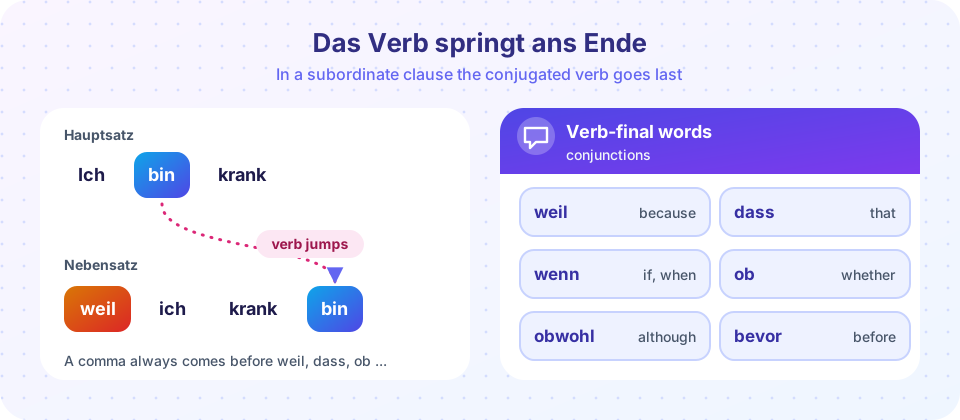
That is the core rule of this lesson: in a subordinate clause, the conjugated verb goes to the end. If you can do that, you can give reasons, report what people say, ask indirect questions and talk about conditions. These sentences make you sound like a real speaker, not like a phrasebook.
Caption: After weil, dass, wenn, ob and similar words, the conjugated verb jumps to the end of its clause.
Compare a statement with the same words in a subordinate clause:
Main clause (verb second)
Subordinate clause (verb last)
Ich bin müde.
..., weil ich müde bin.
Er kommt morgen.
..., dass er morgen kommt.
Sie hat Zeit.
..., ob sie Zeit hat.
Wir haben Hunger.
..., wenn wir Hunger haben.
The conjunction takes the first place, the subject follows, and all other words stay in their order. The only change is that the verb moves to the end. A comma always stands before the conjunction.
You can put the subordinate clause first. Then the whole clause counts as the first element of the sentence, so in the main clause the verb comes immediately after the comma, before the subject:
Ich bleibe zu Hause, weil ich krank bin.
Weil ich krank bin, bleibe ich zu Hause.
Wenn ich Zeit habe, rufe ich dich an.
Wir gehen spazieren, obwohl es regnet. → Obwohl es regnet, gehen wir spazieren.
Notice the sound: ..., bleibe ich. A comma followed by a verb is the signature of this order.
Weil sends the verb to the end; denn does not.Ich bleibe zu Hause, weil ich krank bin. But: Ich bleibe zu Hause, denn ich bin krank.Denn is a coordinating conjunction like und and aber: the clause after it keeps its normal word order.
Wenn is for present and future and for repeated events in the past. Als is for one event in the past. Wenn ich Zeit habe, ... / Als ich gestern ankam, war es schon dunkel.
Wann (a question word) is not a conjunction for conditions: Wann kommst du? but Wenn du kommst, ...
You may also hear Deshalb, deswegen, darum (therefore). They are adverbs, so they occupy first place and the verb stays second: Ich bin krank. Deshalb bleibe ich zu Hause.
Here is a little text that uses weil, dass, wenn and ob. Underline the verb at the end of each subordinate clause.
Ich lerne Deutsch, weil ich nächstes Jahr in Wien arbeiten möchte. Meine Kollegen sagen, dass Wien eine schöne Stadt ist. Wenn ich Zeit habe, lese ich jeden Tag eine kurze Geschichte. Ich weiß noch nicht, ob mein Deutsch dann gut genug ist, aber ich hoffe es.
Translation: I am learning German because I would like to work in Vienna next year. My colleagues say that Vienna is a beautiful city. When I have time, I read a short story every day. I do not know yet whether my German will then be good enough, but I hope so.
In the first sentence the modal möchte stands last, after the infinitive arbeiten. In the second, ist closes the dass clause. In the third, the subordinate clause comes first, so the main clause continues with the verb lese right after the comma. In the last sentence, ob introduces an indirect yes/no question.
In casual speech many Germans say weil with the verb in second place: Ich bleibe zu Hause, weil ich bin krank. You will hear it a lot, and it is natural in chat. Still, in tests, in writing and in formal speech, the verb goes to the end, so learn that form first.
This program turns main clauses into subordinate clauses for the four verb types, then flips the sentence order.
Python
Verb-final converter
defmain_clause(subject, verb, middle="", tail=""):"""Verb in second place."""
words =[subject.capitalize(), verb, middle, tail]return" ".join(w for w in words if w)+"."defsubordinate(conj, subject, verb, middle="", tail="", kind=""):"""Verb at the end. kind: 'sep' (separable prefix), 'part' (participle), 'inf' (infinitive with a modal)."""if kind =="sep":
end = tail + verb # the prefix and the verb join againelif kind in("part","inf"):
end = tail +" "+ verb # participle/infinitive, then the finite verbelse:
end = verb
words =[conj, subject, middle, end]return" ".join(w for w in words if w)defflip(sub_clause, subject, verb, rest=""):"""Subordinate clause first: the main-clause verb comes right after the comma."""
words =[verb, subject, rest]return sub_clause.capitalize()+", "+" ".join(w for w in words if w)+"."
cases =[("weil","ich","bin","müde","",""),("dass","er","kommt","morgen","",""),("weil","ich","stehe","früh","auf","sep"),("weil","ich","habe","gestern nicht","gearbeitet","part"),("weil","ich","muss","heute","arbeiten","inf"),]for conj, subj, verb, middle, tail, kind in cases:print(subordinate(conj, subj, verb, middle, tail, kind))print()
sub = subordinate("weil","ich","bin","krank")print("Ich bleibe zu Hause, "+ sub +".")print(flip(sub,"ich","bleibe","zu Hause"))
Press Run (or Ctrl + Enter) to see the result here.
Program input · what you'd type while the program runs
Type the answers before you press Run, one per line. Each time the program reads a line (with input()), it gets the next line from this box.
Put the words in the right order.
Build the subordinate clause
<style>:root{--ink:#1e1b4b;--mut:#475569;--acc:#6366f1;--bd:#c7d2fe}*{box-sizing:border-box}body{margin:0;padding:14px;font-family:system-ui,-apple-system,'Segoe UI',sans-serif;color:var(--ink);background:linear-gradient(135deg,#faf5ff,#eff6ff)}.card{background:#fff;border-radius:18px;box-shadow:0 8px 22px rgba(67,56,202,.15);padding:16px}button{font:inherit;cursor:pointer;border:0;border-radius:999px;padding:8px 14px;background:linear-gradient(135deg,#6366f1,#8b5cf6);color:#fff;font-weight:600}button.alt{background:#eef2ff;color:#3730a3}button:disabled{opacity:.5;cursor:default}.row{display:flex;gap:8px;flex-wrap:wrap;align-items:center;margin-top:10px}.mut{color:var(--mut);font-size:.9rem}</style><style>.tgt{min-height:54px;border:2px dashed var(--bd);border-radius:14px;padding:8px;display:flex;gap:6px;flex-wrap:wrap;align-items:center;background:#fff}.w{background:#eef2ff;color:#3730a3;border:2px solid var(--bd);border-radius:12px;padding:6px 12px;font-weight:600;cursor:pointer}.w.used{opacity:.3;cursor:default}.t{background:linear-gradient(135deg,#6366f1,#8b5cf6);color:#fff;border-radius:12px;padding:6px 12px;font-weight:600}.en{font-size:1.1rem;font-weight:600;margin-bottom:10px}.fb{min-height:1.6em;margin-top:8px}</style><divclass="card"><divclass="mut"id="prog"></div><divclass="en"id="en"></div><divclass="tgt"id="tgt"aria-live="polite"></div><divclass="row"id="bank"style="margin-top:12px"></div><divclass="fb"id="fb"></div><divclass="row"><buttonid="chk">Check</button><buttonclass="alt"id="clr">Clear</button><buttonclass="alt"id="nx">Next</button><spanclass="mut"id="sc"></span></div></div><script>var items=[{"en":"I stay at home because I am sick.","words":["Ich","bleibe","zu","Hause","weil","ich","krank","bin"],"ok":["Ich bleibe zu Hause weil ich krank bin","Weil ich krank bin bleibe ich zu Hause"]},{"en":"I think that he is coming.","words":["Ich","glaube","dass","er","kommt"],"ok":["Ich glaube dass er kommt"]},{"en":"I do not know whether he is coming.","words":["Ich","weiß","nicht","ob","er","kommt"],"ok":["Ich weiß nicht ob er kommt"]},{"en":"I am learning German because I work in Vienna.","words":["Ich","lerne","Deutsch","weil","ich","in","Wien","arbeite"],"ok":["Ich lerne Deutsch weil ich in Wien arbeite","Weil ich in Wien arbeite lerne ich Deutsch"]},{"en":"If I have time, I call you.","words":["Wenn","ich","Zeit","habe","rufe","ich","dich","an"],"ok":["Wenn ich Zeit habe rufe ich dich an","Ich rufe dich an wenn ich Zeit habe"]},{"en":"I stay at home because I have to work.","words":["Ich","bleibe","zu","Hause","weil","ich","arbeiten","muss"],"ok":["Ich bleibe zu Hause weil ich arbeiten muss","Weil ich arbeiten muss bleibe ich zu Hause"]},{"en":"I know that you are learning German.","words":["Ich","weiß","dass","du","Deutsch","lernst"],"ok":["Ich weiß dass du Deutsch lernst"]}];var i=0,score=0,picked=[],solved=false;functionnorm(s){return s.toLowerCase().replace(/[.,?!]/g,'').replace(/s+/g,' ').trim();}functionshuffle(a){a=a.slice();for(var k=a.length-1;k>0;k--){var r=Math.floor(Math.random()*(k+1));var t=a[k];a[k]=a[r];a[r]=t;}return a;}functionrender(){var it=items[i];
document.getElementById('prog').textContent='Sentence '+(i+1)+' of '+items.length;
document.getElementById('en').textContent=it.en;var tg=document.getElementById('tgt');tg.innerHTML='';
picked.forEach(function(k){var s=document.createElement('span');s.className='t';s.textContent=it.shuf[k];tg.appendChild(s);});var bank=document.getElementById('bank');bank.innerHTML='';
it.shuf.forEach(function(w,k){var b=document.createElement('button');b.className='w'+(picked.indexOf(k)>=0?' used':'');b.textContent=w;
b.onclick=function(){if(solved||picked.indexOf(k)>=0)return;picked.push(k);render();};
bank.appendChild(b);});}functionload(){var it=items[i];it.shuf=shuffle(it.words);picked=[];solved=false;document.getElementById('fb').textContent='';render();}
document.getElementById('clr').onclick=function(){picked=[];solved=false;document.getElementById('fb').textContent='';render();};
document.getElementById('chk').onclick=function(){if(solved)return;var it=items[i];var s=norm(picked.map(function(k){return it.shuf[k];}).join(' '));var good=it.ok.some(function(o){returnnorm(o)===s;});if(good){solved=true;score++;document.getElementById('fb').textContent='Correct! '+it.ok[0]+'.';}else{document.getElementById('fb').textContent='Not quite. Check the verb position and try again.';}
document.getElementById('sc').textContent='Score: '+score;};
document.getElementById('nx').onclick=function(){i=(i+1)%items.length;load();};load();</script>
Fill in conjunctions and verbs at the end of the clause.
Conjunctions and verbs at the end
<style>:root{--ink:#1e1b4b;--mut:#475569;--acc:#6366f1;--bd:#c7d2fe}*{box-sizing:border-box}body{margin:0;padding:14px;font-family:system-ui,-apple-system,'Segoe UI',sans-serif;color:var(--ink);background:linear-gradient(135deg,#faf5ff,#eff6ff)}.card{background:#fff;border-radius:18px;box-shadow:0 8px 22px rgba(67,56,202,.15);padding:16px}button{font:inherit;cursor:pointer;border:0;border-radius:999px;padding:8px 14px;background:linear-gradient(135deg,#6366f1,#8b5cf6);color:#fff;font-weight:600}button.alt{background:#eef2ff;color:#3730a3}button:disabled{opacity:.5;cursor:default}.row{display:flex;gap:8px;flex-wrap:wrap;align-items:center;margin-top:10px}.mut{color:var(--mut);font-size:.9rem}</style><style>.q{display:flex;gap:8px;align-items:center;flex-wrap:wrap;padding:8px 0;border-bottom:1px solid #eef2ff;font-size:1.05rem}input{font:inherit;padding:6px 10px;border:2px solid var(--bd);border-radius:10px;width:9em}input.ok{border-color:#10b981;background:#ecfdf5}input.no{border-color:#ef4444;background:#fef2f2}.h{font-size:.85rem;color:var(--mut)}</style><divclass="card"><divid="list"></div><divclass="row"><buttonid="chk">Check answers</button><buttonclass="alt"id="rev">Show answers</button><spanid="score"class="mut"></span></div><divclass="mut"style="margin-top:8px">Capitals do not matter. Type ä ö ü ß, or use ae oe ue ss.</div></div><script>var items=[{"s":"Ich bleibe zu Hause, ___ ich krank bin.","a":"weil"},{"s":"Ich glaube, ___ er recht hat.","a":"dass"},{"s":"Ich weiß nicht, ___ er kommt.","a":"ob"},{"s":"___ ich Zeit habe, rufe ich dich an.","a":"Wenn"},{"s":"Sie lernt Deutsch, weil sie in Wien ___.","a":"arbeitet","h":"arbeiten"},{"s":"Ich bin müde, weil ich früh ___.","a":"aufstehe","h":"aufstehen, one word"},{"s":"Er sagt, dass er morgen ___.","a":"kommt","h":"kommen"},{"s":"Ich bleibe zu Hause, weil ich arbeiten ___.","a":"muss","h":"müssen"},{"s":"Sie ist müde, weil sie gestern nicht gut geschlafen ___.","a":"hat","h":"haben"},{"s":"Ich frage, ___ du Zeit hast.","a":"ob"}];functionnorm(s){return s.toLowerCase().trim().replace(/\s+/g,' ').replace(/ae/g,'ä').replace(/oe/g,'ö').replace(/ue/g,'ü').replace(/ss/g,'ß');}functionnormAns(s){returnnorm(s).replace(/ß/g,'ß');}var list=document.getElementById('list');
items.forEach(function(it,n){var d=document.createElement('div');d.className='q';var parts=it.s.split('___');
d.appendChild(document.createTextNode(parts[0]));var inp=document.createElement('input');inp.id='i'+n;inp.setAttribute('aria-label','Answer '+(n+1));d.appendChild(inp);
d.appendChild(document.createTextNode(parts[1]||''));if(it.h){var h=document.createElement('span');h.className='h';h.textContent='('+it.h+')';d.appendChild(h);}
list.appendChild(d);});functionok(it,v){var arr=Array.isArray(it.a)?it.a:[it.a];var x=normAns(v);return arr.some(function(a){returnnormAns(a)===x;});}
document.getElementById('chk').onclick=function(){var right=0;
items.forEach(function(it,n){var e=document.getElementById('i'+n);var g=ok(it,e.value);e.className=g?'ok':'no';if(g)right++;});
document.getElementById('score').textContent=right+' of '+items.length+' correct';};
document.getElementById('rev').onclick=function(){
items.forEach(function(it,n){var e=document.getElementById('i'+n);e.value=Array.isArray(it.a)?it.a[0]:it.a;e.className='ok';});};</script>
And key conjunction cards.
Conjunction cards
<style>:root{--ink:#1e1b4b;--mut:#475569;--acc:#6366f1;--bd:#c7d2fe}*{box-sizing:border-box}body{margin:0;padding:14px;font-family:system-ui,-apple-system,'Segoe UI',sans-serif;color:var(--ink);background:linear-gradient(135deg,#faf5ff,#eff6ff)}.card{background:#fff;border-radius:18px;box-shadow:0 8px 22px rgba(67,56,202,.15);padding:16px}button{font:inherit;cursor:pointer;border:0;border-radius:999px;padding:8px 14px;background:linear-gradient(135deg,#6366f1,#8b5cf6);color:#fff;font-weight:600}button.alt{background:#eef2ff;color:#3730a3}button:disabled{opacity:.5;cursor:default}.row{display:flex;gap:8px;flex-wrap:wrap;align-items:center;margin-top:10px}.mut{color:var(--mut);font-size:.9rem}</style><style>.fc{height:150px;display:flex;align-items:center;justify-content:center;text-align:center;font-size:1.5rem;font-weight:700;border-radius:18px;cursor:pointer;padding:12px;user-select:none}.front{background:linear-gradient(135deg,#6366f1,#8b5cf6);color:#fff}.back{background:#fff;color:var(--ink);border:2px solid var(--bd)}</style><divclass="card"><divid="fc"class="fc front"tabindex="0"role="button"aria-label="Flash card, press to flip"></div><divclass="mut"id="cnt"style="margin-top:8px"></div><divclass="row"><buttonclass="alt"id="prev">Back</button><buttonid="flip">Flip</button><buttonclass="alt"id="next">Next</button><buttonclass="alt"id="shuf">Shuffle</button><buttonclass="alt"id="say">Listen</button></div><divclass="mut"id="note"style="margin-top:8px">Click the card to flip it. Listen uses your browser's voice if it is available.</div></div><script>var cards=[["weil","because"],["dass","that"],["ob","whether"],["wenn","if, when (repeated or future)"],["obwohl","although"],["als","when (one event in the past)"],["bevor","before"],["damit","so that"],["denn","because (verb stays second)"],["deshalb","therefore (verb stays second)"]];var i=0,showBack=false;var fc=document.getElementById('fc');functiondraw(){var c=cards[i];fc.textContent=showBack?c[1]:c[0];fc.className='fc '+(showBack?'back':'front');document.getElementById('cnt').textContent='Card '+(i+1)+' of '+cards.length;}functionflip(){showBack=!showBack;draw();}
fc.onclick=flip;fc.onkeydown=function(e){if(e.key==='Enter'||e.key===' '){e.preventDefault();flip();}};
document.getElementById('flip').onclick=flip;
document.getElementById('next').onclick=function(){i=(i+1)%cards.length;showBack=false;draw();};
document.getElementById('prev').onclick=function(){i=(i-1+cards.length)%cards.length;showBack=false;draw();};
document.getElementById('shuf').onclick=function(){for(var k=cards.length-1;k>0;k--){var r=Math.floor(Math.random()*(k+1));var t=cards[k];cards[k]=cards[r];cards[r]=t;}i=0;showBack=false;draw();};
document.getElementById('say').onclick=function(){try{var u=newSpeechSynthesisUtterance(cards[i][0]);u.lang='de-DE';window.speechSynthesis.cancel();window.speechSynthesis.speak(u);}catch(e){document.getElementById('note').textContent='Speech is not available in this preview.';}};draw();</script>