


















Lesson 20 of 50 · Present Tense and Word Order
Sein, haben and other irregular verbs
Master sein, haben and werden in the present tense, plus the stem-changing verbs sprechen, essen, sehen, lesen, fahren and wissen, with idioms and drills.
The most common verbs in any language are irregular, and German is no exception. Sein (to be), haben (to have) and werden (to become) do not follow the regular endings, and a group of everyday verbs change their stem vowel in the du and er/sie/es forms: ich spreche, du sprichst, er spricht. This lesson gives you the full tables, the patterns behind the vowel changes, and useful idioms. Because these verbs appear in nearly every conversation, you will learn them quickly through use.
What you will learn
- the present tense of sein, haben, werden and wissen
- stem-changing verbs: e → i, e → ie, a → ä
- which forms change (only du and er/sie/es)
- idioms with haben (Hunger haben) and sein (age, weather)
- the difference between kennen and wissen
Key terms
Irregular (unregular) verb: a verb whose forms do not follow the regular pattern. Stem change (Vokalwechsel): a change of the stem vowel in the present tense, for du and er/sie/es. Auxiliary verb: a helper verb such as haben, sein and werden, used to form other tenses. Idiom: a fixed expression with a meaning of its own.
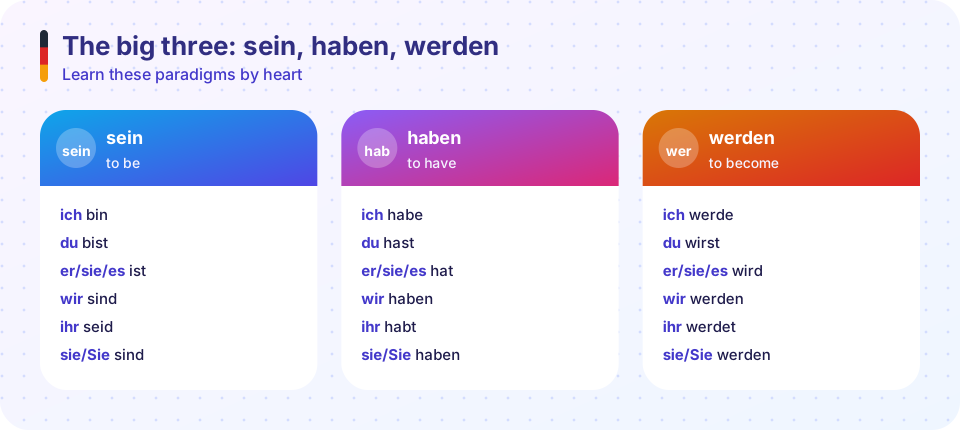
sein, haben, werden
Learn these three paradigms by heart, say them aloud many times. The patterns repeat in later chapters (past tense, future, passive).
| Person | sein (be) | haben (have) | werden (become) |
|---|---|---|---|
| ich | bin | habe | werde |
| du | bist | hast | wirst |
| er/sie/es | ist | hat | wird |
| wir | sind | haben | werden |
| ihr | seid | habt | werdet |
| sie/Sie | sind | haben | werden |
Examples:
- Ich bin müde. (I am tired.) Du bist nett. (You are nice.) Er ist Lehrer. (He is a teacher.)
- Ich habe einen Bruder. (I have a brother.) Sie hat eine Katze. (She has a cat.) Wir haben Zeit. (We have time.)
- Es wird kalt. (It is getting cold.) Er wird Arzt. (He is becoming a doctor.) Ich werde 30. (I am turning 30.)
Notice how haben is almost regular, with only du hast, er hat shortened and ihr habt losing the e. And werden changes e to i in du wirst, er wird.
Sein is used for identity, description, location, age and weather: Ich bin Anna. Das Haus ist groß. Wir sind in Berlin. Ich bin 25 (Jahre alt). Es ist kalt. English "I am 25 years old" is also "Ich bin 25 Jahre alt", never Ich habe 25 Jahre.
Haben is used for possession and in many idioms where English uses "to be":
| German | English |
|---|---|
| Hunger / Durst haben | to be hungry / thirsty |
| Angst haben (vor + dative) | to be afraid |
| Recht / Unrecht haben | to be right / wrong |
| Zeit / Lust haben | to have time / feel like it |
| Glück / Pech haben | to be lucky / unlucky |
| Geburtstag haben | to have a birthday |
Ich habe Hunger is the correct way to say "I am hungry". Ich bin hungrig is also possible but rarer. And Mir ist kalt or Ich habe kalt mean "I am cold": mir ist kalt is the common form.
Verbs that change their stem vowel
A group of very common verbs change their stem vowel only in the du and er/sie/es forms. The other four forms (ich, wir, ihr, sie/Sie) are regular. There are three main patterns.
e → i (short vowel):
| Infinitive | ich | du | er/sie/es | Meaning |
|---|---|---|---|---|
| sprechen | spreche | sprichst | spricht | speak |
| essen | esse | isst | isst | eat |
| geben | gebe | gibst | gibt | give |
| nehmen | nehme | nimmst | nimmt | take |
| helfen | helfe | hilfst | hilft | help |
| treffen | treffe | triffst | trifft | meet |
| vergessen | vergesse | vergisst | vergisst | forget |
e → ie (long vowel):
| Infinitive | ich | du | er/sie/es | Meaning |
|---|---|---|---|---|
| sehen | sehe | siehst | sieht | see |
| lesen | lese | liest | liest | read |
| empfehlen | empfehle | empfiehlst | empfiehlt | recommend |
a → ä (and au → äu):
| Infinitive | ich | du | er/sie/es | Meaning |
|---|---|---|---|---|
| fahren | fahre | fährst | fährt | drive, go (by vehicle) |
| schlafen | schlafe | schläfst | schläft | sleep |
| tragen | trage | trägst | trägt | carry, wear |
| waschen | wasche | wäschst | wäscht | wash |
| laufen | laufe | läufst | läuft | run, walk |
| halten | halte | hältst | hält | hold |
| lassen | lasse | lässt | lässt | let, leave |
Two notes: nehmen also changes a consonant (nimmst, nimmt), and verbs whose stem ends in s (essen, lesen, vergessen, lassen) have du and er look the same (du isst, er isst; du liest, er liest).
How to remember them. The vowel change happens only where the ending is -st or -t after a stressed stem, that is, in du and er/sie/es. Think of it as a rule about the singular "you" and "he/she/it": ich stays regular, and so do all plural forms. So wir sprechen keeps the e.
Always learn stem-changing verbs in the form: sprechen (spricht). A good dictionary lists spricht after the infinitive.
wissen and kennen
German has two verbs for English "to know". Wissen is for facts, information and things you can state in a clause. It is irregular: ich weiß, du weißt, er weiß, wir wissen, ihr wisst, sie wissen. Kennen (regular, ich kenne) is for being acquainted with people, places or things. Compare:
- Ich weiß, wo du wohnst. (I know where you live: a fact.)
- Ich kenne deine Schwester. (I know your sister: I have met her.)
- Kennst du Berlin? (Do you know Berlin: have you been there?)
- Ich weiß das nicht. (I don't know that.)
Using these verbs in sentences
Because the verb comes second, pronouns and objects fall into place easily: Heute esse ich eine Pizza. Am Samstag fahren wir nach Wien. Was sprichst du? A few useful questions: Sprechen Sie Englisch? Sprichst du Deutsch? Hast du Zeit? Bist du müde? Wohin fährst du?
Dialogue at a café:
A: Was nimmst du? — What are you having? B: Ich nehme einen Tee und esse ein Stück Kuchen. — I'll have a tea and eat a piece of cake. A: Ich habe Hunger! Hier gibt es auch Pizza. — I'm hungry! They have pizza here too. B: Gut, dann nimmst du eine Pizza. — Good, then you take a pizza. A: Und du isst nur Kuchen? — And you only eat cake? B: Genau, ich habe keinen Hunger. — Exactly, I am not hungry.
Short conversations to practice
Use this mini conversation to rehearse the verbs from this lesson aloud, then change the details to fit your own life.
Anna: Wie alt bist du? — How old are you? Ben: Ich bin zwanzig Jahre alt. Und du? — I am twenty years old. And you? Anna: Ich werde nächste Woche einundzwanzig. — I am turning twenty-one next week. Ben: Dann hast du bald Geburtstag! Hast du schon Pläne? — Then your birthday is soon! Do you have plans already? Anna: Ja, wir haben einen Tisch im Restaurant. Kommst du? — Yes, we have a table at a restaurant. Are you coming?
Notice Ich bin ... alt for age, werden for a coming change, and haben for plans and a table. Notice too that Hast du schon Pläne? has no English "do": the verb simply moves to first place.
Common misconceptions
"I am hungry = Ich bin Hunger." Say Ich habe Hunger.
"The vowel change applies to all persons." Only to du and er/sie/es: wir sprechen, not wir sprichen.
"Ich bin 25 Jahre." / "Ich habe 25 Jahre." Use Ich bin 25 Jahre alt.
"wissen and kennen are the same." Facts versus familiarity.
Try it
Press Run (or Ctrl + Enter) to see the result here.
Program input · what you'd type while the program runs
Type the answers before you press Run, one per line. Each time the program reads a line (with input()), it gets the next line from this box.
Check your understanding
Quick check · 6 questions
of 6 answered You scored / 6 · perfect!
-
1. What is the correct form: 'du ___' (sein)?
ich bin, du bist, er ist. -
2. How do you say 'I am hungry'?
German uses haben with Hunger and Durst. -
3. What is the correct form: 'er ___ ' (fahren)?
a changes to ä in du and er/sie/es: du fährst, er fährt. -
4. Which sentence is correct?
The vowel change affects only du and er/sie/es. -
5. Which verb is used for facts: 'I know that he lives here'?
wissen is for facts; kennen is for acquaintance. -
6. What is 'du ___' (lesen)?
e changes to ie, and the s of the stem absorbs the -st: du liest.
Summary
- Sein: bin, bist, ist, sind, seid, sind. Haben: habe, hast, hat, haben, habt, haben. Werden: werde, wirst, wird, werden, werdet, werden.
- Stem changes affect only du and er/sie/es: e→i (sprechen), e→ie (sehen, lesen), a→ä (fahren, schlafen).
- Use haben in idioms (Hunger, Durst, Angst, Zeit) and sein for age and weather.
- wissen = to know facts (ich weiß); kennen = to be acquainted.
Track your progress
Create a free account to tick off lessons and pick up where you left off on any device.
of German for Beginners lessons completed