


















Lesson 17 of 50 · Cases and Articles
Chapter 3 review: Cases and articles
Review chapter 3 of German for Beginners: noun gender, the nominative, accusative and dative articles, pronouns, prepositions and plurals, with a 10-question quiz.
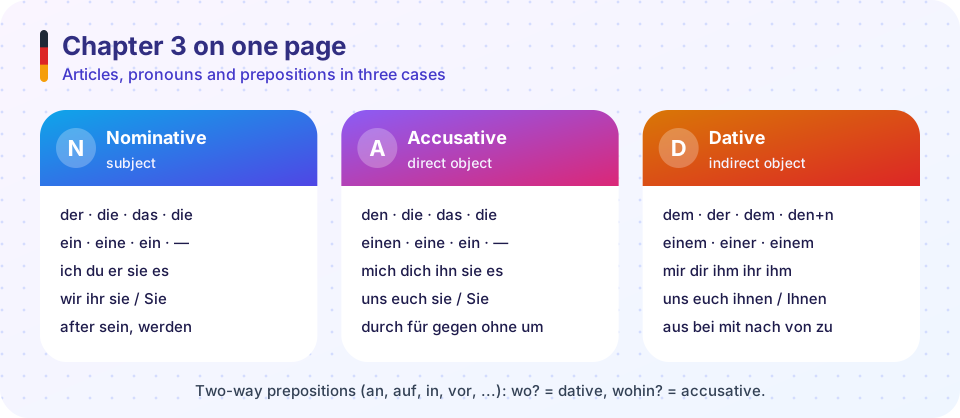
You have just worked through the hardest part of German grammar for most English speakers: gender, case and plural. Do not worry if you do not remember every form yet. The articles reappear in every single sentence you will read from now on, so repetition is automatic. This review puts the whole system on one page and then tests you on it. Use the table as a reference, not as something to memorize in one sitting.
What you will learn
- the complete table of articles for three cases and three genders
- the pronouns and prepositions that belong to each case
- which mistakes to watch for before moving on to verbs
Key terms
Nominativ, Akkusativ, Dativ: the cases of the subject, the direct object and the indirect object. Maskulinum, Femininum, Neutrum: the three genders. Wechselpräposition: a two-way preposition (dative for location, accusative for direction). Deklination: the pattern of article and noun endings.
The articles in one table
| Masculine | Feminine | Neuter | Plural | |
|---|---|---|---|---|
| Nominative | der / ein | die / eine | das / ein | die / — |
| Accusative | den / einen | die / eine | das / ein | die / — |
| Dative | dem / einem | der / einer | dem / einem | den (+n) / — |
Remember: the masculine changes in the accusative; all genders change in the dative; plurals add -n in the dative.
Pronouns, three cases
| Nominative | Accusative | Dative |
|---|---|---|
| ich | mich | mir |
| du | dich | dir |
| er | ihn | ihm |
| sie | sie | ihr |
| es | es | ihm |
| wir | uns | uns |
| ihr | euch | euch |
| sie / Sie | sie / Sie | ihnen / Ihnen |
Prepositions by case
| Case | Prepositions |
|---|---|
| Accusative | durch, für, gegen, ohne, um |
| Dative | aus, außer, bei, mit, nach, seit, von, zu |
| Two-way (dative = where, accusative = where to) | an, auf, hinter, in, neben, über, unter, vor, zwischen |
Gender and plural reminders
- Feminine endings: -ung, -heit, -keit, -schaft, -tion, -tät, -ik, -ie, -ei, -in.
- Neuter endings: -chen, -lein, -ment, -um; infinitives used as nouns.
- Masculine: days, months, seasons, -er (people), -ling, -ismus, -ist.
- Compounds take the gender of the last word: die Haustür.
- Plural patterns: -e, -er, -(e)n, no change, -s. Feminine nouns mostly take -n or -en.
Worked example
Look at this sentence and name the case of every noun phrase:
Der Lehrer gibt den Kindern die Hausaufgaben. (The teacher gives the children the homework.)
- Der Lehrer: nominative, the subject (who gives?).
- den Kindern: dative plural (to whom?), with the -n on Kindern.
- die Hausaufgaben: accusative plural (what?), unchanged because plurals look the same in the nominative and accusative. (Hausaufgabe is a feminine noun used mostly in the plural.)
Now change the sentence to pronouns: Er gibt ihnen die Hausaufgaben. Or even: Er gibt sie ihnen. (He gives them to them.)
Study plan for the next days
The case system is learned by repetition in context, not by staring at tables. Spend a few minutes a day with one case at a time. On the first day, write ten sentences with accusative objects, using nouns of all genders. On the second, write ten sentences with dative objects and dative prepositions. On the third, mix them: Ich gebe dem Mann einen Apfel, and check each article against the table. On the fourth, review genders and plurals using flashcards. On the fifth, read a short German text and label every noun phrase with N, A or D. Do not expect to be perfect: native-speaking children take years to master all of this, and learners who make case mistakes are still understood. The goal now is to build the habit of noticing the article, which is the first step to using it correctly.
Common misconceptions
"The accusative changes everything." Only the masculine singular.
"I can ignore the dative plural -n." It is a small thing, but native speakers notice it. den Kindern, den Freunden.
"All prepositions take the same case." They are grouped: DOGFU for the accusative, aus-bei-mit-nach-seit-von-zu for the dative, nine two-way prepositions for both.
"If I get the case wrong, nobody understands me." Usually they do. Keep speaking, and improve gradually.
Try it
Press Run (or Ctrl + Enter) to see the result here.
Program input · what you'd type while the program runs
Type the answers before you press Run, one per line. Each time the program reads a line (with input()), it gets the next line from this box.
Check your understanding
Quick check · 10 questions
of 10 answered You scored / 10 · perfect!
-
1. Which sentence is correct?
Tisch is masculine and a direct object: einen Tisch. -
2. Which sentence is correct?
mit takes the dative: dem Bus. -
3. What is the dative of 'die Frau'?
Feminine dative: der Frau. -
4. Which pronoun fits: 'Ich liebe ___' (you, informal, one person)?
liebe takes the accusative: dich. -
5. What is the plural of 'das Buch'?
-er plural with umlaut: die Bücher. -
6. Which preposition always takes the accusative?
für is one of durch, für, gegen, ohne, um. -
7. Which sentence is correct?
Location (wo?) takes the dative: auf dem Tisch. -
8. Which sentence is correct?
Dative plural: den Kindern, with -n. -
9. What gender is 'die Zeitung'?
Nouns in -ung are feminine. -
10. Which pronoun replaces 'der Tisch' in 'Ich sehe ... '?
Tisch is masculine, accusative: ihn.
Summary
- Nominative = subject, accusative = direct object, dative = indirect object and after dative prepositions.
- Only masculine changes in the accusative (den, einen); all genders change in the dative (dem, der, dem, den + n).
- Prepositions: DOGFU take the accusative; aus-bei-mit-nach-seit-von-zu take the dative; two-way prepositions depend on wo/wohin.
- Plurals follow five patterns; learn each noun with its plural.
- Next: verbs in the present tense and the golden rule of word order.
Track your progress
Create a free account to tick off lessons and pick up where you left off on any device.
of German for Beginners lessons completed