


















Lesson 4 of 50 · Getting Started
Cognates and false friends
Use the words German and English share to build vocabulary fast, learn the suffix patterns, and avoid the false friends that trick every beginner.
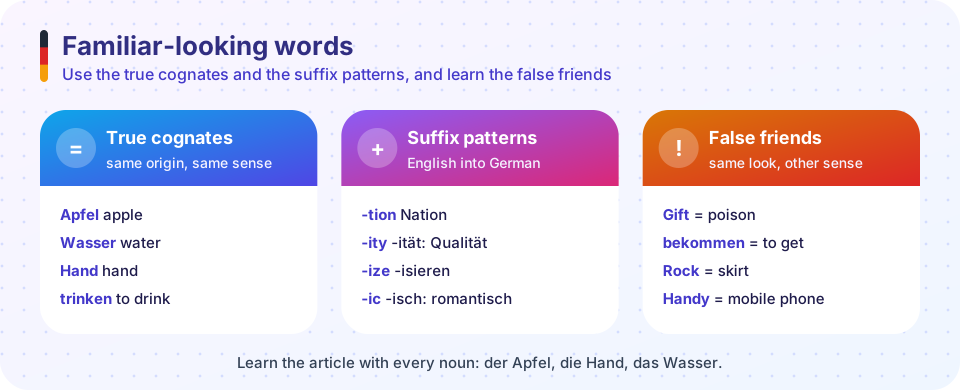
You already know more German than you think. Hundreds of everyday words are cognates: words that descend from the same ancestor in both languages, so they look and mean almost the same. A learner who recognizes the patterns can read the first lines of a German menu, a street sign or a short email on day one. But a few words are traps. They look familiar and mean something different. German teachers call them falsche Freunde, false friends, and every English speaker falls for some. This lesson gives you the shortcut and the warning labels together.
What you will learn
- how to recognize true cognates and loanwords
- suffix patterns that turn English words into German ones
- the most common false friends and their real meanings
- a rule for guessing safely without being fooled
Key terms
Cognate (Kognat): a word with a shared origin and similar form and meaning in two languages. Loanword (Lehnwort): a word borrowed from another language, such as das Taxi or der Computer. False friend (falscher Freund): a word that looks like an English word but means something else. Suffix: an ending added to a word stem, such as -tion, -ität or -ieren.
True cognates: guess and check
Start with words from the home, the body, the family and nature. The core vocabulary of English and German is closely related, and the sound shifts from lesson 2 make it predictable. Say each word aloud with a German accent in mind (w like v, ei like "eye", ie like "ee"):
| German | English | Note |
|---|---|---|
| der Apfel | apple | p became pf |
| das Wasser | water | t became ss |
| der Finger | finger | identical |
| die Hand | hand | identical |
| das Haus | house | vowel sound ow |
| der Winter | winter | w sounds like v |
| der Sommer | summer | o is short |
| der Bruder | brother | d and th |
| die Mutter | mother | tt and th |
| der Fisch | fish | sch sounds like "sh" |
| das Glas | glass | one s |
| trinken | to drink | the verb ending is -en |
Notice that verbs end in -en in their dictionary form (the infinitive). If you remove the -en, you get a stem close to English: trinken gives "drink", singen gives "sing", finden gives "find", bringen gives "bring", kommen gives "come". That alone unlocks dozens of verbs.
Many words are loanwords that stayed almost the same, and they give you instant vocabulary for travel: das Hotel, das Taxi, der Bus, das Auto, das Restaurant, die Pizza, der Kaffee, das Radio, das Internet, der Computer, die Banane. The gender is not guessable from English, so learn each with its article.
Pattern words: suffixes that convert English
A set of suffix rules lets you build German words from English ones, nearly mechanically:
| English ending | German ending | Examples |
|---|---|---|
| -tion | -tion (feminine: die) | die Nation, die Information, die Station |
| -ity | -ität (feminine) | die Universität, die Qualität, die Aktivität |
| -ize | -isieren (verb) | organisieren, modernisieren |
| -ic | -isch (adjective) | fantastisch, romantisch |
| -ism | -ismus (masculine: der) | der Tourismus, der Optimismus |
| -ist | -ist (masculine: der) | der Tourist, der Optimist |
| -y (noun) | -ie | die Energie, die Harmonie |
Two practical hints. First, nouns ending in -tion, -tät, -ik, -ie and -ung are almost always feminine (die), a gift for chapter 3. Second, remember to capitalize the noun and add the article.
False friends: the ones that bite
A false friend is not a bad word. It is just a word with a different job than the English twin. Here are common traps, with the real meaning:
| German word | Looks like | Really means |
|---|---|---|
| das Gift | gift | poison |
| das Geschenk | (not a false friend) | gift, present |
| bekommen | become | to get, to receive |
| werden | (no obvious twin) | to become |
| der Chef | chef | boss (a cook is der Koch) |
| das Handy | handy | mobile (cell) phone |
| also | also | so, therefore (also = auch) |
| der Rat | rat | advice (a rat is die Ratte) |
| der Rock | rock | skirt |
| fast | fast | almost (fast = schnell) |
| die Art | art | kind, type (art = die Kunst) |
| der Mist | mist | manure, rubbish |
| sensibel | sensible | sensitive (sensible = vernünftig) |
| aktuell | actual | current (actual = tatsächlich) |
| eventuell | eventually | possibly (eventually = schließlich) |
| die Pension | pension | guest house (a pension = die Rente) |
| sympathisch | sympathetic | likeable, nice |
The most useful to learn first is bekommen. A famous beginner sentence is "Ich bekomme ein Steak" ("I get a steak"). A learner who says "Ich will ein Steak bekommen" for "I want to become a steak" is joking by accident. Also remember that Gift is poison, which makes labels on German products unintentionally funny to English readers, and that Handy is the standard word for a mobile phone. English speakers often think Handy is an English word, but English does not use it that way. It is a German invention that sounds like English, called a Scheinanglizismus (pseudo-anglicism). Other examples: der Beamer (projector), das Smoking (tuxedo), der Oldtimer (vintage car).
Guessing safely
Use a three-step habit when a word looks familiar:
- Guess from the form, using the shifts and suffix patterns.
- Check the context. Does the meaning fit the sentence? "Ich bekomme einen Kaffee" fits "I get a coffee", but "I become a coffee" does not.
- Verify in a dictionary the first time you use a word actively.
Reading is safer than speaking: when you read, context catches most mistakes. When you speak, a false friend can mislead your listener, so keep a short personal list of false friends and review it once a week.
Building your own cognate list
The fastest way to grow your vocabulary is to collect cognates as you meet them. Keep a notebook or a spreadsheet with four columns: the German word with its article, its English twin, the pattern that connects them, and a short example sentence. For instance: der Winter / winter / identical / Im Winter ist es kalt. Or das Wasser / water / t became ss / Ich trinke Wasser. Each week, add ten new entries and review the old ones aloud. After a month you will have around forty words you can recognize at a glance and, more importantly, you will start to predict patterns: you will guess that "foot" might be Fuß, that "pound" is Pfund, and that "tongue" is Zunge. Add a fifth column for false friends and mark them in red, so the traps are impossible to miss. Reading short German texts, such as menus, signs and headlines, with a pen in hand will give you plenty of material.
Common misconceptions
"If a word looks like English, it means the same." Usually, but 5 to 10 percent do not. Learn the traps above.
"German borrowed Handy from English." English has "handy" but not in this meaning. German created the new meaning.
"I can skip genders for cognates." The gender is independent of English: das Haus, der Computer, die Nase, das Wasser. Learn the article with each cognate.
Try it
First, convert English words with the suffix rules, then check yourself on false friends.
Press Run (or Ctrl + Enter) to see the result here.
Program input · what you'd type while the program runs
Type the answers before you press Run, one per line. Each time the program reads a line (with input()), it gets the next line from this box.
Press Run (or Ctrl + Enter) to see the result here.
Program input · what you'd type while the program runs
Type the answers before you press Run, one per line. Each time the program reads a line (with input()), it gets the next line from this box.
Check your understanding
Quick check · 5 questions
of 5 answered You scored / 5 · perfect!
-
1. What does the German word 'Gift' mean?
'Gift' means poison. A present is 'das Geschenk'. -
2. How do you say 'I get a coffee' in German?
'bekommen' means to get or receive. 'werden' means to become. -
3. Which ending turns the English '-ity' into German?
English university becomes Universität; quality becomes Qualität. These nouns are feminine. -
4. What is 'das Handy' in German?
'Handy' is a German word for a mobile phone, sounding English but not used that way in English. -
5. Nouns ending in -tion in German are almost always ...?
-tion, -tät, -ung, -ik and -ie nouns are almost always feminine: die Nation, die Universität.
Summary
- Many everyday words are cognates: Apfel, Wasser, Hand, Finger, Winter, Sommer.
- Verb infinitives end in -en; remove it to find an English-like stem.
- Suffix patterns (-tion, -ität, -isieren, -isch, -ismus) turn English words into German.
- False friends such as Gift, bekommen, Rock, fast, Chef and Handy must be learned as exceptions.
- Always learn the article with the noun, because genders do not follow English.
Next: Chapter 1 review
Track your progress
Create a free account to tick off lessons and pick up where you left off on any device.
of German for Beginners lessons completed