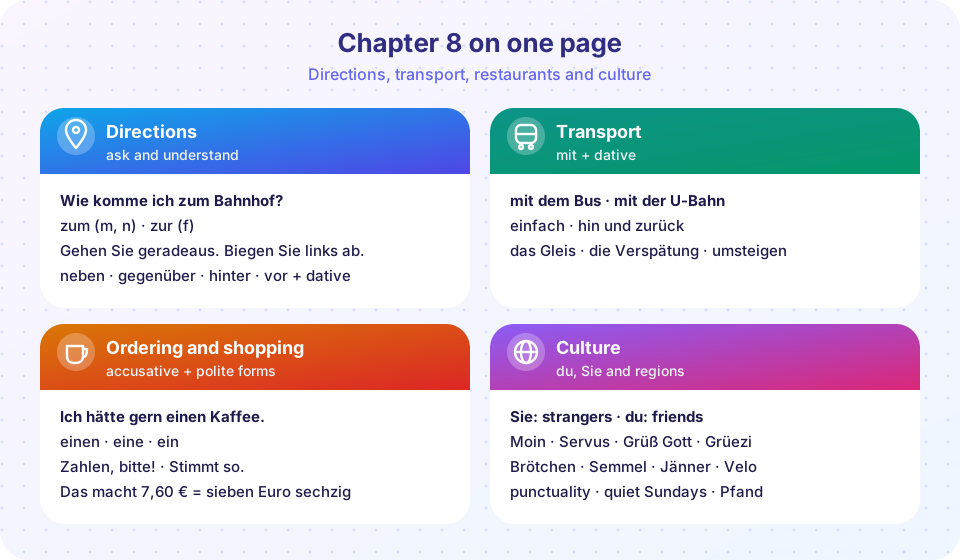
Review German directions, transport, restaurant and shopping phrases, du and Sie, and regional culture with a poster, dialogue, recap table and quiz.
Chapter 8 took you out of the textbook and into the street, the train station, the restaurant and the bakery. You can now ask the way, understand simple directions, buy a ticket, order a meal, pay, and choose between du and Sie. This review puts it all on one page, gives you a longer dialogue that links the situations, and finishes with ten questions.
Caption: Chapter 8 in one picture: ask the way, travel, order and pay, and remember the cultural basics.
A visitor in a city looks for a restaurant, then orders.
Gast:Entschuldigung, wie komme ich zum Restaurant „Zum Löwen“?
Passantin:Gehen Sie geradeaus bis zur Kirche. Dort biegen Sie rechts ab. Das Restaurant ist neben der Bank.
Gast:Vielen Dank!
(Im Restaurant)
Gast:Guten Abend! Haben Sie einen Tisch für eine Person?
Kellnerin:Ja, gern. Was möchten Sie trinken?
Gast:Ich hätte gern ein Glas Wein und eine Gemüsesuppe, bitte.
(Später)
Gast:Zahlen, bitte!
Kellnerin:Das macht 12,50 Euro.
Gast:Machen Sie 14. Vielen Dank, einen schönen Abend noch!
English: Guest: Excuse me, how do I get to the restaurant "Zum Löwen"? Passer-by: Go straight ahead to the church. There turn right. The restaurant is next to the bank. Guest: Thank you very much! (In the restaurant) Guest: Good evening! Do you have a table for one person? Waitress: Yes, gladly. What would you like to drink? Guest: I would like a glass of wine and a vegetable soup, please. (Later) Guest: The bill, please! Waitress: That comes to 12.50 euros. Guest: Make it 14. Thank you very much, have a nice evening!
Count the tools: zum, zur, neben der (dative), Gehen Sie, biegen Sie ab (imperative), hätte gern, ein Glas, eine Gemüsesuppe (ordering), Machen Sie 14 (tip).
<style>:root{--ink:#1e1b4b;--mut:#475569;--acc:#6366f1;--bd:#c7d2fe}*{box-sizing:border-box}body{margin:0;padding:14px;font-family:system-ui,-apple-system,'Segoe UI',sans-serif;color:var(--ink);background:linear-gradient(135deg,#faf5ff,#eff6ff)}.card{background:#fff;border-radius:18px;box-shadow:0 8px 22px rgba(67,56,202,.15);padding:16px}button{font:inherit;cursor:pointer;border:0;border-radius:999px;padding:8px 14px;background:linear-gradient(135deg,#6366f1,#8b5cf6);color:#fff;font-weight:600}button.alt{background:#eef2ff;color:#3730a3}button:disabled{opacity:.5;cursor:default}.row{display:flex;gap:8px;flex-wrap:wrap;align-items:center;margin-top:10px}.mut{color:var(--mut);font-size:.9rem}</style><style>.q{display:flex;gap:8px;align-items:center;flex-wrap:wrap;padding:8px 0;border-bottom:1px solid #eef2ff;font-size:1.05rem}input{font:inherit;padding:6px 10px;border:2px solid var(--bd);border-radius:10px;width:9em}input.ok{border-color:#10b981;background:#ecfdf5}input.no{border-color:#ef4444;background:#fef2f2}.h{font-size:.85rem;color:var(--mut)}</style><divclass="card"><divid="list"></div><divclass="row"><buttonid="chk">Check answers</button><buttonclass="alt"id="rev">Show answers</button><spanid="score"class="mut"></span></div><divclass="mut"style="margin-top:8px">Capitals do not matter. Type ä ö ü ß, or use ae oe ue ss.</div></div><script>var items=[{"s":"Wie komme ich ___ Post?","a":"zur"},{"s":"Biegen Sie rechts ___.","a":"ab"},{"s":"Ich fahre mit ___ Zug.","a":"dem"},{"s":"Das Hotel ist neben ___ Bank.","a":"der"},{"s":"Ich ___ gern einen Kaffee.","a":"hätte"},{"s":"Ich möchte ___ Salat.","a":"einen"},{"s":"___, bitte! (the bill)","a":"Zahlen"},{"s":"Können ___ mir helfen? (formal)","a":"Sie"},{"s":"In der Schweiz sagt man zur Begrüßung „___“.","a":"Grüezi"},{"s":"Eine Fahrkarte nach Köln, ___.","a":"bitte"}];functionnorm(s){return s.toLowerCase().trim().replace(/\s+/g,' ').replace(/ae/g,'ä').replace(/oe/g,'ö').replace(/ue/g,'ü').replace(/ss/g,'ß');}functionnormAns(s){returnnorm(s).replace(/ß/g,'ß');}var list=document.getElementById('list');
items.forEach(function(it,n){var d=document.createElement('div');d.className='q';var parts=it.s.split('___');
d.appendChild(document.createTextNode(parts[0]));var inp=document.createElement('input');inp.id='i'+n;inp.setAttribute('aria-label','Answer '+(n+1));d.appendChild(inp);
d.appendChild(document.createTextNode(parts[1]||''));if(it.h){var h=document.createElement('span');h.className='h';h.textContent='('+it.h+')';d.appendChild(h);}
list.appendChild(d);});functionok(it,v){var arr=Array.isArray(it.a)?it.a:[it.a];var x=normAns(v);return arr.some(function(a){returnnormAns(a)===x;});}
document.getElementById('chk').onclick=function(){var right=0;
items.forEach(function(it,n){var e=document.getElementById('i'+n);var g=ok(it,e.value);e.className=g?'ok':'no';if(g)right++;});
document.getElementById('score').textContent=right+' of '+items.length+' correct';};
document.getElementById('rev').onclick=function(){
items.forEach(function(it,n){var e=document.getElementById('i'+n);e.value=Array.isArray(it.a)?it.a[0]:it.a;e.className='ok';});};</script>
And a choice exercise.
Which is correct?
<style>:root{--ink:#1e1b4b;--mut:#475569;--acc:#6366f1;--bd:#c7d2fe}*{box-sizing:border-box}body{margin:0;padding:14px;font-family:system-ui,-apple-system,'Segoe UI',sans-serif;color:var(--ink);background:linear-gradient(135deg,#faf5ff,#eff6ff)}.card{background:#fff;border-radius:18px;box-shadow:0 8px 22px rgba(67,56,202,.15);padding:16px}button{font:inherit;cursor:pointer;border:0;border-radius:999px;padding:8px 14px;background:linear-gradient(135deg,#6366f1,#8b5cf6);color:#fff;font-weight:600}button.alt{background:#eef2ff;color:#3730a3}button:disabled{opacity:.5;cursor:default}.row{display:flex;gap:8px;flex-wrap:wrap;align-items:center;margin-top:10px}.mut{color:var(--mut);font-size:.9rem}</style><style>.q{font-size:1.15rem;font-weight:600;margin:6px 0 12px}.opts{display:flex;gap:10px;flex-wrap:wrap}.opts button{background:#fff;color:var(--ink);border:2px solid var(--bd);border-radius:14px;padding:10px 18px}.opts button.good{background:#ecfdf5;border-color:#10b981;color:#047857}.opts button.bad{background:#fef2f2;border-color:#ef4444;color:#b91c1c}.fb{min-height:2.6em;margin-top:10px;font-size:.95rem}</style><divclass="card"><divclass="mut"id="prog"></div><divclass="q"id="q"></div><divclass="opts"id="opts"></div><divclass="fb"id="fb"></div><divclass="row"><buttonid="nx"disabled>Next</button><spanclass="mut"id="sc"></span></div></div><script>var items=[{"q":"Ask the way to the station (der Bahnhof).","o":["Wie komme ich zum Bahnhof?","Wie komme ich zur Bahnhof?","Wie komme ich zu der Bahnhof?"],"a":0,"w":"Masculine: zum."},{"q":"Turn left.","o":["Biegen Sie ab links.","Biegen Sie links ab.","Sie biegen ab links."],"a":1,"w":"The prefix goes to the end."},{"q":"I would like a soup.","o":["Ich hätte gern einer Suppe.","Ich hätte gern eine Suppe.","Ich hätte gern einen Suppe."],"a":1,"w":"Feminine accusative: eine."},{"q":"I travel by bus.","o":["Ich fahre mit dem Bus.","Ich fahre mit der Bus.","Ich fahre mit Bus."],"a":0,"w":"Mit + dative: dem Bus."},{"q":"Which greeting is typical for Switzerland?","o":["Moin","Grüezi","Servus"],"a":1,"w":"Grüezi is Swiss."},{"q":"Can you help me? (to a stranger)","o":["Kannst du mir helfen?","Können Sie mir helfen?","Könnt ihr mir helfen?"],"a":1,"w":"Strangers: Sie."}];var i=0,score=0,answered=false;functionshow(){var it=items[i];answered=false;
document.getElementById('prog').textContent='Question '+(i+1)+' of '+items.length;
document.getElementById('q').textContent=it.q;
document.getElementById('fb').textContent='';
document.getElementById('nx').disabled=true;var box=document.getElementById('opts');box.innerHTML='';
it.o.forEach(function(t,k){var b=document.createElement('button');b.textContent=t;
b.onclick=function(){if(answered)return;answered=true;var ok=k===it.a;if(ok)score++;
b.className=ok?'good':'bad';if(!ok){box.children[it.a].className='good';}
document.getElementById('fb').textContent=(ok?'Correct. ':'Not quite. ')+(it.w||'');
document.getElementById('sc').textContent='Score: '+score+' / '+(i+1);
document.getElementById('nx').disabled=false;
document.getElementById('nx').textContent=(i===items.length-1)?'Start again':'Next';};
box.appendChild(b);});}
document.getElementById('nx').onclick=function(){if(i===items.length-1){i=0;score=0;document.getElementById('sc').textContent='';}else{i++;}show();};show();</script>