


















Lesson 48 of 50 · Projects and Practice
Glossary: German Words and Grammar Terms
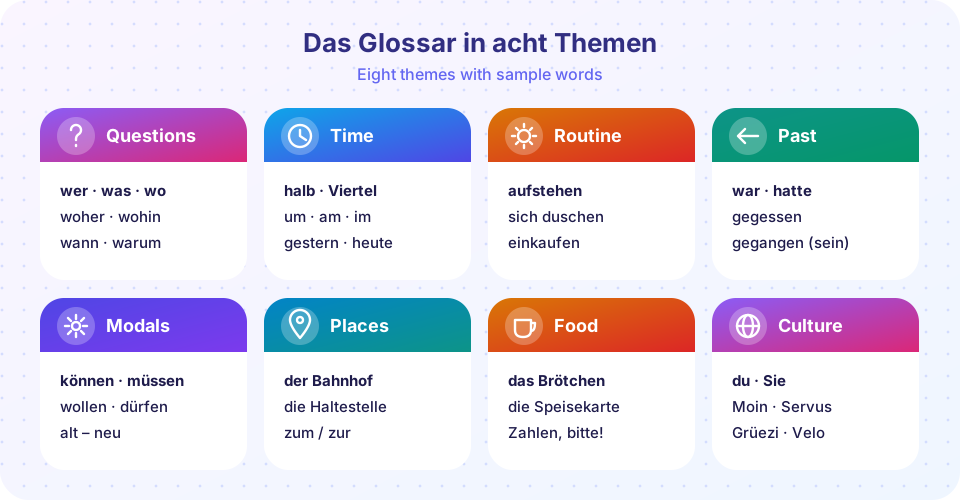
A thematic glossary of the German words, phrases and grammar terms from Chapters 5 to 8: questions, time, routine, past tenses, modals, clauses, places, food and culture.
This glossary collects the vocabulary and the grammar terms from Chapters 5 to 8 in one place. It is organized by theme, not alphabetically, because we remember words better in groups: all the question words together, all the places in a town together. Use it to look things up, to test yourself by covering one column, and to build your own flash cards.
Nouns are listed with their article, because the gender is part of the word: learn der Bahnhof, not just Bahnhof. Verbs are listed in the infinitive; irregular participles and the helping verb are shown where it matters. Some entries show a short usage hint in brackets.
What you will learn
- how the vocabulary of Chapters 5 to 8 fits into themes
- how to use the glossary for self-testing
- how to build your own flash cards from the lists
- where to find the grammar terms used in lessons
Key terms
- das Glossar (glossary): a list of words with their meaning.
- das Wörterbuch (dictionary): a book or app with many words.
- der Wortschatz (vocabulary): all the words you know.
- der Artikel (article): der, die, das, learned with each noun.
- die Wortfamilie (word family): words that share a root.
How to use this page
- Cover and test. Cover the English column and try to say the German. Cover the German and try to say the English. Mark the words you miss.
- Learn in chunks. Ten words per session is plenty. Mix old and new words.
- Say the word in a sentence. Der Bahnhof ist gegenüber der Post. A word in a sentence is easier to remember than a word alone.
- Use the search tool below. It looks through all the entries in German or English.
Questions and answers
| German | English |
|---|---|
| wer | who |
| was | what |
| wo | where (position) |
| woher | where from |
| wohin | where to |
| wann | when |
| warum | why |
| wie | how |
| wie viel | how much |
| wie viele | how many |
| wie lange | how long |
| wie oft | how often |
| welcher, welche, welches | which |
| doch | yes (answer to a negative question) |
| Wie bitte? | Pardon? |
| Was bedeutet das? | What does that mean? |
Numbers, time and the calendar
| German | English |
|---|---|
| null | zero |
| eins | one |
| zwölf | twelve |
| zwanzig | twenty |
| einundzwanzig | twenty-one |
| hundert | one hundred |
| tausend | one thousand |
| die Uhr | clock; o’clock |
| halb | half (half way to the next hour) |
| das Viertel | quarter |
| nach | past |
| vor | to, before |
| um | at (clock time) |
| am | on (day), in (part of the day) |
| im | in (month, season) |
| der Montag | Monday |
| der Dienstag | Tuesday |
| der Mittwoch | Wednesday |
| der Donnerstag | Thursday |
| der Freitag | Friday |
| der Samstag | Saturday |
| der Sonntag | Sunday |
| der Januar … der Dezember | January … December |
| der Frühling | spring |
| der Sommer | summer |
| der Herbst | autumn |
| der Winter | winter |
| gestern | yesterday |
| heute | today |
| morgen | tomorrow |
| der Morgen | morning |
| der Mittag | noon |
| der Nachmittag | afternoon |
| der Abend | evening |
| die Nacht | night |
Daily routine
| German | English |
|---|---|
| aufstehen | to get up |
| frühstücken | to have breakfast |
| sich duschen | to take a shower |
| sich waschen | to wash (oneself) |
| sich anziehen | to get dressed |
| einkaufen | to shop |
| kochen | to cook |
| fernsehen | to watch TV |
| anrufen | to phone |
| abholen | to pick up |
| ankommen | to arrive |
| abfahren | to depart |
| mitkommen | to come along |
| aufräumen | to tidy up |
| einschlafen | to fall asleep |
| schlafen | to sleep |
| arbeiten | to work |
| ins Bett gehen | to go to bed |
| sich freuen | to be glad |
| sich treffen | to meet |
| sich beeilen | to hurry |
| immer | always |
| oft | often |
| manchmal | sometimes |
| selten | rarely |
| nie | never |
Past tenses
| German | English |
|---|---|
| das Perfekt | present perfect (everyday past) |
| das Präteritum | simple past |
| das Plusquamperfekt | past perfect |
| das Partizip II | past participle |
| das Hilfsverb | auxiliary verb (haben, sein) |
| war | was, were |
| hatte | had |
| es gab | there was, there were |
| essen – gegessen | to eat – eaten |
| trinken – getrunken | to drink – drunk |
| sehen – gesehen | to see – seen |
| lesen – gelesen | to read – read |
| schreiben – geschrieben | to write – written |
| gehen – gegangen (sein) | to go – gone |
| kommen – gekommen (sein) | to come – come |
| fahren – gefahren (sein) | to drive, travel – driven |
| fliegen – geflogen (sein) | to fly – flown |
| bleiben – geblieben (sein) | to stay – stayed |
| werden – geworden (sein) | to become – become |
| sein – gewesen (sein) | to be – been |
| bringen – gebracht | to bring – brought |
| denken – gedacht | to think – thought |
| wissen – gewusst | to know – known |
| machen – gemacht | to make, do – made |
| einkaufen – eingekauft | to shop – shopped |
| besuchen – besucht | to visit – visited |
| studieren – studiert | to study – studied |
Modals and adjectives
| German | English |
|---|---|
| können | can, to be able to |
| müssen | must, to have to |
| wollen | to want |
| sollen | should, to be supposed to |
| dürfen | may, to be allowed to |
| mögen | to like |
| möchten | would like to |
| nicht müssen | not have to |
| nicht dürfen | must not |
| konnte | could |
| musste | had to |
| wollte | wanted to |
| sollte | was supposed to |
| durfte | was allowed to |
| mochte | liked |
| alt – neu | old – new |
| jung – alt | young – old |
| groß – klein | big – small |
| gut – schlecht | good – bad |
| schön – hässlich | beautiful – ugly |
| teuer – billig | expensive – cheap |
| schnell – langsam | fast – slow |
| heiß – kalt | hot – cold |
| hell – dunkel | bright – dark |
| leicht – schwer | light, easy – heavy, difficult |
| lang – kurz | long – short |
| rot, blau, gelb, grün | red, blue, yellow, green |
| schwarz, weiß, braun, grau | black, white, brown, grey |
Conjunctions
| German | English |
|---|---|
| weil | because (verb last) |
| dass | that (verb last) |
| wenn | if, when, whenever (verb last) |
| ob | whether, if (verb last) |
| obwohl | although (verb last) |
| als | when (one event in the past) |
| bevor | before |
| damit | so that |
| denn | because (verb stays second) |
| und | and |
| aber | but |
| oder | or |
| sondern | but rather |
| deshalb | therefore |
Places and transport
| German | English |
|---|---|
| der Bahnhof | station |
| der Flughafen | airport |
| die Haltestelle | stop |
| die Post | post office |
| die Apotheke | pharmacy |
| die Bank | bank |
| das Rathaus | town hall |
| das Krankenhaus | hospital |
| der Supermarkt | supermarket |
| die Bäckerei | bakery |
| die Kirche | church |
| der Park | park |
| der Platz | square |
| die Brücke | bridge |
| die Straße | street |
| die Ampel | traffic light |
| die Kreuzung | intersection |
| der Bus | bus |
| die Straßenbahn | tram |
| die U-Bahn | underground |
| die S-Bahn | suburban train |
| der Zug | train |
| das Fahrrad | bicycle |
| das Auto | car |
| zu Fuß | on foot |
| die Fahrkarte | ticket |
| einfach | one way |
| hin und zurück | return |
| das Gleis | platform |
| die Verspätung | delay |
| umsteigen | to change (trains) |
| geradeaus | straight ahead |
| links, rechts | left, right |
| neben | next to |
| gegenüber | opposite |
| hinter | behind |
| zwischen | between |
| zum (m, n), zur (f) | to the |
Food, drink and shopping
| German | English |
|---|---|
| das Brot | bread |
| das Brötchen | bread roll |
| die Butter | butter |
| der Käse | cheese |
| die Wurst | sausage |
| das Ei | egg |
| der Salat | salad |
| die Suppe | soup |
| das Fleisch | meat |
| der Fisch | fish |
| die Kartoffel | potato |
| die Nudeln | pasta |
| der Reis | rice |
| das Gemüse | vegetables |
| das Obst | fruit |
| der Apfel | apple |
| der Kuchen | cake |
| das Wasser | water |
| der Saft | juice |
| die Milch | milk |
| der Tee | tea |
| der Kaffee | coffee |
| das Bier | beer |
| der Wein | wine |
| die Speisekarte | menu |
| die Rechnung | bill |
| das Trinkgeld | tip |
| bestellen | to order |
| bezahlen | to pay |
| Ich hätte gern … | I would like … |
| Guten Appetit! | Enjoy your meal! |
| Prost! | Cheers! |
| Zahlen, bitte! | The bill, please! |
| Stimmt so. | Keep the change. |
| Sonst noch etwas? | Anything else? |
| Das macht … | That comes to … |
Culture and regions
| German | English |
|---|---|
| du | you (informal) |
| Sie | you (formal) |
| ihr | you (plural, informal) |
| Herr, Frau | Mr, Ms |
| duzen | to use du |
| siezen | to use Sie |
| das Hochdeutsch | Standard German |
| der Dialekt | dialect |
| Moin | hello (northern Germany) |
| Servus | hello, goodbye (Bavaria, Austria) |
| Grüß Gott | hello (south, Austria) |
| Grüezi | hello (Switzerland) |
| Tschüss | bye (informal) |
| Auf Wiedersehen | goodbye (formal) |
| Jänner | January (Austria) |
| das Velo | bicycle (Switzerland) |
| die Semmel | bread roll (south, Austria) |
| die Schrippe | bread roll (Berlin) |
| der Paradeiser | tomato (Austria) |
| die Pünktlichkeit | punctuality |
| das Pfand | deposit on bottles and cans |
Grammar terms
You will meet these terms in textbooks, apps and classes. German grammar books use German names for the concepts, so it pays to know them.
| German | English |
|---|---|
| das Verb | verb |
| das Nomen, das Substantiv | noun |
| das Adjektiv | adjective |
| der Artikel | article |
| das Pronomen | pronoun |
| die Präposition | preposition |
| die Konjunktion | conjunction |
| der Satz | sentence, clause |
| der Hauptsatz | main clause |
| der Nebensatz | subordinate clause |
| der Infinitiv | infinitive |
| der Nominativ | nominative |
| der Akkusativ | accusative |
| der Dativ | dative |
| der Genitiv | genitive |
| der Singular, der Plural | singular, plural |
| die Endung | ending |
| das Modalverb | modal verb |
| das trennbare Verb | separable verb |
| das reflexive Verb | reflexive verb |
| der Imperativ | imperative |
| die Satzklammer | sentence bracket |
Memory tips
- Learn the article with the noun. Use colors if you like: blue for der, red for die, green for das.
- Group nouns by ending. Many nouns ending in -ung, -heit, -keit, -schaft are feminine (die Wohnung, die Freiheit). Nouns ending in -chen and -lein are neuter (das Mädchen).
- Use word families. fahren, die Fahrt, der Fahrplan, die Abfahrt, die Ankunft: one root gives you many words.
- Say, do not only read. A word that you have said aloud three times is yours.
Common misconceptions
- "A glossary is enough to learn vocabulary." A list is a reference. Vocabulary is learned through use: reading, speaking and writing.
- "One English word equals one German word." Often not: wo, woher, wohin are three words for English "where", and Sie and du are two for "you".
- "The article does not matter." It does: der See (lake) and die See (sea) are different words.
Try it
Test yourself with a small selection of the harder entries.
Check your understanding
Quick check · 3 questions
of 3 answered You scored / 3 · perfect!
-
1. What does 'der Nebensatz' mean?
Der Nebensatz is the subordinate clause; der Hauptsatz is the main clause. -
2. Which entry is a question word meaning 'where from'?
Woher asks about the origin. -
3. What is 'das Pfand'?
Pfand is the deposit you get back when you return a bottle or can.
Summary
- The glossary groups the vocabulary of Chapters 5 to 8 by theme.
- Learn nouns with their articles and verbs with their participles.
- Test yourself by covering a column, and use the words in sentences.
- Keep the grammar terms handy, because books and classes use them.
Next: Cheat sheet
Track your progress
Create a free account to tick off lessons and pick up where you left off on any device.
of German for Beginners lessons completed