Learn to order food and drinks, ask for the bill, shop at a bakery and read prices in German, with the accusative, quantities, dialogues and an order simulator.
Few situations teach you more German than a café or a bakery. The sentences are short, the vocabulary is concrete, and the staff are usually patient. You also get an immediate reward: the coffee arrives. This lesson gives you everything for a restaurant visit and a shopping trip: how to ask for a table, order, pay, buy bread by the piece or the kilo, and understand the price.
The grammar is mostly what you know. When you order something, it is the direct object, so it takes the accusative: Ich hätte gern einen Kaffee, eine Suppe und ein Wasser. If you remember einen / eine / ein, you can order anything.
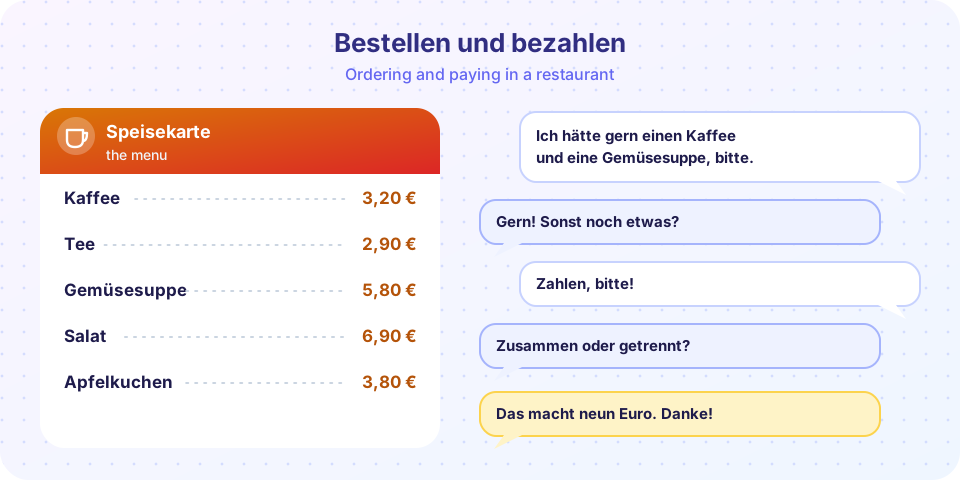
Caption: The ordering conversation in one picture: ich hätte gern, sonst noch etwas, zahlen bitte, das macht.
A typical visit has a clear script. Learn the phrases for each step.
Step
German
Meaning
Arriving
Haben Sie einen Tisch für zwei Personen?
Do you have a table for two?
Ich habe einen Tisch reserviert.
I have reserved a table.
Asking
Die Speisekarte, bitte.
The menu, please.
Was können Sie empfehlen?
What do you recommend?
Drinks
Was möchten Sie trinken?
What would you like to drink?
Ordering
Ich hätte gern ... / Ich möchte ... / Ich nehme ...
I would like ... / I will have ...
Für mich bitte ...
For me, please ...
Diet
Ich bin Vegetarier / Vegetarierin.
I am vegetarian.
Ist das vegetarisch?
Is that vegetarian?
Ich bin allergisch gegen Nüsse.
I am allergic to nuts.
Eating
Guten Appetit!
Enjoy your meal!
Paying
Zahlen, bitte! / Die Rechnung, bitte.
The bill, please.
Zusammen oder getrennt?
Together or separately?
Ich hätte gern ... literally means "I would have gladly ...". It is a polite fixed phrase that you can use for any order. Hätte is a subjunctive form that you do not need to analyze yet.
The menu has sections: die Vorspeise (starter), das Hauptgericht (main course), der Nachtisch or die Nachspeise (dessert), die Getränke (drinks). A Tagesgericht is the dish of the day. When the waiter asks Haben Sie schon gewählt? (Have you chosen already?), you can answer Ja, ich nehme ....
For water you can specify: Wasser mit Kohlensäure (sparkling), stilles Wasser or Wasser ohne Kohlensäure (still). In many restaurants the default water is the bottled kind and it costs money; tap water (Leitungswasser) is safe to drink but may need to be requested.
Quantities stand directly before the noun, with no of: ein Kilo Äpfel, ein Liter Milch, zwei Flaschen Wasser, eine Packung Nudeln, ein Stück Kuchen, 200 Gramm Käse. After a measure the plural noun usually keeps its plural form (zwei Kilo Kartoffeln), but masculine and neuter units often have no plural ending: zwei Kilo, drei Glas Wasser, though Flaschen and Packungen do take -n.
A comma separates euros and cents: 4,50 € is vier Euro fünfzig; 0,99 € is neunundneunzig Cent. A dot marks thousands: 1.250 €.
Two cultural notes. First, cash is still common, and some small shops or restaurants accept only cash (nur Barzahlung), so it helps to carry some. Second, many drink bottles and cans in Germany carry a deposit (Pfand), often 25 cents for single-use ones, which you get back at a machine in the supermarket.
Service is included in the price in German-speaking countries, so a tip is a thank-you, not a duty. A common custom is to round up or add about 5 to 10 percent, and to say the total when you pay instead of leaving coins on the table: the waiter says Das macht 27,40 Euro. and you say Machen Sie 30. (Make it 30.) Or you say Stimmt so. (Keep the change.)
Gast:Nein, aber haben Sie einen Tisch für zwei Personen?
Kellner:Ja, bitte hier entlang. Was möchten Sie trinken?
Gast:Ein Wasser und einen Apfelsaft, bitte.
Kellner:Möchten Sie schon bestellen?
Gast:Ja, ich nehme die Gemüsesuppe, und meine Freundin hätte gern den Salat.
Kellner:Gern. Guten Appetit!
(Später)
Gast:Zahlen, bitte!
Kellner:Zusammen oder getrennt?
Gast:Zusammen. Machen Sie 30.
Kellner:Vielen Dank!
English: Waiter: Good evening! Do you have a reservation? Guest: No, but do you have a table for two? Waiter: Yes, please this way. What would you like to drink? Guest: A water and an apple juice, please. Waiter: Would you like to order already? Guest: Yes, I will have the vegetable soup, and my friend would like the salad. Waiter: Gladly. Enjoy your meal! (Later) Guest: The bill, please! Waiter: Together or separately? Guest: Together. Make it 30. Waiter: Thank you very much!
Kunde:Guten Morgen. Ich hätte gern vier Brötchen und ein Vollkornbrot.
Verkäuferin:Sonst noch etwas?
Kunde:Ja, zwei Stück Apfelkuchen, bitte.
Verkäuferin:Das macht 7,60 Euro.
Kunde:Kann ich mit Karte zahlen?
Verkäuferin:Ja, natürlich. Einen schönen Tag noch!
Kunde:Danke, Ihnen auch! Tschüss!
English: Shop assistant: Good morning! What can I get you? Customer: Good morning. I would like four rolls and a wholemeal loaf. Assistant: Anything else? Customer: Yes, two pieces of apple cake, please. Assistant: That comes to 7.60 euros. Customer: Can I pay by card? Assistant: Yes, of course. Have a nice day! Customer: Thank you, you too! Bye!
This simulator builds your German order and the total in words. Tick the items you want, read the sentence aloud and check the price.
Order simulator
<style>:root{--ink:#1e1b4b;--mut:#475569;--bd:#c7d2fe}*{box-sizing:border-box}body{margin:0;padding:14px;font-family:system-ui,-apple-system,'Segoe UI',sans-serif;color:var(--ink);background:linear-gradient(135deg,#fffbeb,#fef2f2)}.card{background:#fff;border-radius:18px;box-shadow:0 8px 22px rgba(220,38,38,.12);padding:16px}.item{display:flex;align-items:center;gap:10px;padding:8px 10px;border-radius:12px;border:2px solid #fde68a;margin:6px 0;cursor:pointer;background:#fffbeb}.item.on{background:#fef3c7;border-color:#d97706}.item input{width:18px;height:18px;accent-color:#d97706}.item .p{margin-left:auto;font-weight:700;color:#92400e}.say{background:#eef2ff;border-radius:14px;padding:12px;margin-top:12px;font-size:1.1rem;font-weight:600}.tot{background:#fce7f3;border-radius:14px;padding:12px;margin-top:8px;font-size:1.05rem}.mut{color:var(--mut);font-size:.9rem}</style><divclass="card"><divclass="mut">Speisekarte: tick the items you want to order.</div><divid="menu"></div><divclass="say"id="say"></div><divclass="tot"id="tot"></div></div><script>varU=["null","ein","zwei","drei","vier","fünf","sechs","sieben","acht","neun","zehn","elf","zwölf","dreizehn","vierzehn","fünfzehn","sechzehn","siebzehn","achtzehn","neunzehn"];varT=["","","zwanzig","dreißig","vierzig","fünfzig","sechzig","siebzig","achtzig","neunzig"];functionnum(n){if(n<20)returnU[n];var t=Math.floor(n/10),u=n%10;return u===0?T[t]:(u===1?"ein":U[u])+"und"+T[t];}varITEMS=[{n:"Kaffee",a:"einen Kaffee",p:320},{n:"Tee",a:"einen Tee",p:290},{n:"Wasser",a:"ein Wasser",p:250},{n:"Apfelsaft",a:"einen Apfelsaft",p:300},{n:"Gemüsesuppe",a:"eine Gemüsesuppe",p:580},{n:"Salat",a:"einen Salat",p:690},{n:"Nudeln",a:"Nudeln",p:790},{n:"Apfelkuchen",a:"ein Stück Apfelkuchen",p:380}];var on={};functionmoney(c){return(c/100).toFixed(2).replace('.',',');}var menu=document.getElementById('menu');ITEMS.forEach(function(it,k){var d=document.createElement('label');d.className='item';var cb=document.createElement('input');cb.type='checkbox';
cb.onchange=function(){on[k]=cb.checked;d.className='item'+(cb.checked?' on':'');draw();};var s=document.createElement('span');s.textContent=it.n;var p=document.createElement('span');p.className='p';p.textContent=money(it.p)+' €';
d.appendChild(cb);d.appendChild(s);d.appendChild(p);menu.appendChild(d);});functiondraw(){var sel=[],sum=0;ITEMS.forEach(function(it,k){if(on[k]){sel.push(it.a);sum+=it.p;}});var say=document.getElementById('say'),tot=document.getElementById('tot');if(!sel.length){say.textContent='Wähle etwas von der Speisekarte.';tot.textContent='';return;}var list=sel.length===1?sel[0]:sel.slice(0,-1).join(', ')+' und '+sel[sel.length-1];
say.textContent='Ich hätte gern '+list+', bitte.';var eur=Math.floor(sum/100),ct=sum%100;
tot.textContent='Das macht '+money(sum)+' Euro: '+num(eur)+' Euro'+(ct?' '+num(ct):'')+'.';}draw();</script>
Put the words in order.
Order and pay
<style>:root{--ink:#1e1b4b;--mut:#475569;--acc:#6366f1;--bd:#c7d2fe}*{box-sizing:border-box}body{margin:0;padding:14px;font-family:system-ui,-apple-system,'Segoe UI',sans-serif;color:var(--ink);background:linear-gradient(135deg,#faf5ff,#eff6ff)}.card{background:#fff;border-radius:18px;box-shadow:0 8px 22px rgba(67,56,202,.15);padding:16px}button{font:inherit;cursor:pointer;border:0;border-radius:999px;padding:8px 14px;background:linear-gradient(135deg,#6366f1,#8b5cf6);color:#fff;font-weight:600}button.alt{background:#eef2ff;color:#3730a3}button:disabled{opacity:.5;cursor:default}.row{display:flex;gap:8px;flex-wrap:wrap;align-items:center;margin-top:10px}.mut{color:var(--mut);font-size:.9rem}</style><style>.tgt{min-height:54px;border:2px dashed var(--bd);border-radius:14px;padding:8px;display:flex;gap:6px;flex-wrap:wrap;align-items:center;background:#fff}.w{background:#eef2ff;color:#3730a3;border:2px solid var(--bd);border-radius:12px;padding:6px 12px;font-weight:600;cursor:pointer}.w.used{opacity:.3;cursor:default}.t{background:linear-gradient(135deg,#6366f1,#8b5cf6);color:#fff;border-radius:12px;padding:6px 12px;font-weight:600}.en{font-size:1.1rem;font-weight:600;margin-bottom:10px}.fb{min-height:1.6em;margin-top:8px}</style><divclass="card"><divclass="mut"id="prog"></div><divclass="en"id="en"></div><divclass="tgt"id="tgt"aria-live="polite"></div><divclass="row"id="bank"style="margin-top:12px"></div><divclass="fb"id="fb"></div><divclass="row"><buttonid="chk">Check</button><buttonclass="alt"id="clr">Clear</button><buttonclass="alt"id="nx">Next</button><spanclass="mut"id="sc"></span></div></div><script>var items=[{"en":"I would like a coffee.","words":["Ich","hätte","gern","einen","Kaffee"],"ok":["Ich hätte gern einen Kaffee"]},{"en":"The menu, please.","words":["Die","Speisekarte","bitte"],"ok":["Die Speisekarte bitte"]},{"en":"Do you have a table for two?","words":["Haben","Sie","einen","Tisch","für","zwei","Personen"],"ok":["Haben Sie einen Tisch für zwei Personen"]},{"en":"Together or separately?","words":["Zusammen","oder","getrennt"],"ok":["Zusammen oder getrennt"]},{"en":"Can I pay by card?","words":["Kann","ich","mit","Karte","zahlen"],"ok":["Kann ich mit Karte zahlen"]},{"en":"That comes to 7.60 euros.","words":["Das","macht","sieben","Euro","sechzig"],"ok":["Das macht sieben Euro sechzig"]}];var i=0,score=0,picked=[],solved=false;functionnorm(s){return s.toLowerCase().replace(/[.,?!]/g,'').replace(/s+/g,' ').trim();}functionshuffle(a){a=a.slice();for(var k=a.length-1;k>0;k--){var r=Math.floor(Math.random()*(k+1));var t=a[k];a[k]=a[r];a[r]=t;}return a;}functionrender(){var it=items[i];
document.getElementById('prog').textContent='Sentence '+(i+1)+' of '+items.length;
document.getElementById('en').textContent=it.en;var tg=document.getElementById('tgt');tg.innerHTML='';
picked.forEach(function(k){var s=document.createElement('span');s.className='t';s.textContent=it.shuf[k];tg.appendChild(s);});var bank=document.getElementById('bank');bank.innerHTML='';
it.shuf.forEach(function(w,k){var b=document.createElement('button');b.className='w'+(picked.indexOf(k)>=0?' used':'');b.textContent=w;
b.onclick=function(){if(solved||picked.indexOf(k)>=0)return;picked.push(k);render();};
bank.appendChild(b);});}functionload(){var it=items[i];it.shuf=shuffle(it.words);picked=[];solved=false;document.getElementById('fb').textContent='';render();}
document.getElementById('clr').onclick=function(){picked=[];solved=false;document.getElementById('fb').textContent='';render();};
document.getElementById('chk').onclick=function(){if(solved)return;var it=items[i];var s=norm(picked.map(function(k){return it.shuf[k];}).join(' '));var good=it.ok.some(function(o){returnnorm(o)===s;});if(good){solved=true;score++;document.getElementById('fb').textContent='Correct! '+it.ok[0]+'.';}else{document.getElementById('fb').textContent='Not quite. Check the verb position and try again.';}
document.getElementById('sc').textContent='Score: '+score;};
document.getElementById('nx').onclick=function(){i=(i+1)%items.length;load();};load();</script>
Fill in the gaps.
Order and shop: fill the gaps
<style>:root{--ink:#1e1b4b;--mut:#475569;--acc:#6366f1;--bd:#c7d2fe}*{box-sizing:border-box}body{margin:0;padding:14px;font-family:system-ui,-apple-system,'Segoe UI',sans-serif;color:var(--ink);background:linear-gradient(135deg,#faf5ff,#eff6ff)}.card{background:#fff;border-radius:18px;box-shadow:0 8px 22px rgba(67,56,202,.15);padding:16px}button{font:inherit;cursor:pointer;border:0;border-radius:999px;padding:8px 14px;background:linear-gradient(135deg,#6366f1,#8b5cf6);color:#fff;font-weight:600}button.alt{background:#eef2ff;color:#3730a3}button:disabled{opacity:.5;cursor:default}.row{display:flex;gap:8px;flex-wrap:wrap;align-items:center;margin-top:10px}.mut{color:var(--mut);font-size:.9rem}</style><style>.q{display:flex;gap:8px;align-items:center;flex-wrap:wrap;padding:8px 0;border-bottom:1px solid #eef2ff;font-size:1.05rem}input{font:inherit;padding:6px 10px;border:2px solid var(--bd);border-radius:10px;width:9em}input.ok{border-color:#10b981;background:#ecfdf5}input.no{border-color:#ef4444;background:#fef2f2}.h{font-size:.85rem;color:var(--mut)}</style><divclass="card"><divid="list"></div><divclass="row"><buttonid="chk">Check answers</button><buttonclass="alt"id="rev">Show answers</button><spanid="score"class="mut"></span></div><divclass="mut"style="margin-top:8px">Capitals do not matter. Type ä ö ü ß, or use ae oe ue ss.</div></div><script>var items=[{"s":"Ich ___ gern einen Tee.","a":"hätte"},{"s":"Ich möchte ___ Kaffee.","a":"einen","h":"der Kaffee"},{"s":"Ich möchte ___ Suppe.","a":"eine","h":"die Suppe"},{"s":"Ich möchte ___ Wasser.","a":"ein","h":"das Wasser"},{"s":"___, bitte! (I want to pay)","a":"Zahlen"},{"s":"___ oder getrennt?","a":"Zusammen"},{"s":"Guten ___!","a":"Appetit"},{"s":"Das ___ 7,60 Euro.","a":"macht"},{"s":"Sonst noch ___?","a":"etwas"},{"s":"Ein ___ Äpfel, bitte. (1 kg)","a":"Kilo"}];functionnorm(s){return s.toLowerCase().trim().replace(/\s+/g,' ').replace(/ae/g,'ä').replace(/oe/g,'ö').replace(/ue/g,'ü').replace(/ss/g,'ß');}functionnormAns(s){returnnorm(s).replace(/ß/g,'ß');}var list=document.getElementById('list');
items.forEach(function(it,n){var d=document.createElement('div');d.className='q';var parts=it.s.split('___');
d.appendChild(document.createTextNode(parts[0]));var inp=document.createElement('input');inp.id='i'+n;inp.setAttribute('aria-label','Answer '+(n+1));d.appendChild(inp);
d.appendChild(document.createTextNode(parts[1]||''));if(it.h){var h=document.createElement('span');h.className='h';h.textContent='('+it.h+')';d.appendChild(h);}
list.appendChild(d);});functionok(it,v){var arr=Array.isArray(it.a)?it.a:[it.a];var x=normAns(v);return arr.some(function(a){returnnormAns(a)===x;});}
document.getElementById('chk').onclick=function(){var right=0;
items.forEach(function(it,n){var e=document.getElementById('i'+n);var g=ok(it,e.value);e.className=g?'ok':'no';if(g)right++;});
document.getElementById('score').textContent=right+' of '+items.length+' correct';};
document.getElementById('rev').onclick=function(){
items.forEach(function(it,n){var e=document.getElementById('i'+n);e.value=Array.isArray(it.a)?it.a[0]:it.a;e.className='ok';});};</script>
And a deck of the key phrases.
Restaurant and shop phrases
<style>:root{--ink:#1e1b4b;--mut:#475569;--acc:#6366f1;--bd:#c7d2fe}*{box-sizing:border-box}body{margin:0;padding:14px;font-family:system-ui,-apple-system,'Segoe UI',sans-serif;color:var(--ink);background:linear-gradient(135deg,#faf5ff,#eff6ff)}.card{background:#fff;border-radius:18px;box-shadow:0 8px 22px rgba(67,56,202,.15);padding:16px}button{font:inherit;cursor:pointer;border:0;border-radius:999px;padding:8px 14px;background:linear-gradient(135deg,#6366f1,#8b5cf6);color:#fff;font-weight:600}button.alt{background:#eef2ff;color:#3730a3}button:disabled{opacity:.5;cursor:default}.row{display:flex;gap:8px;flex-wrap:wrap;align-items:center;margin-top:10px}.mut{color:var(--mut);font-size:.9rem}</style><style>.fc{height:150px;display:flex;align-items:center;justify-content:center;text-align:center;font-size:1.5rem;font-weight:700;border-radius:18px;cursor:pointer;padding:12px;user-select:none}.front{background:linear-gradient(135deg,#6366f1,#8b5cf6);color:#fff}.back{background:#fff;color:var(--ink);border:2px solid var(--bd)}</style><divclass="card"><divid="fc"class="fc front"tabindex="0"role="button"aria-label="Flash card, press to flip"></div><divclass="mut"id="cnt"style="margin-top:8px"></div><divclass="row"><buttonclass="alt"id="prev">Back</button><buttonid="flip">Flip</button><buttonclass="alt"id="next">Next</button><buttonclass="alt"id="shuf">Shuffle</button><buttonclass="alt"id="say">Listen</button></div><divclass="mut"id="note"style="margin-top:8px">Click the card to flip it. Listen uses your browser's voice if it is available.</div></div><script>var cards=[["Ich hätte gern ...","I would like ..."],["Die Speisekarte, bitte.","The menu, please."],["Zahlen, bitte!","The bill, please!"],["Zusammen oder getrennt?","Together or separately?"],["Stimmt so.","Keep the change."],["Guten Appetit!","Enjoy your meal!"],["Prost! / Zum Wohl!","Cheers!"],["Sonst noch etwas?","Anything else?"],["Das ist alles.","That is all."],["Was darf es sein?","What can I get you?"],["Kann ich mit Karte zahlen?","Can I pay by card?"],["das Brötchen","bread roll"],["die Rechnung","the bill"]];var i=0,showBack=false;var fc=document.getElementById('fc');functiondraw(){var c=cards[i];fc.textContent=showBack?c[1]:c[0];fc.className='fc '+(showBack?'back':'front');document.getElementById('cnt').textContent='Card '+(i+1)+' of '+cards.length;}functionflip(){showBack=!showBack;draw();}
fc.onclick=flip;fc.onkeydown=function(e){if(e.key==='Enter'||e.key===' '){e.preventDefault();flip();}};
document.getElementById('flip').onclick=flip;
document.getElementById('next').onclick=function(){i=(i+1)%cards.length;showBack=false;draw();};
document.getElementById('prev').onclick=function(){i=(i-1+cards.length)%cards.length;showBack=false;draw();};
document.getElementById('shuf').onclick=function(){for(var k=cards.length-1;k>0;k--){var r=Math.floor(Math.random()*(k+1));var t=cards[k];cards[k]=cards[r];cards[r]=t;}i=0;showBack=false;draw();};
document.getElementById('say').onclick=function(){try{var u=newSpeechSynthesisUtterance(cards[i][0]);u.lang='de-DE';window.speechSynthesis.cancel();window.speechSynthesis.speak(u);}catch(e){document.getElementById('note').textContent='Speech is not available in this preview.';}};draw();</script>