Learn the German Perfekt with haben: how to form the past participle of regular, irregular, separable and inseparable verbs, with word order and examples.
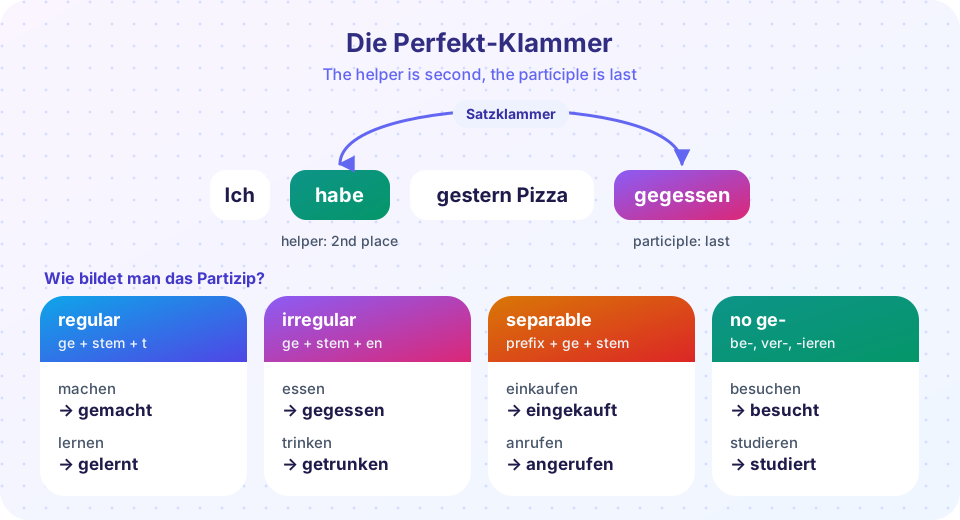
Was hast du gestern gemacht? (What did you do yesterday?) You will hear this question constantly, and the answer almost always uses the Perfekt: Ich habe gearbeitet. Ich habe Freunde getroffen. Ich habe Pizza gegessen. The Perfekt is built from two pieces, a form of the helping verb haben in second place and the past participle at the end of the clause.
This lesson covers the large majority of German verbs, the ones that take haben. You will learn how to build participles for regular verbs, for irregular verbs, for separable verbs and for verbs that take no ge- at all. The next lesson adds the verbs that take sein.
Caption: The Perfekt is a bracket: haben in second place, the participle at the end, and four recipes for making participles.
The helping verb haben is conjugated in the present tense and takes the usual verb-second position. The participle jumps to the end:
Person
haben
Example
ich
habe
Ich habe Kaffee getrunken.
du
hast
Du hast gut gespielt.
er/sie/es
hat
Sie hat ein Buch gelesen.
wir
haben
Wir haben Fußball gespielt.
ihr
habt
Ihr habt viel gearbeitet.
sie/Sie
haben
Sie haben den Film gesehen.
If something else comes first, such as a time word, the subject follows the verb: Gestern habe ich Pizza gegessen. The helping verb is still in second place, and the participle is still last.
The participle carries the meaning and haben only marks the tense. That is why the participle must be right.
Most verbs are regular. Remove -en, add ge- in front and -t at the end:
Infinitive
Participle
Example
machen
gemacht
Ich habe Hausaufgaben gemacht.
lernen
gelernt
Wir haben Deutsch gelernt.
kaufen
gekauft
Er hat ein Auto gekauft.
spielen
gespielt
Sie haben Karten gespielt.
wohnen
gewohnt
Ich habe in Wien gewohnt.
kochen
gekocht
Er hat Suppe gekocht.
hören
gehört
Ich habe Musik gehört.
sagen
gesagt
Was hat sie gesagt?
If the stem ends in -t or -d (or in a hard-to-pronounce cluster such as -chn or -ffn), insert an e before the -t: arbeiten → gearbeitet, warten → gewartet, baden → gebadet, öffnen → geöffnet. This is only to make the word pronounceable.
Strong verbs change their stem vowel (and sometimes more) and end in -en. You must learn these by heart, in the same way you learn English "eat, ate, eaten":
Infinitive
Participle
Meaning
essen
gegessen
eat
trinken
getrunken
drink
sehen
gesehen
see
lesen
gelesen
read
schreiben
geschrieben
write
nehmen
genommen
take
geben
gegeben
give
finden
gefunden
find
singen
gesungen
sing
schlafen
geschlafen
sleep
sprechen
gesprochen
speak
helfen
geholfen
help
treffen
getroffen
meet
Some verbs are mixed: they change the vowel like strong verbs, but they end in -t like regular ones. The important ones are bringen → gebracht, denken → gedacht, kennen → gekannt, nennen → genannt, wissen → gewusst. And haben itself: gehabt (Ich habe Glück gehabt. I was lucky).
Learn irregular verbs as families: trinken – getrunken, singen – gesungen, finden – gefunden share the same pattern. Your memory loves patterns.
Read this little story about a Saturday. Every verb takes haben, and every participle stands at the end of its clause. Find the regular, irregular and separable participles.
Am Samstag habe ich lange geschlafen. Dann habe ich Kaffee gekocht und die Zeitung gelesen. Mittags haben wir bei meiner Oma gegessen, und sie hat einen Kuchen gebacken. Am Abend habe ich meine Freundin angerufen, und wir haben zwei Stunden gesprochen.
Translation: On Saturday I slept for a long time. Then I made coffee and read the newspaper. At noon we ate at my grandmother's, and she baked a cake. In the evening I phoned my girlfriend, and we talked for two hours.
Notice that the helping verb haben is repeated in each clause, while und joins two participles that share a helper: Ich habe Kaffee gekocht und die Zeitung gelesen. Notice also how the time words (am Samstag, dann, mittags, am Abend) keep the story moving, and how an inverted subject (Mittags haben wir ...) does not change the position of the participle.
The conjugator builds participles with the rules above and uses a short list for the irregular ones. Add your own verbs and see which rule applies.
Python
Participle builder
IRREGULAR ={"essen":"gegessen","trinken":"getrunken","sehen":"gesehen","lesen":"gelesen","schreiben":"geschrieben","nehmen":"genommen","geben":"gegeben","finden":"gefunden","singen":"gesungen","schlafen":"geschlafen","sprechen":"gesprochen","helfen":"geholfen","treffen":"getroffen","bringen":"gebracht","denken":"gedacht","wissen":"gewusst","kennen":"gekannt","haben":"gehabt","rufen":"gerufen","backen":"gebacken","verstehen":"verstanden","vergessen":"vergessen","bekommen":"bekommen","gefallen":"gefallen","beginnen":"begonnen","gewinnen":"gewonnen",# these take sein (next lesson), listed so the builder does not guess wrongly"gehen":"gegangen","kommen":"gekommen","fahren":"gefahren","stehen":"gestanden",}
SEPARABLE =sorted(["auf","an","ein","mit","fern","ab","aus","vor","zurück","weg"],
key=len, reverse=True)
INSEPARABLE =("be","ge","er","ver","zer","ent","emp","miss")
HABEN ={"ich":"habe","du":"hast","er/sie/es":"hat","wir":"haben","ihr":"habt","sie/Sie":"haben"}defparticiple(verb):if verb in IRREGULAR:return IRREGULAR[verb]for prefix in SEPARABLE:if verb.startswith(prefix)andlen(verb)>len(prefix)+3:return prefix + participle(verb[len(prefix):])
stem = verb[:-2]if verb.endswith("ieren")or verb.startswith(INSEPARABLE):return stem +"t"# no ge-if stem[-1]in"dt"or stem.endswith(("chn","ffn","gn")):return"ge"+ stem +"et"# arbeiten -> gearbeitetreturn"ge"+ stem +"t"defperfekt(pronoun, verb, middle=""):
parts =[pronoun.capitalize(), HABEN[pronoun], middle, participle(verb)]return" ".join(p for p in parts if p)+"."for verb in["machen","lernen","arbeiten","essen","einkaufen","anrufen","fernsehen","besuchen","verstehen","studieren","telefonieren","öffnen"]:print(f"{verb:14} -> {participle(verb)}")print()for pronoun, verb, middle in[("ich","trinken","gestern Kaffee"),("du","lernen","viel"),("er/sie/es","einkaufen","im Supermarkt"),("wir","besuchen","unsere Oma"),("ihr","sehen","den Film"),("sie/Sie","telefonieren","lange")]:print(perfekt(pronoun, verb, middle))
Press Run (or Ctrl + Enter) to see the result here.
Program input · what you'd type while the program runs
Type the answers before you press Run, one per line. Each time the program reads a line (with input()), it gets the next line from this box.
Fill in the helping verb or the participle.
Helping verb and participle
<style>:root{--ink:#1e1b4b;--mut:#475569;--acc:#6366f1;--bd:#c7d2fe}*{box-sizing:border-box}body{margin:0;padding:14px;font-family:system-ui,-apple-system,'Segoe UI',sans-serif;color:var(--ink);background:linear-gradient(135deg,#faf5ff,#eff6ff)}.card{background:#fff;border-radius:18px;box-shadow:0 8px 22px rgba(67,56,202,.15);padding:16px}button{font:inherit;cursor:pointer;border:0;border-radius:999px;padding:8px 14px;background:linear-gradient(135deg,#6366f1,#8b5cf6);color:#fff;font-weight:600}button.alt{background:#eef2ff;color:#3730a3}button:disabled{opacity:.5;cursor:default}.row{display:flex;gap:8px;flex-wrap:wrap;align-items:center;margin-top:10px}.mut{color:var(--mut);font-size:.9rem}</style><style>.q{display:flex;gap:8px;align-items:center;flex-wrap:wrap;padding:8px 0;border-bottom:1px solid #eef2ff;font-size:1.05rem}input{font:inherit;padding:6px 10px;border:2px solid var(--bd);border-radius:10px;width:9em}input.ok{border-color:#10b981;background:#ecfdf5}input.no{border-color:#ef4444;background:#fef2f2}.h{font-size:.85rem;color:var(--mut)}</style><divclass="card"><divid="list"></div><divclass="row"><buttonid="chk">Check answers</button><buttonclass="alt"id="rev">Show answers</button><spanid="score"class="mut"></span></div><divclass="mut"style="margin-top:8px">Capitals do not matter. Type ä ö ü ß, or use ae oe ue ss.</div></div><script>var items=[{"s":"Ich ___ gestern Pizza gegessen.","a":"habe"},{"s":"Du ___ gut gearbeitet.","a":"hast"},{"s":"Ihr ___ viel gegessen.","a":"habt"},{"s":"Er hat ein Buch ___.","a":"gelesen","h":"lesen"},{"s":"Wir haben Fußball ___.","a":"gespielt","h":"spielen"},{"s":"Sie hat ihre Oma ___.","a":"angerufen","h":"anrufen"},{"s":"Ich habe das Zimmer ___.","a":"aufgeräumt","h":"aufräumen"},{"s":"Hast du Deutsch ___?","a":"gelernt","h":"lernen"},{"s":"Wir haben im Supermarkt ___.","a":"eingekauft","h":"einkaufen"},{"s":"Er hat den Film ___.","a":"verstanden","h":"verstehen"},{"s":"Sie haben Kaffee ___.","a":"getrunken","h":"trinken"},{"s":"Ich habe meinen Freund ___.","a":"besucht","h":"besuchen"}];functionnorm(s){return s.toLowerCase().trim().replace(/\s+/g,' ').replace(/ae/g,'ä').replace(/oe/g,'ö').replace(/ue/g,'ü').replace(/ss/g,'ß');}functionnormAns(s){returnnorm(s).replace(/ß/g,'ß');}var list=document.getElementById('list');
items.forEach(function(it,n){var d=document.createElement('div');d.className='q';var parts=it.s.split('___');
d.appendChild(document.createTextNode(parts[0]));var inp=document.createElement('input');inp.id='i'+n;inp.setAttribute('aria-label','Answer '+(n+1));d.appendChild(inp);
d.appendChild(document.createTextNode(parts[1]||''));if(it.h){var h=document.createElement('span');h.className='h';h.textContent='('+it.h+')';d.appendChild(h);}
list.appendChild(d);});functionok(it,v){var arr=Array.isArray(it.a)?it.a:[it.a];var x=normAns(v);return arr.some(function(a){returnnormAns(a)===x;});}
document.getElementById('chk').onclick=function(){var right=0;
items.forEach(function(it,n){var e=document.getElementById('i'+n);var g=ok(it,e.value);e.className=g?'ok':'no';if(g)right++;});
document.getElementById('score').textContent=right+' of '+items.length+' correct';};
document.getElementById('rev').onclick=function(){
items.forEach(function(it,n){var e=document.getElementById('i'+n);e.value=Array.isArray(it.a)?it.a[0]:it.a;e.className='ok';});};</script>
Finally, drill the strong verbs you need most.
Irregular participles
<style>:root{--ink:#1e1b4b;--mut:#475569;--acc:#6366f1;--bd:#c7d2fe}*{box-sizing:border-box}body{margin:0;padding:14px;font-family:system-ui,-apple-system,'Segoe UI',sans-serif;color:var(--ink);background:linear-gradient(135deg,#faf5ff,#eff6ff)}.card{background:#fff;border-radius:18px;box-shadow:0 8px 22px rgba(67,56,202,.15);padding:16px}button{font:inherit;cursor:pointer;border:0;border-radius:999px;padding:8px 14px;background:linear-gradient(135deg,#6366f1,#8b5cf6);color:#fff;font-weight:600}button.alt{background:#eef2ff;color:#3730a3}button:disabled{opacity:.5;cursor:default}.row{display:flex;gap:8px;flex-wrap:wrap;align-items:center;margin-top:10px}.mut{color:var(--mut);font-size:.9rem}</style><style>.fc{height:150px;display:flex;align-items:center;justify-content:center;text-align:center;font-size:1.5rem;font-weight:700;border-radius:18px;cursor:pointer;padding:12px;user-select:none}.front{background:linear-gradient(135deg,#6366f1,#8b5cf6);color:#fff}.back{background:#fff;color:var(--ink);border:2px solid var(--bd)}</style><divclass="card"><divid="fc"class="fc front"tabindex="0"role="button"aria-label="Flash card, press to flip"></div><divclass="mut"id="cnt"style="margin-top:8px"></div><divclass="row"><buttonclass="alt"id="prev">Back</button><buttonid="flip">Flip</button><buttonclass="alt"id="next">Next</button><buttonclass="alt"id="shuf">Shuffle</button><buttonclass="alt"id="say">Listen</button></div><divclass="mut"id="note"style="margin-top:8px">Click the card to flip it. Listen uses your browser's voice if it is available.</div></div><script>var cards=[["essen","gegessen (eaten)"],["trinken","getrunken (drunk)"],["sehen","gesehen (seen)"],["lesen","gelesen (read)"],["schreiben","geschrieben (written)"],["nehmen","genommen (taken)"],["geben","gegeben (given)"],["finden","gefunden (found)"],["sprechen","gesprochen (spoken)"],["helfen","geholfen (helped)"],["treffen","getroffen (met)"],["bringen","gebracht (brought)"],["denken","gedacht (thought)"],["wissen","gewusst (known)"],["schlafen","geschlafen (slept)"]];var i=0,showBack=false;var fc=document.getElementById('fc');functiondraw(){var c=cards[i];fc.textContent=showBack?c[1]:c[0];fc.className='fc '+(showBack?'back':'front');document.getElementById('cnt').textContent='Card '+(i+1)+' of '+cards.length;}functionflip(){showBack=!showBack;draw();}
fc.onclick=flip;fc.onkeydown=function(e){if(e.key==='Enter'||e.key===' '){e.preventDefault();flip();}};
document.getElementById('flip').onclick=flip;
document.getElementById('next').onclick=function(){i=(i+1)%cards.length;showBack=false;draw();};
document.getElementById('prev').onclick=function(){i=(i-1+cards.length)%cards.length;showBack=false;draw();};
document.getElementById('shuf').onclick=function(){for(var k=cards.length-1;k>0;k--){var r=Math.floor(Math.random()*(k+1));var t=cards[k];cards[k]=cards[r];cards[r]=t;}i=0;showBack=false;draw();};
document.getElementById('say').onclick=function(){try{var u=newSpeechSynthesisUtterance(cards[i][0]);u.lang='de-DE';window.speechSynthesis.cancel();window.speechSynthesis.speak(u);}catch(e){document.getElementById('note').textContent='Speech is not available in this preview.';}};draw();</script>