


















Lesson 3 of 50 · Getting Started
The alphabet and your first words
Learn the German alphabet with letter names, the umlauts ä ö ü, the letter ß, capitalization rules and a first set of useful words and phrases.
German uses the same Latin alphabet as English, plus four extra symbols. That is a gift: you can already read German aloud, badly at first, and fix the sounds step by step in chapter 2. In this lesson you will meet the letters and their German names (you need them to spell your name on the phone), the three umlauts, the curious letter ß, the capitalization rule that surprises everyone, and your first twenty words.
What you will learn
- the 26 letters plus ä, ö, ü and ß, and what their German names are
- how to spell a name aloud (buchstabieren)
- when to use ß and when ss, and how to type umlauts without a German keyboard
- the capitalization rule for nouns
- twenty first words and phrases
Key terms
Umlaut: the two dots over a, o or u (ä, ö, ü). They change the sound and often the meaning. Eszett (ß): a letter for a long "s" sound after long vowels and diphthongs; also called "scharfes S". Buchstabieren: spelling a word aloud, letter by letter. Substantiv: a noun. German writes every noun with a capital letter.
The letters and their names
German has the 26 letters you know from English. Their names, however, are different, and you will hear them whenever someone spells an email address or a surname. The respelling below shows the sound in English-friendly letters; "ay" means the vowel of "day", "eh" as in "bed".
| Letter | Name | Letter | Name | Letter | Name |
|---|---|---|---|---|---|
| A | ah | J | yot | S | ess |
| B | beh | K | kah | T | teh |
| C | tseh | L | ell | U | oo |
| D | deh | M | emm | V | fow |
| E | eh | N | enn | W | veh |
| F | eff | O | oh | X | iks |
| G | geh | P | peh | Y | ÜP-si-lon |
| H | hah | Q | koo | Z | tset |
| I | ee | R | err |
Notice the patterns: many consonants are "consonant + eh" (beh, deh, geh, peh, teh), exactly the way English says "bee, dee, gee, pee, tee" with a different vowel. Three names are trickier: W is "veh" (the German W sounds like English V), V is "fow" (like "fau", the German V often sounds like English F), and J is "yot". The letter Y is called "Üpsilon" and is rare in native German words.
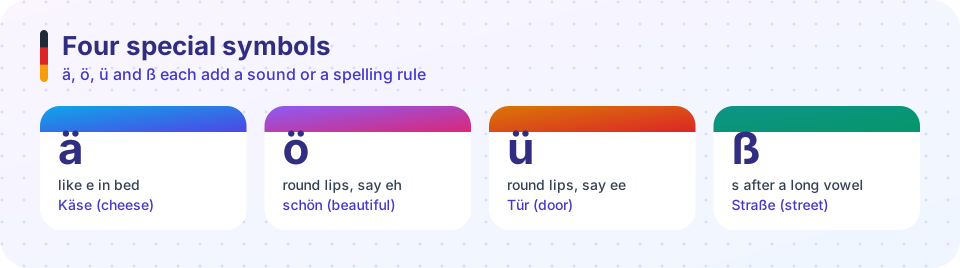
The four extra symbols are ä (like "eh"), ö (no English equivalent, round your lips as for "oh" and say "eh"), ü (round your lips as for "oo" and say "ee"), and ß ("ess-tset"). You will practice the real sounds in chapter 2; for now, simply recognize them as separate letters.
Spelling aloud
When you give your name at a hotel desk or over the phone, you say it letter by letter. Here is a short dialogue.
A: Wie heißen Sie? (VEE HY-sen zee) — What is your name? B: Ich heiße Müller. (ikh HY-seh MÜ-ler) — My name is Müller. A: Wie schreibt man das? (vee shrypt man dass) — How do you spell that? B: Em, Ü, Ell, Ell, E, Err. — M, Ü, L, L, E, R.
On the phone, many Germans use a spelling alphabet of first names ("A wie Anton, B wie Berta, C wie Cäsar"). This traditional list is widely known (newer standards use city names, but the old one is still what people say), so it is worth recognizing: Anton, Berta, Cäsar, Dora, Emil, Friedrich, Gustav, Heinrich, Ida, Julius, Kaufmann, Ludwig, Martha, Nordpol, Otto, Paula, Quelle, Richard, Samuel, Theodor, Ulrich, Viktor, Wilhelm, Xanthippe, Ypsilon, Zacharias. Do not memorize them now. Just know that "M wie Martha" means "M as in Martha".
The letter ß and the "ss" rule
The Eszett ß looks like a capital B but is a lowercase "s" sound. It exists to tell you the preceding vowel is long, or part of a diphthong:
| After a long vowel or diphthong | After a short vowel |
|---|---|
| die Straße (street) | das Wasser (water) |
| heißen (to be called) | müssen (to have to) |
| groß (big) | dass (that, conjunction) |
| der Fuß (foot) | essen (to eat) |
If you cannot type ß, write "ss", which is always understood. In Switzerland and Liechtenstein, people always write "ss" and never use ß. In all-capital text, ß traditionally becomes "SS" (STRASSE). A capital ẞ was officially added to German orthography in 2017, but it is rare in practice.
Typing umlauts
If your keyboard has no ä, ö, ü, you have options. Press and hold the vowel on a phone keyboard to see the umlaut; on Windows use the "US International" layout or hold Alt and type a number code; on a Mac hold Option and press "u", then the vowel. When none of that works, the accepted fallback is ae, oe, ue for ä, ö, ü (and ss for ß): "Muenchen" for München, "Strasse" for Straße. Everyone understands these, and official documents often print names that way when umlauts are not available. Do not just drop the dots, though: schon (already) and schön (beautiful) are different words, and Mutter (mother) and Mütter (mothers) differ too.
Every noun gets a capital letter
English capitalizes names and the start of a sentence. German does that and also capitalizes every noun: Ich sehe den Hund und die Katze (I see the dog and the cat). It helps reading: you spot the nouns at a glance. The rule applies to nouns for things and ideas, not only people: die Freude (the joy), das Essen (the food, the meal).
Two other differences: ich (I) is lowercase in the middle of a sentence, and the polite word Sie (you, formal) is always capitalized, as are its forms Ihnen, Ihr. The informal du is lowercase.
Your first words
You do not need grammar to say these. Learn them aloud, with the respelling, and notice how many sound like English.
| German | Respelling | English |
|---|---|---|
| ja | yah | yes |
| nein | nine | no |
| bitte | BIT-teh | please; you're welcome |
| danke | DAN-keh | thanks |
| hallo | HAL-loh | hello |
| tschüss | chüss | bye (casual) |
| Entschuldigung | ent-SHOOL-dee-goong | excuse me; sorry |
| Wie bitte? | vee BIT-teh | Pardon? |
| ich | ikh | I |
| du | doo | you (informal) |
| Sie | zee | you (formal) |
| der Mann | dair man | the man |
| die Frau | dee frow | the woman |
| das Kind | dass kint | the child |
| das Wasser | dass VAS-ser | the water |
| der Kaffee | dair KAF-fay | the coffee |
| das Brot | dass broht | the bread |
| gut | goot | good |
| schön | shern (rounded) | beautiful, nice |
| heute | HOY-teh | today |
Look at the nouns: each comes with der, die or das. Those are the three German words for "the", and the choice depends on the noun's gender. Chapter 3 explains it in depth. For now, treat "der Mann" as one unit, like a single word.
One gentle warning: "Wie bitte?" is your best friend. If you did not understand, say it. It is polite, natural and gives you a second chance to listen.
Common misconceptions
"The letter ß is a capital B." It is not. It is a lowercase letter that means "ss" after a long vowel.
"Umlauts are optional decoration." They change the word. schon (already) versus schön (beautiful); Bruder (brother) versus Brüder (brothers).
"German W sounds like English W." It sounds like English V: Wasser starts like "vasser". The English "w" sound barely exists in standard German.
Try it
Use these two tools to train letter names. The first spells any word in German letter names; the second is a flashcard drill for the special letters.
Press Run (or Ctrl + Enter) to see the result here.
Program input · what you'd type while the program runs
Type the answers before you press Run, one per line. Each time the program reads a line (with input()), it gets the next line from this box.
Check your understanding
Quick check · 5 questions
of 5 answered You scored / 5 · perfect!
-
1. How do you write 'Straße' if you have no ß on your keyboard?
ss is the accepted fallback for ß, and Swiss writers always use it. -
2. Which German letter name matches the letter W?
W is 'veh' (like English V). 'fow' is the letter V, and 'yot' is J. -
3. Which of these is spelled correctly in German?
The sentence starts with a capital, and the noun 'Hund' is capitalized. 'sehe' and 'den' stay lowercase. -
4. What is the difference between 'schon' and 'schön'?
The umlaut changes the word completely: schon = already, schön = beautiful, nice. -
5. What does 'Wie bitte?' do?
'Wie bitte?' means 'Pardon?' and is your safety net when you did not understand.
Summary
- German has the 26 English letters plus ä, ö, ü and ß; letter names differ from English (W is "veh", V is "fow").
- Spell with ae, oe, ue, ss if you cannot type the special characters; never just drop the dots.
- ß follows long vowels and diphthongs, ss follows short vowels; Switzerland always writes ss.
- Every noun starts with a capital letter; "ich" is lowercase, "Sie" (formal you) is capital.
- Learn nouns as "der Mann", "die Frau", "das Kind", with the article.
Track your progress
Create a free account to tick off lessons and pick up where you left off on any device.
of German for Beginners lessons completed