


















Lesson 8 of 50 · Sounds, Greetings and Basics
Consonants and stress
Learn German consonant sounds: the ich and ach sounds, sch, sp and st, r, w, v, z, s, final devoicing and where to put the stress in a word.
Consonants carry most of the meaning of a word, and a handful of German consonant patterns decide whether you sound clear or confusing. English speakers need to learn only a few new habits: use the ch sounds correctly, say sch, sp and st like "sh", "shp" and "sht" at the start of words, read w as "v", z as "ts", say s as "z" before a vowel, and let b, d, g turn into "p, t, k" at the end of a syllable. Add the stress rule and the rhythm of German falls into place.
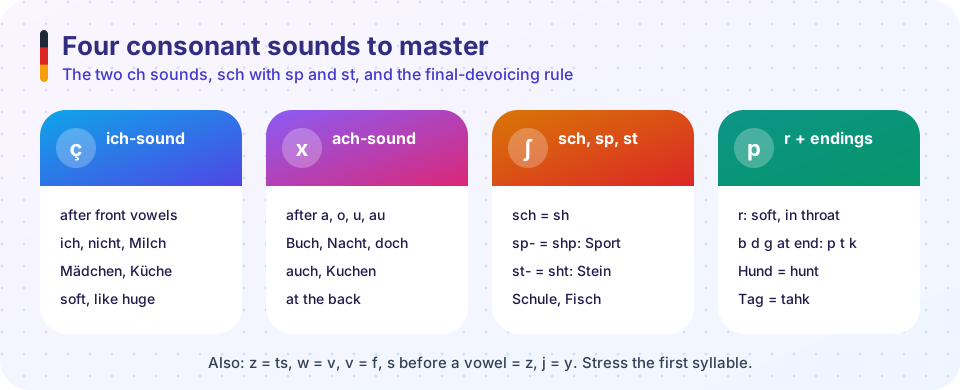
What you will learn
- the two ch sounds and which one to use
- sch, sp, st, tsch, pf, qu, ng, ck and ph
- how w, v, z, s, j and r are pronounced
- final devoicing (why Hund sounds like "hunt")
- where the stress goes in German words
Key terms
Ich-Laut [ç]: the soft "ch" after front vowels, as in ich, Milch. Ach-Laut [x]: the back "ch" after a, o, u, au, as in Buch, Nacht. Auslautverhärtung (final devoicing): b, d, g become p, t, k at the end of a syllable. Stress: the syllable said louder, longer and higher in pitch.
The two ch sounds
Spelling ch is neither English "ch" in "chair" nor "k". It is a hissing sound made in the mouth, and it has two versions that depend on the vowel before it.
The ich-sound [ç] comes after the front vowels i, e, ä, ö, ü, the diphthongs ei and eu, and after the consonants l, n, r. To make it, say "h" as in "huge" or "hue" and push the air through a narrow channel between the tongue and the hard palate. Smile slightly; it is the sound at the start of "huge" with more friction. Examples: ich (I), nicht (not), Milch (milk), Mädchen (girl), Küche (kitchen), Bücher (books), manchmal (sometimes).
The ach-sound [x] comes after a, o, u and au. It is made at the back of the throat, like the Scottish "loch" or the Spanish "j" in "jota". Examples: Buch (book), Nacht (night), doch (yes it is / but), auch (also), Woche (week), Kuchen (cake).
If you cannot make the difference at first, use the ach-sound everywhere: people will understand you. But the ich-sound is worth the effort: ich is the first word in thousands of sentences. A diminutive ending -chen is always an ich-sound: Mädchen, Brötchen (bread roll), Kätzchen (kitten).
Special cases: chs is [ks]: sechs (six), Wachs (wax). At the start of loanwords, ch can be [k] (Chor, choir; Chaos) or [ʃ] (Chef, boss; Chance).
sch, sp, st and friends
sch is simply English "sh": Schule (school), Fisch (fish), schön (beautiful). tsch is English "ch" as in "chair": Deutsch (German), tschüss (bye).
At the beginning of a word or word part, sp and st are pronounced "shp" and "sht": Sport (shport), Spiel (shpeel, game), Stein (shtine, stone), Straße (SHTRAH-suh), Stadt (shtat). Everywhere else they keep their English sound: Fenster (window), Kunst (art), Wurst (sausage), lispeln.
Other patterns worth knowing:
| Spelling | Sound | Examples |
|---|---|---|
| pf | p + f together | Pfund (pound), Apfel, Pferd (horse) |
| qu | "kv" | Qualität, bequem (comfortable) |
| ng | like English "sing", never "n-g" | Ring, lang, singen |
| ck | "k" (and makes the vowel short) | Rock, Zucker (sugar), Jacke |
| ph | "f" in words from Greek | Physik, Telefon, Fotografie |
| th | "t" in loanwords | Theater, Thema, Mathematik |
| h | pronounced at the start of a syllable, silent after a vowel | Haus [h], Bahn (silent) |
w, v, z, s, j and r
These single letters need care because they look English but sound different:
| Letter | Sound | Examples |
|---|---|---|
| w | "v" | Wasser, wir (we), wo (where) |
| v | "f" in native words, "v" in loanwords | Vater (FAH-ter), viel (feel, much), vier (feer, four); Vase, Video |
| z | "ts" | Zeit, Zug (train), zwei, Katze |
| s before a vowel | "z" | Sonne (ZON-nuh), lesen (LAY-zen), Salz (salt: "zalts") |
| s at the end or before a consonant | "s" | Haus, Wasser, Fenster, ist |
| ss, ß | "s" | Wasser, Straße, groß |
| j | "y" as in "yes" | ja, Jahr (year), Junge (boy) |
You can remember v = f with a list: Vater, viel, vier, vor (before), von (from), vergessen (to forget), Vogel (bird). The "v" in Vase, Video, November and Visum keeps the foreign "v" sound.
The German r
Standard German has two versions of r. At the start of a syllable (rot, red; Radio), it is a soft sound in the back of the throat, like a very light gargle or the French r. After a vowel at the end of a syllable (Uhr, clock; hier, here; Vater), it is vocalized: it becomes a short "uh" sound, so Vater is close to "FAH-tuh" and Uhr to "oo-uh". A tongue-tip rolled r is regional (south Germany, Austria, Switzerland) and acceptable. What matters: do not use the English "er" curl of the tongue. If you cannot make the throat r yet, a light tongue-tip tap will do.
Final devoicing
At the end of a word or syllable, the voiced consonants b, d, g are pronounced as their voiceless partners p, t, k:
| Written | Said | Why |
|---|---|---|
| Hund (dog) | "hunt" | the plural Hunde has a real d |
| Tag (day) | "tahk" | the plural Tage has a real g |
| lieb (dear) | "leep" | liebe has a real b |
| Kind (child) | "kint" | Kinder has a real d |
| Land (country) | "lant" | Länder has a real d |
This is why Hund and Hunt would sound the same, and why you can find the "hidden" d by making the plural or adding an ending. The rule only affects the pronunciation; the spelling stays the same. It also explains how German speakers pronounce English: "dog" often comes out as "dock".
Word stress
In German, stress is mostly predictable. These rules cover most words:
- Native words are stressed on the first syllable (the root): AR-beit (work), FRÜH-stück (breakfast), BAHN-hof (station), HAUS-tür (front door), MUT-ter.
- Compound nouns are stressed on the first part: BAHN-hof, HAND-schuh (glove), SCHUL-tasche (school bag).
- Inseparable prefixes are never stressed: be-, ge-, ver-, er-, zer-, ent-, emp-: be-KOM-men (get), ver-STE-hen (understand), ent-SCHUL-di-gen (excuse).
- Words ending in -ieren are stressed on -ie-: stu-DIE-ren, tele-fo-NIE-ren.
- Many loanwords are stressed on the last or second syllable: Ho-TEL, Mu-SIK, Uni-ver-si-TÄT, In-for-ma-ti-ON, Stu-DENT.
- Separable prefixes are stressed: AN-kom-men (arrive), AUF-ste-hen (get up), EIN-kau-fen (shop). You will learn them in chapter 4.
As in English, sentences also have melody. A statement falls at the end (Ich heiße Anna.), a question that can be answered yes or no rises (Heißt du Anna?), and a question word question falls like a statement (Wie heißt du?).
Common misconceptions
"ch is like English ch or k." Never. Use the ich-sound after front vowels and the ach-sound after a, o, u, au.
"Wasser starts with a W like 'water'." It starts with a v-sound: "VAS-ser".
"Final b, d, g are pronounced as in English." They harden to p, t, k: Tag is "tahk", Hund is "hunt".
"Every German word has its stress at the end, like Dutch or French." In German native words it is the first syllable.
Try it
First, a tool that turns German spelling into a rough English-style reading. Then a sorter for the two ch sounds and a final-devoicing demo.
Press Run (or Ctrl + Enter) to see the result here.
Program input · what you'd type while the program runs
Type the answers before you press Run, one per line. Each time the program reads a line (with input()), it gets the next line from this box.
Press Run (or Ctrl + Enter) to see the result here.
Program input · what you'd type while the program runs
Type the answers before you press Run, one per line. Each time the program reads a line (with input()), it gets the next line from this box.
Check your understanding
Quick check · 6 questions
of 6 answered You scored / 6 · perfect!
-
1. Which ch sound is used in 'Buch'?
After a, o, u and au, ch is the back ach-sound: Buch, Nacht, doch. -
2. How is 'Stein' pronounced?
At the start of a word, st becomes 'sht' and ei is 'eye': SHTINE. -
3. How is the word 'Hund' pronounced?
Final devoicing turns the d at the end into t. -
4. Which syllable is stressed in 'verstehen'?
The prefix ver- is never stressed: ver-STE-hen. -
5. How is the letter s pronounced in 'Sonne'?
Before a vowel at the start of a syllable, German s is voiced: ZON-nuh. -
6. Which word contains the ich-sound?
After l the ch is the soft ich-sound. After a and u it is the ach-sound.
Summary
- The ich-sound follows front vowels and l, n, r; the ach-sound follows a, o, u, au.
- sch = "sh"; sp and st at the start of a word = "shp", "sht"; z = "ts"; w = "v"; v = "f" in native words; s before a vowel = "z".
- The German r is made in the throat and vocalizes after a vowel.
- b, d, g at the end of a syllable sound like p, t, k.
- Stress native words on the first syllable; prefixes like be-, ge-, ver- are never stressed.
Track your progress
Create a free account to tick off lessons and pick up where you left off on any device.
of German for Beginners lessons completed