


















Lesson 49 of 50 · Projects and Practice
Cheat Sheet: German Patterns from Chapters 5 to 8
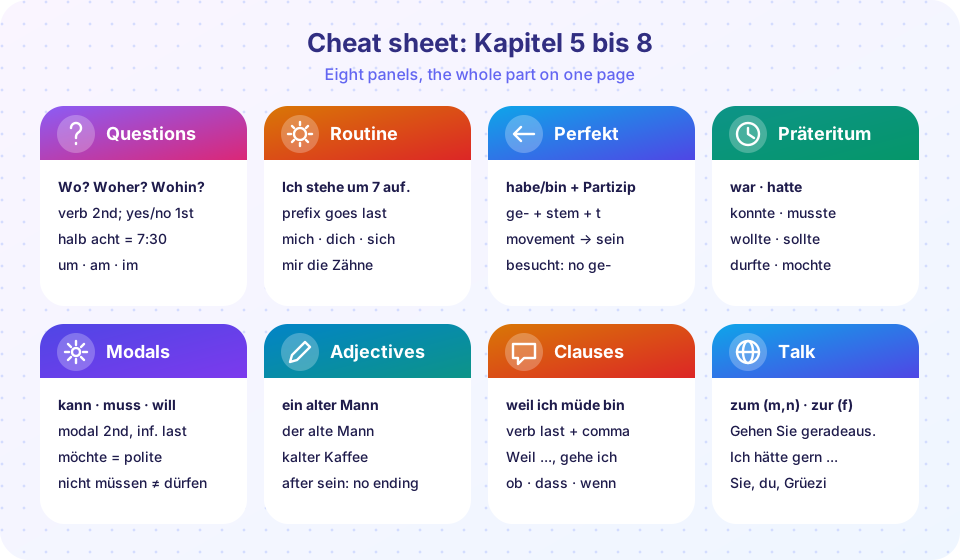
A one-page German cheat sheet with verb positions, participles, haben or sein, modal verbs, adjective endings, subordinate clauses and polite phrases.
A cheat sheet is not for learning something new. It is for the moment when you think "Wait, where does the verb go?" and need the answer in five seconds. This page puts the patterns of Chapters 5 to 8 on a single poster, followed by compact tables that you can copy to a card, print, or keep on your phone.
Use it in two ways: as a reference when you write, and as a self-test: cover the right column of each table and try to produce the answers from memory.
What you will learn
- where to find each pattern quickly
- how to use the sheet as a self-test
- which patterns to review first when you are unsure
Key terms
- die Zusammenfassung (summary): a short overview.
- die Wortstellung (word order): the order of words in a sentence.
- die Endung (ending): the letters at the end of a word.
- der Merksatz (rule of thumb): a short sentence that helps you remember.
- das Nachschlagen (looking up): using a reference.
1. Where does the verb go?
| Sentence type | Verb position | Example |
|---|---|---|
| Statement | second | Ich lerne heute Deutsch. |
| W-question | second | Was lernst du heute? |
| Yes/no question | first | Lernst du heute Deutsch? |
| Separable verb | second, prefix last | Ich stehe um sieben auf. |
| Perfekt | helper second, participle last | Ich habe Deutsch gelernt. |
| Modal verb | modal second, infinitive last | Ich muss Deutsch lernen. |
| Subordinate clause | conjugated verb last | ..., weil ich Deutsch lerne. |
| After denn, und, aber, oder | second (unchanged) | ..., denn ich lerne Deutsch. |
2. Questions, numbers and time
| Topic | Pattern | Example |
|---|---|---|
| Where | wo (position), woher (origin), wohin (goal) | Wohin fährst du? |
| Quantity | wie viel (amount), wie viele (plural) | Wie viele Kinder? |
| Negative question | doch = yes | Kein Hunger? — Doch! |
| Numbers | unit + und + ten | einundzwanzig |
| Everyday clock | halb points to the next hour | halb acht = 7:30 |
| Prepositions of time | um clock, am day, im month | um acht, am Montag, im Mai |
| Dates | ordinal + dative after am | am dritten Oktober |
3. Participles and the Perfekt
| Verb type | Participle | Example |
|---|---|---|
| regular | ge- + stem + -t | gemacht, gelernt |
| irregular | ge- + stem + -en | gegessen, getrunken, gesehen |
| mixed | vowel change + -t | gebracht, gedacht, gewusst |
| separable | prefix + ge- + stem | eingekauft, aufgestanden |
| inseparable prefix | no ge- | besucht, verstanden, bekommen |
| -ieren | no ge- | studiert, telefoniert |
| Helper | Use | Example |
|---|---|---|
| haben | most verbs, verbs with an object | Ich habe Pizza gegessen. |
| sein | movement to a goal, change of state, sein, bleiben, werden | Ich bin nach Wien gefahren. |
Rule of thumb: an object means haben; a destination means sein.
4. Präteritum for speech
| Verb | ich / er | wir / sie |
|---|---|---|
| sein | war | waren |
| haben | hatte | hatten |
| können | konnte | konnten |
| müssen | musste | mussten |
| wollen | wollte | wollten |
| sollen | sollte | sollten |
| dürfen | durfte | durften |
| mögen | mochte | mochten |
5. Modal verbs (present)
| können | müssen | wollen | sollen | dürfen | mögen | möchten | |
|---|---|---|---|---|---|---|---|
| ich / er | kann | muss | will | soll | darf | mag | möchte |
| du | kannst | musst | willst | sollst | darfst | magst | möchtest |
| wir / sie | können | müssen | wollen | sollen | dürfen | mögen | möchten |
Nicht müssen = no need. Nicht dürfen = forbidden.
6. Adjective endings
| After | Case | masc. | fem. | neut. | plural |
|---|---|---|---|---|---|
| der, die, das | nominative | -e | -e | -e | -en |
| accusative | -en | -e | -e | -en | |
| dative | -en | -en | -en | -en | |
| ein, kein, mein | nominative | -er | -e | -es | -en |
| accusative | -en | -e | -es | -en | |
| dative | -en | -en | -en | -en | |
| no article | nominative | -er | -e | -es | -e |
| accusative | -en | -e | -es | -e | |
| dative | -em | -er | -em | -en |
After sein the adjective has no ending. Spelling: hoch → hoh-, teuer → teur-, dunkel → dunkl-.
7. Subordinate clauses
| Conjunction | Meaning | Example |
|---|---|---|
| weil | because | ..., weil ich müde bin. |
| dass | that | Ich glaube, dass er kommt. |
| wenn | if, when | Wenn ich Zeit habe, ... |
| ob | whether | Ich weiß nicht, ob er kommt. |
| obwohl | although | ..., obwohl es regnet. |
If the subordinate clause comes first, the verb of the main clause follows the comma: Weil ich müde bin, gehe ich ins Bett.
8. Conversation
| Situation | Phrase |
|---|---|
| asking the way | Entschuldigung, wie komme ich zum / zur ...? |
| directions | Gehen Sie geradeaus. Biegen Sie links ab. |
| transport | mit dem Bus, mit der U-Bahn |
| tickets | einfach or hin und zurück |
| ordering | Ich hätte gern einen Kaffee. |
| paying | Zahlen, bitte! Das macht ... |
| formal or informal | Sie (strangers), du (friends) |
How to use the sheet
- Print it or save it as a note on your phone.
- Check it before you write. Before you finish a sentence, look at the verb-position table.
- Cover and test. Cover the right column and produce the examples from memory.
- Update it. Add your own examples and your own recurring mistakes next to the rules.
Common misconceptions
- "A cheat sheet replaces practice." It reminds you of rules, but only practice makes the patterns automatic.
- "The tables are complete." They show the core. Real German has more exceptions, which you will meet in later study.
- "I should memorize everything at once." Choose the two tables that give you the most trouble and learn those first.
Try it
Quick-fire questions about the sheet.
And a deck of key patterns.
Check your understanding
Quick check · 4 questions
of 4 answered You scored / 4 · perfect!
-
1. Where does the conjugated verb go in a subordinate clause?
In a subordinate clause the conjugated verb stands at the end. -
2. Which helping verb for 'Ich ___ nach Rom geflogen'?
Movement to a goal takes sein. -
3. What is the adjective ending in 'ein alt___ Haus' (nominative)?
Ein shows nothing in the neuter nominative, so the adjective takes -es. -
4. What does 'nicht dürfen' mean?
Nicht dürfen means forbidden; nicht müssen means no need.
Summary
- The sheet gives you verb position, participle recipes, helper choice, modal forms, endings, clauses and conversation patterns on one page.
- Use it for reference and for cover-and-test.
- Add your own mistakes and examples to make it personal.
Next: Further study
Track your progress
Create a free account to tick off lessons and pick up where you left off on any device.
of German for Beginners lessons completed