


















Lesson 14 of 50 · Cases and Articles
The accusative case
Learn the German accusative case: direct objects, den and einen, the pronouns mich, dich, ihn, accusative prepositions and es gibt, with practice.
The accusative is the second case you meet, and the good news is that it is almost invisible. It marks the direct object of a sentence, the thing that receives the action, and in most nouns it looks exactly like the nominative. The only article that changes is the masculine: der becomes den, ein becomes einen. Learn that one change and you have mastered most of the accusative. You will also learn the accusative pronouns (mich, dich, ihn), the prepositions that always take the accusative, and the useful phrase es gibt.
What you will learn
- how to recognize a direct object with the question "whom or what?"
- the accusative articles den, die, das, die and einen, eine, ein
- the accusative pronouns mich, dich, ihn, sie, es, uns, euch
- the prepositions durch, für, gegen, ohne, um
- how to say "there is/are" with es gibt
Key terms
Akkusativ: the case of the direct object. Direct object: the person or thing that receives the action of the verb. Akkusativ-Präposition: a preposition that is always followed by the accusative: für, ohne, durch, gegen, um. Transitive verb: a verb that takes a direct object (sehen, kaufen, haben).
What is a direct object?
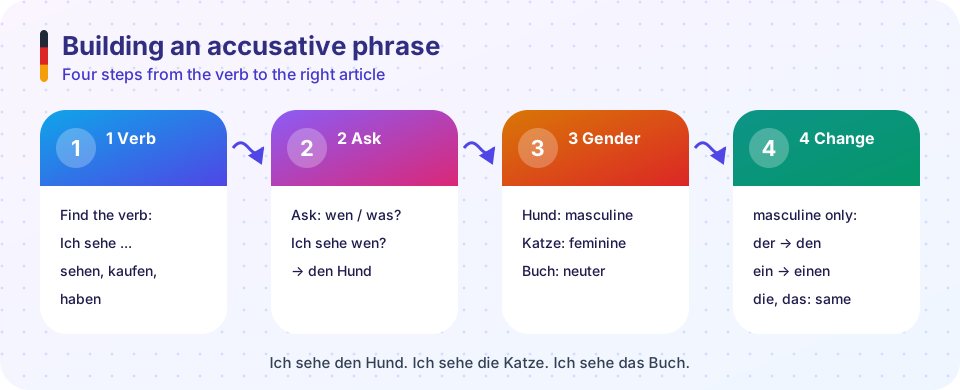
In "The man sees the dog," the man does the seeing (subject), and the dog is what is seen (direct object). To find the direct object, ask "Wen oder was?" (whom or what?) after the verb: Der Mann sieht ... wen? den Hund. The answer is in the accusative.
| Subject (nominative) | Verb | Direct object (accusative) |
|---|---|---|
| Ich | habe | einen Bruder. (I have a brother.) |
| Du | siehst | den Film. (You see the film.) |
| Wir | kaufen | das Brot. (We buy the bread.) |
| Sie | trinkt | eine Cola. (She drinks a cola.) |
| Er | liebt | die Musik. (He loves the music.) |
Notice how the dictionary form of the verb ends in -en (haben, sehen, kaufen), and the form after ich ends in -e. You will learn the verb endings in chapter 4; for now, copy the forms in the examples.
Only the masculine changes
Here is the complete article table for the nominative and the accusative. The only differences are in bold:
| Masculine | Feminine | Neuter | Plural | |
|---|---|---|---|---|
| Nominative (the) | der | die | das | die |
| Accusative (the) | den | die | das | die |
| Nominative (a) | ein | eine | ein | — |
| Accusative (a) | einen | eine | ein | — |
| Nominative (no) | kein | keine | kein | keine |
| Accusative (no) | keinen | keine | kein | keine |
| Nominative (my) | mein | meine | mein | meine |
| Accusative (my) | meinen | meine | mein | meine |
Compare the sentences:
- Der Hund ist groß. → Ich sehe den Hund. (masculine: the form changes)
- Die Katze ist klein. → Ich sehe die Katze. (feminine: unchanged)
- Das Kind ist müde. → Ich sehe das Kind. (neuter: unchanged)
- Die Kinder sind laut. → Ich sehe die Kinder. (plural: unchanged)
Look at the pair Ein Apfel ist rot and Ich esse einen Apfel. The extra -en is the clue that Apfel is a direct object. Many learners forget this in speech, and it is the most common accusative mistake. If you say Ich habe ein Bruder, people will usually still understand you, but Ich habe einen Bruder is correct.
Because the case is marked on the article, German word order is free: Den Hund sieht der Mann has the same meaning as Der Mann sieht den Hund. A direct object in first position is used for emphasis or contrast.
Accusative pronouns
Pronouns change in the accusative in all persons:
| Nominative | Accusative | Example |
|---|---|---|
| ich | mich | Du siehst mich. (You see me.) |
| du | dich | Ich liebe dich. (I love you.) |
| er | ihn | Ich sehe ihn. (I see him / it, masc.) |
| sie (she/it) | sie | Ich sehe sie. |
| es | es | Ich sehe es. |
| wir | uns | Sie hört uns. (She hears us.) |
| ihr | euch | Ich besuche euch. (I visit you, pl.) |
| sie (they) / Sie (you formal) | sie / Sie | Ich kenne sie. / Ich kenne Sie. |
Remember that pronouns follow the grammatical gender: Wo ist der Schlüssel? Ich suche ihn. (Where is the key? I am looking for it.) Here ihn replaces den Schlüssel, because Schlüssel is masculine.
Common verbs with the accusative
haben (to have), sehen (to see), hören (to hear), kaufen (to buy), essen (to eat), trinken (to drink), lieben (to love), mögen (to like), brauchen (to need), suchen (to look for), finden (to find), nehmen (to take), bestellen (to order), lesen (to read), kennen (to know a person), besuchen (to visit).
Examples: Ich brauche einen Stift. (I need a pen.) Wir essen einen Kuchen. (We eat a cake.) Sie liest eine Zeitung. (She reads a newspaper.) Er sucht seinen Schlüssel. (He is looking for his key.)
Accusative prepositions
Five common prepositions are always followed by the accusative. A memory trick: D-O-G-F-U: durch, ohne, gegen, für, um.
| Preposition | Meaning | Example |
|---|---|---|
| durch | through | Wir gehen durch den Park. (We walk through the park.) |
| ohne | without | Ich trinke Kaffee ohne Zucker. (I drink coffee without sugar; no article) |
| gegen | against, around (time) | Er ist gegen den Plan. / gegen acht Uhr (around eight) |
| für | for | Das Geschenk ist für meinen Bruder. (The gift is for my brother.) |
| um | around, at (time) | Wir treffen uns um acht Uhr. / um die Ecke (around the corner) |
Contractions: für das becomes fürs, durch das becomes durchs, um das becomes ums. They are common in speech.
es gibt: there is, there are
Es gibt means "there is / there are" and always takes the accusative, because literally it says "it gives": Es gibt einen Park in der Stadt. (There is a park in the town.) Es gibt keine Milch. (There is no milk.) Gibt es hier ein Café? (Is there a café here?) The verb stays gibt even for plurals: Es gibt viele Restaurants.
Time and quantity in the accusative
Some expressions of time and measure use the accusative without a preposition: jeden Tag (every day), jedes Jahr (every year), nächsten Montag (next Monday), letzte Woche (last week), einen Monat (for one month), den ganzen Tag (all day). You will meet them over and over.
Dialogue: at the bakery
Verkäuferin: Guten Tag! Was möchten Sie? — Good day! What would you like? Kunde: Ich hätte gern einen Kaffee und ein Brötchen. — I would like a coffee and a bread roll. Verkäuferin: Gern. Möchten Sie auch einen Kuchen? — Gladly. Would you also like a cake? Kunde: Nein, danke. Haben Sie keine Milch? — No thanks. Don't you have any milk? Verkäuferin: Doch, wir haben Milch. Hier bitte. — Yes, we have milk. Here you are.
Notice einen Kaffee (masculine, accusative), ein Brötchen (neuter, unchanged), einen Kuchen (masculine), keine Milch (feminine).
Spotting the accusative in the wild
Once you know the accusative, you will see it everywhere. Greetings such as Guten Morgen, Guten Tag and Gute Nacht are short for Ich wünsche dir einen guten Morgen, which is why Guten has an accusative ending. Signs say Keine Werbung (no advertising), using kein. On menus you will find Ich nehme den Fisch and Wir haben einen Tisch für zwei Personen. When reading, make a habit of finding the verb first, then asking wen oder was? to locate the object. Underline each masculine article: if you see den or einen, you know you have an accusative masculine noun. In listening, train your ear to hear that tiny -n at the end of den and einen. It is easy to miss, but it tells you who does what, and with practice you will notice it automatically.
Common misconceptions
"All genders change in the accusative." Only the masculine singular changes: der/den, ein/einen.
"The accusative is used after every verb." Some verbs take a different case. sein and werden take the nominative; helfen takes the dative.
"Word order shows the object." In German the article shows it. That is why the object can come first.
Try it
Press Run (or Ctrl + Enter) to see the result here.
Program input · what you'd type while the program runs
Type the answers before you press Run, one per line. Each time the program reads a line (with input()), it gets the next line from this box.
Press Run (or Ctrl + Enter) to see the result here.
Program input · what you'd type while the program runs
Type the answers before you press Run, one per line. Each time the program reads a line (with input()), it gets the next line from this box.
Check your understanding
Quick check · 5 questions
of 5 answered You scored / 5 · perfect!
-
1. Which sentence is correct?
Hund is masculine and a direct object, so the accusative article is den. -
2. Which article is the accusative of 'eine Lampe'?
Feminine nouns do not change in the accusative. -
3. How do you say 'I love you' (to a friend)?
du becomes dich in the accusative. -
4. Which preposition does NOT take the accusative?
mit always takes the dative. für, durch, gegen, ohne and um take the accusative. -
5. What does 'Es gibt einen Park' mean?
es gibt = there is/there are, followed by the accusative.
Summary
- The accusative marks the direct object (wen oder was?).
- Only masculine singular changes: der/den, ein/einen, kein/keinen, mein/meinen.
- Pronouns: ich/mich, du/dich, er/ihn, sie/sie, es/es, wir/uns, ihr/euch.
- Accusative prepositions: durch, ohne, gegen, für, um (DOGFU).
- Es gibt + accusative means "there is/there are".
Next: The dative case
Track your progress
Create a free account to tick off lessons and pick up where you left off on any device.
of German for Beginners lessons completed