


















Lesson 5 of 50 · Getting Started
Chapter 1 review: Getting started
Review chapter 1 of German for Beginners: where German is spoken, the alphabet with umlauts and ß, cognates, false friends, plus a 9-question quiz.
You have finished the first chapter. You know where German is spoken and why it looks familiar, you can read the alphabet including ä, ö, ü and ß, you know the capitalization rule for nouns, and you have a toolbox for guessing words and avoiding false friends. This review pulls the chapter into one picture, one table and one longer quiz. Do not rush through it: retrieval, meaning pulling facts out of your memory, is the most powerful way to make them stay.
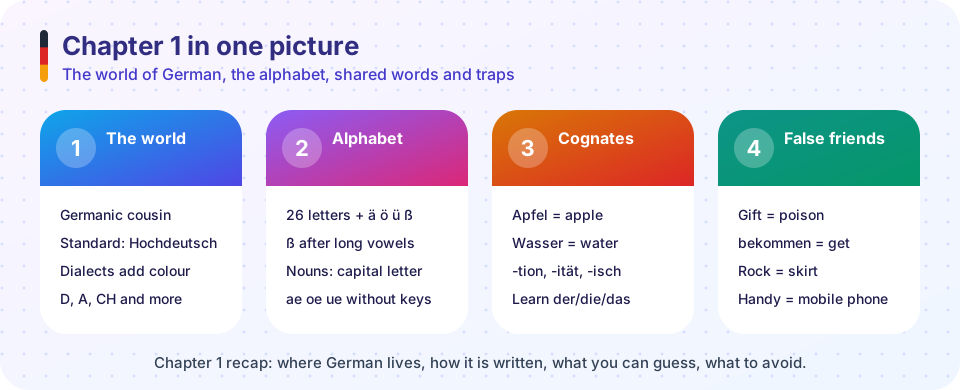
What you will learn
- a quick recap of every lesson in chapter 1
- which facts you should be able to recall without looking
- where your weak spots are, using a self-check and a nine-question quiz
Key terms
Hochdeutsch: standard German. Umlaut: ä, ö, ü; Eszett: ß. Cognate: a word that looks and means about the same in both languages. False friend: a look-alike with a different meaning (Gift = poison). Infinitive: the dictionary form of a verb, ending in -en.
The chapter in a table
| Lesson | Big idea | Example to remember |
|---|---|---|
| Course map | Nine chapters, daily short practice, talk to real people | learn "der Tisch", not "Tisch" |
| German in the world | Germanic cousin of English; used in D, A, CH and more | Wasser / water, Servus / Moin / Grüezi |
| Alphabet and first words | 26 letters + ä ö ü ß; nouns are capitalized | Straße, schon vs schön, "W wie Wasser" |
| Cognates and false friends | Use similar words, beware of traps | Apfel = apple, Gift = poison, bekommen = get |
Things to be able to do now
Check yourself against this list. If you cannot do one item, go back to that lesson before moving on.
- Name three countries where German is an official language, and say what Hochdeutsch means.
- Explain why English "water" and German "Wasser" look alike (the consonant shift).
- Spell your first name aloud in German letter names (for example Lena: ell, eh, enn, ah).
- Say when you write ß and when ss; know the fallback ae, oe, ue.
- Capitalize correctly: Ich sehe den Hund. and explain why Hund has a capital letter.
- Give five cognates and five false friends, with their real meanings.
- Say five useful words: hallo, danke, bitte, Entschuldigung, Wie bitte?
Study plan for the next days
Before you start chapter 2, spend a few short sessions consolidating chapter 1. On the first day, reread the alphabet lesson and spell five names aloud, including your own. On the second day, write ten cognates with their articles and the pattern that links them to English. On the third day, make a list of your five most dangerous false friends and write a correct example sentence for each. On the fourth day, say hallo, danke, bitte, Entschuldigung and Wie bitte? to yourself in front of a mirror, with the right accent. On the fifth day, retake the quiz. If you score eight or nine out of nine, you are ready. If not, repeat the lessons where your answers were wrong. The aim is not perfection: the aim is that the basic facts of German no longer surprise you.
Common misconceptions to leave behind
"I don't need the article." You do. Nouns come with der, die or das, and they matter from chapter 3 on.
"Similar means identical." Gift, Rock, fast, Chef and bekommen are all traps.
"Umlauts are the same as the plain vowel." schon and schön, Mutter and Mütter: different words.
Try it
Press Run (or Ctrl + Enter) to see the result here.
Program input · what you'd type while the program runs
Type the answers before you press Run, one per line. Each time the program reads a line (with input()), it gets the next line from this box.
Check your understanding
Quick check · 9 questions
of 9 answered You scored / 9 · perfect!
-
1. Which of these countries has German as ONE of several national languages?
Switzerland has four national languages: German, French, Italian and Romansh. -
2. Which pair shows the regular shift of English t to German z?
two / zwei, ten / zehn: English t often matches German z (pronounced ts). -
3. Which spelling is correct German?
Both the sentence start and the noun are capitalized. 'Strasse' is a valid fallback, but not the only form. -
4. What does 'Ich bekomme einen Kaffee' mean?
'bekommen' means to get or receive. -
5. Which pair is correct?
Rock is a skirt. Rat is advice and Gift is poison. -
6. How is the letter V named in German?
V is 'fow'. W is 'veh', J is 'yot'. -
7. Which suffix is typical of feminine nouns like Universität?
-ität (from -ity) forms feminine nouns: die Universität, die Qualität. -
8. Which sentence is a good reason to say 'Wie bitte?'
'Wie bitte?' means 'Pardon?' and asks for repetition. -
9. Why does 'schon' differ from 'schön'?
schon = already, schön = beautiful. Umlauts are part of the spelling and cannot be dropped.
Summary
- German is a Germanic cousin of English, spoken in several countries, taught here as Hochdeutsch.
- The alphabet has ä, ö, ü and ß; nouns are capitalized; learn letter names to spell aloud.
- Cognates and suffix patterns give you free vocabulary; false friends need special care.
- You are ready for chapter 2: sounds and greetings, where you will start to speak.
Track your progress
Create a free account to tick off lessons and pick up where you left off on any device.
of German for Beginners lessons completed