


















Lesson 7 of 50 · Sounds, Greetings and Basics
Vowels and umlauts
Master German vowels: long and short sounds, the diphthongs ei, ie, eu and au, and how to say ä, ö and ü, with minimal pairs and exercises.
German vowels are the heart of its sound. The good news is that every vowel has a fixed sound that does not wander from word to word the way English vowels do. The challenge is that each vowel comes in two lengths, long and short, and that German adds three umlaut vowels that do not exist in standard English. In this lesson you will learn how to tell the length from the spelling, how to produce the umlauts, and how to avoid the biggest English-speaker habit: gliding vowels into diphthongs where German keeps them pure.
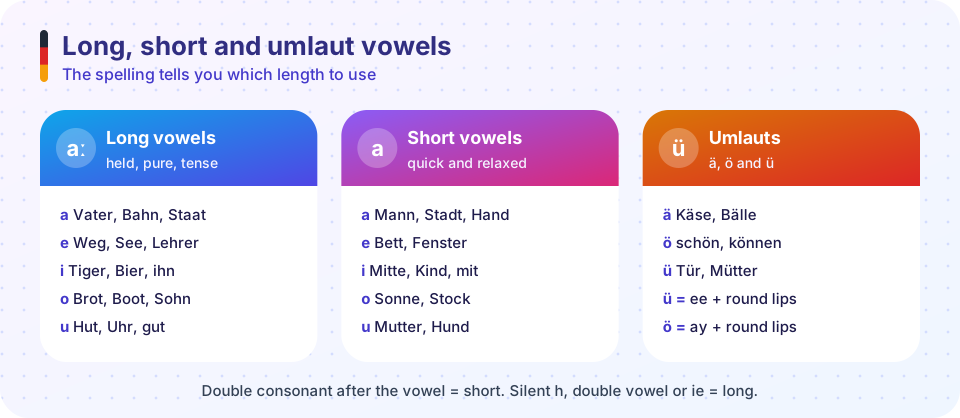
What you will learn
- the five basic vowels a, e, i, o, u in their long and short forms
- how to predict vowel length from spelling
- the diphthongs ei, au, eu and äu, and the spelling ie
- how to pronounce ä, ö and ü
- how to hear the difference in minimal pairs
Key terms
Long vowel: held a bit longer and usually tenser, shown with [ː] in IPA, as in Vater [ˈfaːtɐ]. Short vowel: quick and relaxed, as in Mutter [ˈmʊtɐ]. Diphthong: a vowel that glides from one sound to another, like ei [aɪ]. Minimal pair: two words that differ in only one sound, such as Staat and Stadt.
The basic vowels, long and short
A long vowel is not just "longer": it is also tenser and purer. Compare these. The IPA symbols are in square brackets and the respelling is approximate.
| Letter | Long | Short |
|---|---|---|
| a | Vater [aː] "FAH-ter" | Mann [a] "mahn", like the vowel between "cut" and "father" |
| e | Weg [eː] "vayk", pure ay, no glide | Bett [ɛ] like the vowel in "bed" |
| i | Tiger [iː] "TEE-ger" | Mitte [ɪ] like the vowel in "bit" |
| o | Brot [oː] "broht", pure oh | Sonne [ɔ] like a short "off" |
| u | Hut [uː] "hoot" | Mutter [ʊ] like the vowel in "put" |
The long e is the one English speakers distort most. In English "day" glides to an "ee" at the end; in German Weg does not. Hold the vowel steady and your lips stay still. The same goes for long o: Brot does not end with a "w" sound.
A special case is the unstressed e at the end of many words, written e but pronounced as a weak "uh" [ə]: bitte "BIT-tuh", Name "NAH-muh", danke "DAN-kuh", Katze "KAT-suh". It is the same sound as the "a" in English "about".
How to tell long from short
German spelling gives reliable clues:
| Spelling clue | Vowel is | Examples |
|---|---|---|
| Followed by a double consonant | short | Mutter, Bett, Wasser, Sonne, Mann |
| Followed by two or more different consonants | usually short | Hand, Kind, Stadt, Wunsch |
| Followed by h | long (the h is silent) | Bahn, Lehrer, Uhr, Sohn |
| Double vowel: aa, ee, oo | long | Paar, See, Boot |
| ie | long [iː] | Bier, Liebe, vier |
| Followed by one consonant at the end of a syllable | usually long | Tag, Weg, Hut, Brot, Tür |
| Followed by ß | long | Straße, Fuß |
There are exceptions, especially in very short everyday words: mit (with), an (on), in (in), das (the, neuter), es (it), was (what) all have short vowels even though only one consonant follows. You learn these on sight. The rules are right most of the time and give you a strong start.
The diphthongs and the ie spelling
Three combinations are diphthongs, and one looks like a diphthong but is not.
- ei (also written ai) sounds like English "eye": nein [naɪn], Eis, zwei, Mai (May).
- au sounds like English "ow" in "cow": Haus, Auto, Frau.
- eu and äu sound like English "oy" in "boy": Euro, neu (new), Häuser (houses), Bäume (trees).
- ie is not a diphthong. It is simply a long "ee": Bier (beer), Liebe (love), Tier (animal).
A classic trap: English speakers read ei as "ay" and ie as "eye", which is the reverse of German. The memory trick: the second letter names the sound in English. In ei, the "i" sounds like English "eye"; in ie, the "e" says "ee". Compare Wein (wine), which sounds like "vine", with Wien (Vienna), which sounds like "veen".
In words from French and Latin, ie can be two syllables: Familie "fa-MEE-lee-uh", Ferien (holidays) "FAY-ree-en". Context tells you.
The three umlauts
The umlaut vowels are made by combining tongue and lip positions that English does not combine:
| Letter | How to make it | Long example | Short example |
|---|---|---|---|
| ü | Say "ee" and keep your tongue forward, then round your lips as for "oo" | Tür [yː] (door), grün (green) | Mütter [ʏ] (mothers), müssen (must) |
| ö | Say "ay" (as in the long German e), then round your lips as for "oh" | schön [øː] (beautiful), Öl (oil) | können [œ] (can), Götter (gods) |
| ä | Say it like the e in "bed" (or like a long ay in many speakers) | Käse [ɛː] (cheese), Bär (bear) | Bälle (balls), kälter (colder) |
Practice ü first, because it is the most common. Say "ee" and hold the tongue still. Now slowly push your lips into a small round hole, like blowing out a candle. The sound that results is ü. Another trick: whistle a note while saying "ee". For ö, do the same with "ay": say "ay", push the lips forward and round.
ä is easy. In standard German, short ä sounds like short e (Bälle and Belle match), and long ä sounds like the "e" in "bed" held longer or, for many speakers, like long e. When in doubt, say "eh".
The umlaut often marks plural or comparison: der Bruder (brother), die Brüder (brothers); warm, wärmer (warmer); die Mutter (mother), die Mütter (mothers). It is not just decoration: it carries grammar.
Minimal pairs for your ear
Train your ear and mouth with pairs of words that differ by just one vowel feature. Say them aloud and exaggerate the difference.
| Word 1 | Word 2 | What differs |
|---|---|---|
| Staat [ʃtaːt] state | Stadt [ʃtat] town | long vs short a |
| Miete [ˈmiːtə] rent | Mitte [ˈmɪtə] middle | long vs short i |
| Ofen [ˈoːfn̩] stove | offen [ˈɔfn̩] open | long vs short o |
| Hüte [ˈhyːtə] hats | Hütte [ˈhʏtə] hut | long vs short ü |
| lesen [ˈleːzn̩] to read | lösen [ˈløːzn̩] to solve | e vs ö |
| Kuchen cake | Küchen kitchens | u vs ü |
| schon already | schön beautiful | o vs ö |
Pairs like these show why correct vowel length matters: "Staat" and "Stadt" are both common, and so are "Miete" and "Mitte". Context usually saves you, but a clear vowel avoids misunderstandings.
A five-minute pronunciation routine
Pronunciation improves fastest with tiny daily sessions. Try this routine. First, say the five long vowels slowly in a row, keeping each one pure and still: aah, ay, ee, oh, oo. Then say the five short ones: a, e, i, o, u as in Mann, Bett, Mitte, Sonne, Mutter. Third, practice the umlauts by pairing them with their partners: ee, ü, ee, ü (keep the tongue still and round the lips), then ay, ö, ay, ö. Fourth, read one minimal pair aloud, for example Staat and Stadt, five times each, exaggerating the difference. Finally, record yourself saying Tür, schön, Brüder, Käse, Mütter and compare it with a native speaker if you can. Do not worry if your first ü sounds odd: most learners need a few weeks before it feels natural. Your mouth is learning a new movement, and movements need repetition.
Common misconceptions
"Long vowels are just louder." They are held longer and are purer; volume is a separate feature.
"ei is pronounced 'ee' and ie 'eye'." It is the opposite: ei = "eye", ie = "ee".
"ü is the same as 'oo'." It is not. Tür (door) is not "tour". Keep your tongue forward as for "ee".
"The final -e is silent like in English 'name'." In German the final e is pronounced as a weak "uh": Name is NAH-muh.
Try it
First, a small Python helper that guesses vowel length from the spelling rules above. Then a drill, and finally a schematic vowel chart.
Press Run (or Ctrl + Enter) to see the result here.
Program input · what you'd type while the program runs
Type the answers before you press Run, one per line. Each time the program reads a line (with input()), it gets the next line from this box.
Press Run (or Ctrl + Enter) to see the result here.
Program input · what you'd type while the program runs
Type the answers before you press Run, one per line. Each time the program reads a line (with input()), it gets the next line from this box.
Check your understanding
Quick check · 5 questions
of 5 answered You scored / 5 · perfect!
-
1. How is the 'ei' in 'nein' pronounced?
ei = eye: nein sounds like English 'nine'. -
2. Which word has a SHORT vowel?
A double consonant (tt) after the vowel makes it short. Bahn has a silent h (long) and Boot a double o (long). -
3. How do you make the sound ü?
ü is 'ee' with rounded lips: the tongue stays forward, the lips round. -
4. What is the difference between 'Staat' and 'Stadt'?
Staat (state) has a long aa; Stadt (town) has a short a before dt. -
5. How do you pronounce the final -e in 'Katze'?
The unstressed final -e is a weak schwa: KAT-suh.
Summary
- Every vowel has a long and a short form; the spelling usually tells you which.
- Double consonant after the vowel means short; h, double vowel, ie or one consonant at a syllable end means long.
- ei = "eye", ie = "ee", au = "ow", eu/äu = "oy".
- ü is "ee" with round lips, ö is "ay" with round lips, ä is like "e" in "bed".
- Unstressed final -e is a weak "uh".
Next: Consonants and stress
Track your progress
Create a free account to tick off lessons and pick up where you left off on any device.
of German for Beginners lessons completed