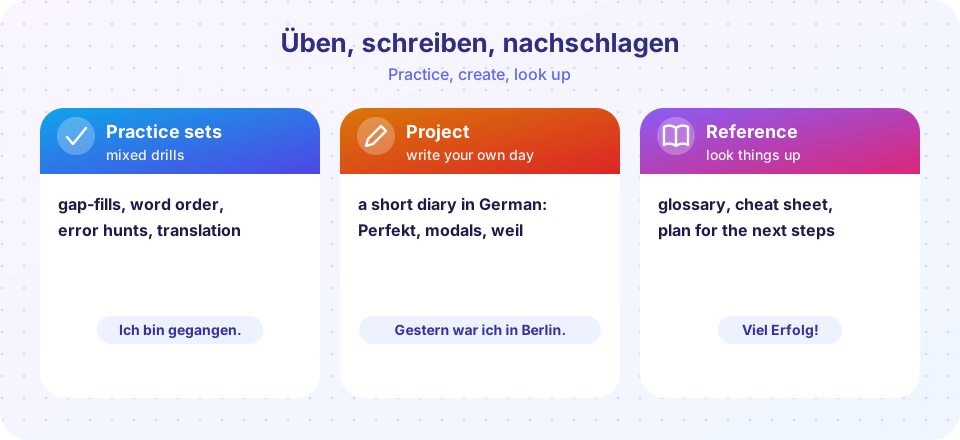
Plan the final stretch of the course: mixed practice sets, a writing project about a day in Berlin, a glossary, a cheat sheet and ideas for further study.
Knowledge becomes skill only when you use it. The last chapter of this part of the course is therefore different from the others. There is almost no new grammar. Instead, you will practice everything from Chapters 5 to 8 in mixed exercises, write a short text of your own about a day in Berlin, and collect the reference pages that you will come back to for months: a glossary, a one-page cheat sheet and a plan for what to study next.
If you have ever learned a language from a textbook and then froze in a real conversation, you know why this matters. The brain remembers what it has retrieved, not what it has only read. Every exercise in this chapter makes you retrieve.
Caption: Practice first, then a project of your own, then reference pages you can come back to.
It is mixed. Real conversations jump between topics, so your exercises should too. When you practice only one tense at a time, you always know which tense to use. In real life you have to decide.
It is active. Typing, building and saying beat reading. If you only recognize the answer in a list, you cannot yet produce it.
It is spaced. Come back to the same exercise after a day, three days and a week. Forgetting a little between sessions makes the memory stronger.
It is honest. Keep a mistake list. Three mistakes that come back again and again (for example the participle of essen, the zum/zur choice and the verb position after weil) are worth more attention than thirty one-time slips.
When an answer is wrong, do not only read the correct form. Ask three questions: Which rule applies? Which word gave me the clue? What will I look for next time? For example, if you wrote Ich habe nach Berlin gefahren, the rule is "movement to a goal takes sein", the clue is nach Berlin, and next time you will look for a destination.
Warm up with phrases from the whole part of the course.
Chapter 9 warm-up cards
<style>:root{--ink:#1e1b4b;--mut:#475569;--acc:#6366f1;--bd:#c7d2fe}*{box-sizing:border-box}body{margin:0;padding:14px;font-family:system-ui,-apple-system,'Segoe UI',sans-serif;color:var(--ink);background:linear-gradient(135deg,#faf5ff,#eff6ff)}.card{background:#fff;border-radius:18px;box-shadow:0 8px 22px rgba(67,56,202,.15);padding:16px}button{font:inherit;cursor:pointer;border:0;border-radius:999px;padding:8px 14px;background:linear-gradient(135deg,#6366f1,#8b5cf6);color:#fff;font-weight:600}button.alt{background:#eef2ff;color:#3730a3}button:disabled{opacity:.5;cursor:default}.row{display:flex;gap:8px;flex-wrap:wrap;align-items:center;margin-top:10px}.mut{color:var(--mut);font-size:.9rem}</style><style>.fc{height:150px;display:flex;align-items:center;justify-content:center;text-align:center;font-size:1.5rem;font-weight:700;border-radius:18px;cursor:pointer;padding:12px;user-select:none}.front{background:linear-gradient(135deg,#6366f1,#8b5cf6);color:#fff}.back{background:#fff;color:var(--ink);border:2px solid var(--bd)}</style><divclass="card"><divid="fc"class="fc front"tabindex="0"role="button"aria-label="Flash card, press to flip"></div><divclass="mut"id="cnt"style="margin-top:8px"></div><divclass="row"><buttonclass="alt"id="prev">Back</button><buttonid="flip">Flip</button><buttonclass="alt"id="next">Next</button><buttonclass="alt"id="shuf">Shuffle</button><buttonclass="alt"id="say">Listen</button></div><divclass="mut"id="note"style="margin-top:8px">Click the card to flip it. Listen uses your browser's voice if it is available.</div></div><script>var cards=[["Was hast du gestern gemacht?","What did you do yesterday?"],["Ich bin nach Berlin gefahren.","I went to Berlin."],["Ich muss lernen.","I have to study."],["Ich lerne Deutsch, weil ...","I am learning German because ..."],["ein großer Hund","a big dog"],["Wie komme ich zum Bahnhof?","How do I get to the station?"],["Ich hätte gern einen Kaffee.","I would like a coffee."],["Viertel nach acht","8:15"],["Zahlen, bitte!","The bill, please!"],["Duzen wir uns?","Shall we use du?"]];var i=0,showBack=false;var fc=document.getElementById('fc');functiondraw(){var c=cards[i];fc.textContent=showBack?c[1]:c[0];fc.className='fc '+(showBack?'back':'front');document.getElementById('cnt').textContent='Card '+(i+1)+' of '+cards.length;}functionflip(){showBack=!showBack;draw();}
fc.onclick=flip;fc.onkeydown=function(e){if(e.key==='Enter'||e.key===' '){e.preventDefault();flip();}};
document.getElementById('flip').onclick=flip;
document.getElementById('next').onclick=function(){i=(i+1)%cards.length;showBack=false;draw();};
document.getElementById('prev').onclick=function(){i=(i-1+cards.length)%cards.length;showBack=false;draw();};
document.getElementById('shuf').onclick=function(){for(var k=cards.length-1;k>0;k--){var r=Math.floor(Math.random()*(k+1));var t=cards[k];cards[k]=cards[r];cards[r]=t;}i=0;showBack=false;draw();};
document.getElementById('say').onclick=function(){try{var u=newSpeechSynthesisUtterance(cards[i][0]);u.lang='de-DE';window.speechSynthesis.cancel();window.speechSynthesis.speak(u);}catch(e){document.getElementById('note').textContent='Speech is not available in this preview.';}};draw();</script>
Match key terms with their meaning.
Grammar terms
<style>:root{--ink:#1e1b4b;--mut:#475569;--acc:#6366f1;--bd:#c7d2fe}*{box-sizing:border-box}body{margin:0;padding:14px;font-family:system-ui,-apple-system,'Segoe UI',sans-serif;color:var(--ink);background:linear-gradient(135deg,#faf5ff,#eff6ff)}.card{background:#fff;border-radius:18px;box-shadow:0 8px 22px rgba(67,56,202,.15);padding:16px}button{font:inherit;cursor:pointer;border:0;border-radius:999px;padding:8px 14px;background:linear-gradient(135deg,#6366f1,#8b5cf6);color:#fff;font-weight:600}button.alt{background:#eef2ff;color:#3730a3}button:disabled{opacity:.5;cursor:default}.row{display:flex;gap:8px;flex-wrap:wrap;align-items:center;margin-top:10px}.mut{color:var(--mut);font-size:.9rem}</style><style>.cols{display:grid;grid-template-columns:1fr 1fr;gap:10px}.it{padding:10px 12px;border-radius:12px;background:#fff;border:2px solid var(--bd);cursor:pointer;font-weight:600;text-align:center}.it.sel{border-color:#6366f1;background:#eef2ff}.it.done{border-color:#10b981;background:#ecfdf5;color:#047857;cursor:default}.it.bad{border-color:#ef4444;background:#fef2f2}</style><divclass="card"><divclass="mut">Click a German item, then its English match.</div><divclass="cols"style="margin-top:10px"><divid="L"></div><divid="R"></div></div><divclass="row"><buttonclass="alt"id="again">Shuffle again</button><spanid="msg"class="mut"></span></div></div><script>var pairs=[["das Perfekt","present perfect"],["das Partizip","participle"],["das Modalverb","modal verb"],["der Nebensatz","subordinate clause"],["die Endung","ending"],["das Hilfsverb","auxiliary verb"],["die Höflichkeitsform","polite form"],["der Dialekt","dialect"]];var left=null,solved=0;functionshuffle(a){a=a.slice();for(var k=a.length-1;k>0;k--){var r=Math.floor(Math.random()*(k+1));var t=a[k];a[k]=a[r];a[r]=t;}return a;}functionbuild(){
solved=0;left=null;document.getElementById('msg').textContent='';varL=document.getElementById('L'),R=document.getElementById('R');L.innerHTML='';R.innerHTML='';var idx=pairs.map(function(_,k){return k;});shuffle(idx).forEach(function(k){L.appendChild(mk(pairs[k][0],k,'L'));});shuffle(idx).forEach(function(k){R.appendChild(mk(pairs[k][1],k,'R'));});}functionmk(text,k,side){var d=document.createElement('div');d.className='it';d.textContent=text;d.style.marginBottom='8px';d.dataset.k=k;d.dataset.side=side;
d.onclick=function(){if(d.classList.contains('done'))return;if(side==='L'){document.querySelectorAll('#L .it').forEach(function(e){e.classList.remove('sel');});d.classList.add('sel');left=d;return;}if(!left)return;if(left.dataset.k===d.dataset.k){left.className='it done';d.className='it done';left=null;solved++;if(solved===pairs.length)document.getElementById('msg').textContent='All matched. Well done!';}else{d.classList.add('bad');setTimeout(function(){d.classList.remove('bad');},500);}};return d;}
document.getElementById('again').onclick=build;build();</script>