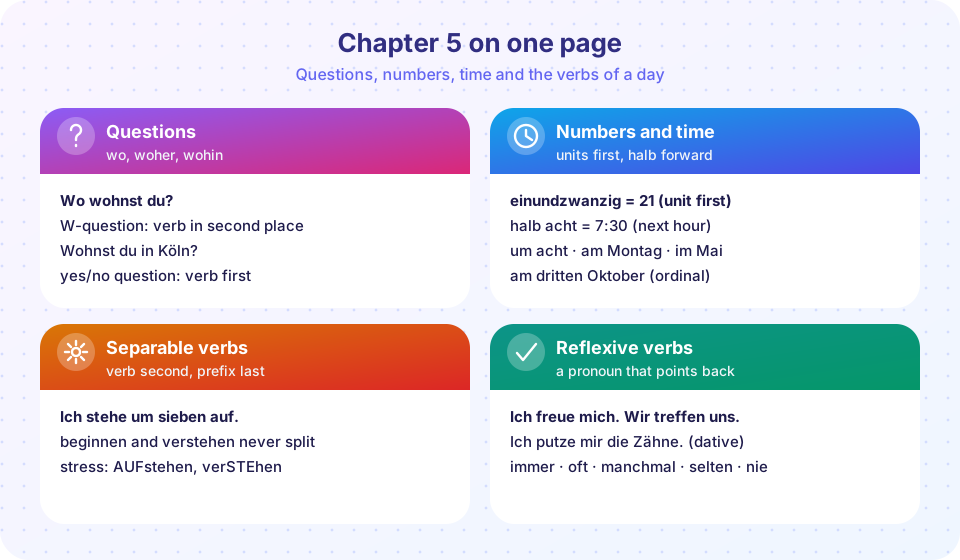
Review questions, numbers, clock time, dates, separable and reflexive verbs with a one-page picture, a recap table and a ten-question quiz.
You have finished Chapter 5. You can now ask questions, count, tell time, name days and months, and describe a normal day with separable and reflexive verbs. This review puts everything on one page, gives you a recap table to keep, and tests you with ten mixed questions.
Caption: Chapter 5 in one picture: the four patterns that carry a German day.
The verb is the anchor. In statements and W-questions it sits in second place; in yes/no questions it goes first. Separable verbs split so that the verb is still second.
German numbers are built in a fixed order. Units first, then und, then the ten, all in one word. Hundreds and thousands come before the rest, with no und between them.
Small words carry the grammar.Um, am, im and doch are tiny, but they tell the listener when something happens and whether you agree.
Two students meet before class. Read the German first, then check the English. Notice the W-questions, the clock phrases and the reflexive verb.
Lena:Hallo, ich bin Lena. Wie heißt du?
Tom:Ich heiße Tom. Woher kommst du?
Lena:Ich komme aus Wien. Und du?
Tom:Aus Leeds, in England. Wann fängt der Kurs an?
Lena:Um Viertel nach neun. Es ist schon halb zehn... nein, Entschuldigung, es ist erst halb neun!
Tom:Dann haben wir noch Zeit. Hast du keinen Hunger?
Lena:Doch! Ich habe heute noch nicht gefrühstückt.
English: Lena: Hello, I am Lena. What is your name? Tom: I am called Tom. Where do you come from? Lena: I come from Vienna. And you? Tom: From Leeds, in England. When does the course start? Lena: At a quarter past nine. It is already half past nine... no, sorry, it is only half past eight! Tom: Then we still have time. Aren't you hungry? Lena: Yes, I am! I have not had breakfast yet today.
The last line borrows a pattern from the next chapter (ich habe gefrühstückt, the perfect tense). If you want to peek ahead, the next chapter starts right after this review.
Mix the chapter's patterns in one gap-fill. Complete every sentence, then check your score.
Chapter 5 mixed practice
<style>:root{--ink:#1e1b4b;--mut:#475569;--acc:#6366f1;--bd:#c7d2fe}*{box-sizing:border-box}body{margin:0;padding:14px;font-family:system-ui,-apple-system,'Segoe UI',sans-serif;color:var(--ink);background:linear-gradient(135deg,#faf5ff,#eff6ff)}.card{background:#fff;border-radius:18px;box-shadow:0 8px 22px rgba(67,56,202,.15);padding:16px}button{font:inherit;cursor:pointer;border:0;border-radius:999px;padding:8px 14px;background:linear-gradient(135deg,#6366f1,#8b5cf6);color:#fff;font-weight:600}button.alt{background:#eef2ff;color:#3730a3}button:disabled{opacity:.5;cursor:default}.row{display:flex;gap:8px;flex-wrap:wrap;align-items:center;margin-top:10px}.mut{color:var(--mut);font-size:.9rem}</style><style>.q{display:flex;gap:8px;align-items:center;flex-wrap:wrap;padding:8px 0;border-bottom:1px solid #eef2ff;font-size:1.05rem}input{font:inherit;padding:6px 10px;border:2px solid var(--bd);border-radius:10px;width:9em}input.ok{border-color:#10b981;background:#ecfdf5}input.no{border-color:#ef4444;background:#fef2f2}.h{font-size:.85rem;color:var(--mut)}</style><divclass="card"><divid="list"></div><divclass="row"><buttonid="chk">Check answers</button><buttonclass="alt"id="rev">Show answers</button><spanid="score"class="mut"></span></div><divclass="mut"style="margin-top:8px">Capitals do not matter. Type ä ö ü ß, or use ae oe ue ss.</div></div><script>var items=[{"s":"Wie ___ ist es? — Es ist drei Uhr.","a":"spät"},{"s":"Hast du keinen Hunger? — ___, ich habe Hunger!","a":"Doch"},{"s":"Es ist 8:45. Es ist ___ vor neun.","a":"Viertel"},{"s":"Der Kurs fängt um neun Uhr ___.","a":"an"},{"s":"Ich putze ___ die Zähne.","a":"mir"},{"s":"Mein Geburtstag ist ___ Dezember.","a":"im"},{"s":"Heute ist der ___ Mai. (1st)","a":"erste"},{"s":"Wir treffen ___ um acht.","a":"uns"},{"s":"67 = sieben___sechzig","a":"und"},{"s":"Ich stehe ___ früh auf. (always)","a":"immer"}];functionnorm(s){return s.toLowerCase().trim().replace(/\s+/g,' ').replace(/ae/g,'ä').replace(/oe/g,'ö').replace(/ue/g,'ü').replace(/ss/g,'ß');}functionnormAns(s){returnnorm(s).replace(/ß/g,'ß');}var list=document.getElementById('list');
items.forEach(function(it,n){var d=document.createElement('div');d.className='q';var parts=it.s.split('___');
d.appendChild(document.createTextNode(parts[0]));var inp=document.createElement('input');inp.id='i'+n;inp.setAttribute('aria-label','Answer '+(n+1));d.appendChild(inp);
d.appendChild(document.createTextNode(parts[1]||''));if(it.h){var h=document.createElement('span');h.className='h';h.textContent='('+it.h+')';d.appendChild(h);}
list.appendChild(d);});functionok(it,v){var arr=Array.isArray(it.a)?it.a:[it.a];var x=normAns(v);return arr.some(function(a){returnnormAns(a)===x;});}
document.getElementById('chk').onclick=function(){var right=0;
items.forEach(function(it,n){var e=document.getElementById('i'+n);var g=ok(it,e.value);e.className=g?'ok':'no';if(g)right++;});
document.getElementById('score').textContent=right+' of '+items.length+' correct';};
document.getElementById('rev').onclick=function(){
items.forEach(function(it,n){var e=document.getElementById('i'+n);e.value=Array.isArray(it.a)?it.a[0]:it.a;e.className='ok';});};</script>
If you want more vocabulary practice, shuffle this deck of the words that appeared in the chapter.
Days, seasons and meals
<style>:root{--ink:#1e1b4b;--mut:#475569;--acc:#6366f1;--bd:#c7d2fe}*{box-sizing:border-box}body{margin:0;padding:14px;font-family:system-ui,-apple-system,'Segoe UI',sans-serif;color:var(--ink);background:linear-gradient(135deg,#faf5ff,#eff6ff)}.card{background:#fff;border-radius:18px;box-shadow:0 8px 22px rgba(67,56,202,.15);padding:16px}button{font:inherit;cursor:pointer;border:0;border-radius:999px;padding:8px 14px;background:linear-gradient(135deg,#6366f1,#8b5cf6);color:#fff;font-weight:600}button.alt{background:#eef2ff;color:#3730a3}button:disabled{opacity:.5;cursor:default}.row{display:flex;gap:8px;flex-wrap:wrap;align-items:center;margin-top:10px}.mut{color:var(--mut);font-size:.9rem}</style><style>.fc{height:150px;display:flex;align-items:center;justify-content:center;text-align:center;font-size:1.5rem;font-weight:700;border-radius:18px;cursor:pointer;padding:12px;user-select:none}.front{background:linear-gradient(135deg,#6366f1,#8b5cf6);color:#fff}.back{background:#fff;color:var(--ink);border:2px solid var(--bd)}</style><divclass="card"><divid="fc"class="fc front"tabindex="0"role="button"aria-label="Flash card, press to flip"></div><divclass="mut"id="cnt"style="margin-top:8px"></div><divclass="row"><buttonclass="alt"id="prev">Back</button><buttonid="flip">Flip</button><buttonclass="alt"id="next">Next</button><buttonclass="alt"id="shuf">Shuffle</button><buttonclass="alt"id="say">Listen</button></div><divclass="mut"id="note"style="margin-top:8px">Click the card to flip it. Listen uses your browser's voice if it is available.</div></div><script>var cards=[["der Montag","Monday"],["der Dienstag","Tuesday"],["der Mittwoch","Wednesday"],["der Donnerstag","Thursday"],["der Freitag","Friday"],["der Samstag","Saturday"],["der Sonntag","Sunday"],["der Frühling","spring"],["der Sommer","summer"],["der Herbst","autumn"],["der Winter","winter"],["das Frühstück","breakfast"],["das Mittagessen","lunch"],["das Abendessen","dinner"],["die Uhr","clock; o’clock"]];var i=0,showBack=false;var fc=document.getElementById('fc');functiondraw(){var c=cards[i];fc.textContent=showBack?c[1]:c[0];fc.className='fc '+(showBack?'back':'front');document.getElementById('cnt').textContent='Card '+(i+1)+' of '+cards.length;}functionflip(){showBack=!showBack;draw();}
fc.onclick=flip;fc.onkeydown=function(e){if(e.key==='Enter'||e.key===' '){e.preventDefault();flip();}};
document.getElementById('flip').onclick=flip;
document.getElementById('next').onclick=function(){i=(i+1)%cards.length;showBack=false;draw();};
document.getElementById('prev').onclick=function(){i=(i-1+cards.length)%cards.length;showBack=false;draw();};
document.getElementById('shuf').onclick=function(){for(var k=cards.length-1;k>0;k--){var r=Math.floor(Math.random()*(k+1));var t=cards[k];cards[k]=cards[r];cards[r]=t;}i=0;showBack=false;draw();};
document.getElementById('say').onclick=function(){try{var u=newSpeechSynthesisUtterance(cards[i][0]);u.lang='de-DE';window.speechSynthesis.cancel();window.speechSynthesis.speak(u);}catch(e){document.getElementById('note').textContent='Speech is not available in this preview.';}};draw();</script>