Write a short German text about a day in Berlin using the Perfekt, modals, adjectives and a weil clause, then analyze it with a small word-frequency program.
In this project you will write a short text in German, about 100 words, that tells the story of a day trip. It is a small piece of writing, but it forces you to use almost everything from Chapters 5 to 8: the past tense, helping verbs, modals, adjective endings, a weil clause, time words and a little conversation vocabulary.
Writing is the best way to find out what you really know. When you speak, you can hide behind gestures and speed. On paper, every ending and every verb position is visible. So write slowly, check each sentence against the rules, and then let a short program look at your text and tell you which tools you have used.
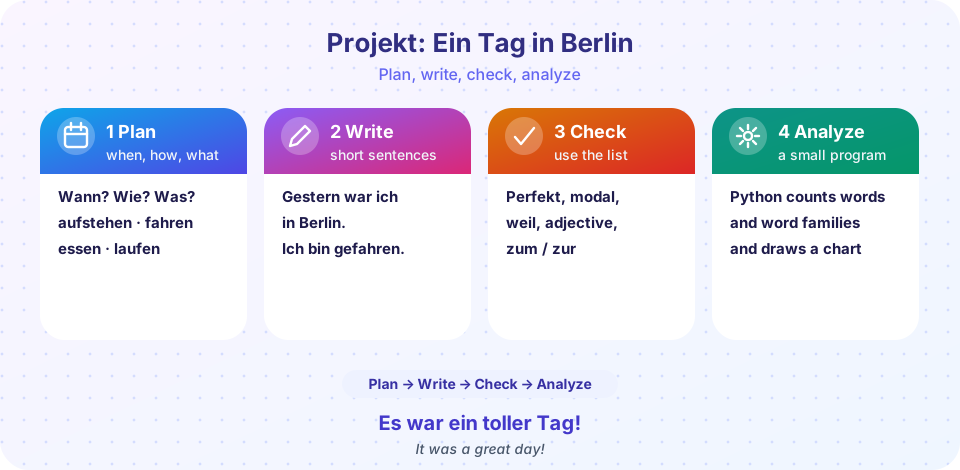
Caption: Four steps: plan the day, write it in the Perfekt, check with a list, and analyze your text.
Imagine you spent yesterday in Berlin. Answer these questions in note form, in German:
Wann? (When did you get up? When did you leave?)
Wie? (By train, by S-Bahn, on foot?)
Was? (Which places did you visit? What did you eat?)
Wie war es? (How was the weather? How were the people?)
Warum? (Why did you go? What did you have to do?)
Write down verbs, not sentences, at first: aufstehen, frühstücken, fahren, abholen, essen, laufen, zurückfahren. Then decide the tense. The rule of thumb for this text: Perfekt for what happened, Präteritum for war, hatte and the modals.
Here is a model of about 100 words. Read it twice. Then look for the patterns listed below it.
Gestern war ich in Berlin. Ich bin um sieben Uhr aufgestanden und habe schnell gefrühstückt. Dann bin ich mit der S-Bahn zum Hauptbahnhof gefahren, weil ich meine Freundin abholen wollte. Wir haben einen großen Kaffee getrunken und sind zum Brandenburger Tor gelaufen. Das Wetter war schön, und wir konnten lange spazieren gehen. Am Mittag haben wir in einem kleinen Restaurant gegessen. Ich habe eine Suppe genommen, und meine Freundin hat einen Salat bestellt. Danach mussten wir leider zum Bahnhof zurück, denn der Zug nach Hamburg ist um sechs Uhr abgefahren. Es war ein toller Tag!
Translation: Yesterday I was in Berlin. I got up at seven o'clock and quickly had breakfast. Then I took the S-Bahn to the main station because I wanted to pick up my friend. We drank a big coffee and walked to the Brandenburg Gate. The weather was nice, and we were able to walk for a long time. At noon we ate in a small restaurant. I had a soup, and my friend ordered a salad. Afterwards we unfortunately had to go back to the station, because the train to Hamburg left at six o'clock. It was a great day!
The program below takes a text, counts the words and the most frequent ones, and checks whether certain families of words are present: helping verbs, Präteritum forms, modals and conjunctions. It also draws a bar chart of the most frequent words. Paste your own text into the quotation marks and run it.
Remember that this is a simple counter, not a grammar checker. It finds words, not mistakes: it can tell you that the text contains weil, but not whether the verb is in the right place. That job is still yours.
Python
Text analyzer
import re
from collections import Counter
import matplotlib.pyplot as plt
plt.rcParams.update({"figure.facecolor":"#faf5ff","axes.facecolor":"#ffffff","axes.edgecolor":"#c7d2fe","axes.spines.top":False,"axes.spines.right":False,"axes.grid":True,"grid.color":"#eef2ff","axes.prop_cycle": plt.cycler(color=["#6366f1","#ec4899","#f59e0b","#14b8a6","#38bdf8"]),"font.size":12})# Replace this model text with your own
text ="""Gestern war ich in Berlin. Ich bin um sieben Uhr aufgestanden und habe schnell gefrühstückt.
Dann bin ich mit der S-Bahn zum Hauptbahnhof gefahren, weil ich meine Freundin abholen wollte.
Wir haben einen großen Kaffee getrunken und sind zum Brandenburger Tor gelaufen.
Das Wetter war schön, und wir konnten lange spazieren gehen.
Am Mittag haben wir in einem kleinen Restaurant gegessen.
Ich habe eine Suppe genommen, und meine Freundin hat einen Salat bestellt.
Danach mussten wir leider zum Bahnhof zurück, denn der Zug nach Hamburg ist um sechs Uhr abgefahren.
Es war ein toller Tag!"""
words = re.findall(r"[A-Za-zÄÖÜäöüß]+", text)
lower =[w.lower()for w in words]
freq = Counter(lower)
sentences =[s for s in re.split(r"[.!?]+", text)if s.strip()]print(len(words),"words,",len(freq),"different words,",len(sentences),"sentences")print("Average sentence length:",round(len(words)/len(sentences),1),"words")print()
families ={"Perfekt helper (haben/sein)":{"habe","hast","hat","haben","habt","bin","bist","ist","sind","seid"},"Präteritum of sein/haben":{"war","warst","waren","wart","hatte","hattest","hatten","hattet"},"modal verb":{"kann","muss","will","soll","darf","mag","möchte","konnte","musste","wollte","sollte","durfte","mochte","konnten","mussten","wollten","können","müssen","wollen"},"conjunction":{"weil","dass","wenn","ob","obwohl","denn"},"time word":{"gestern","heute","morgen","dann","danach","später","um","am"},}for name, group in families.items():
found =sorted(set(lower)& group)
status ="found "if found else"missing"print(status, name +":",", ".join(found))
top = freq.most_common(10)
labels =[w for w, _ in top]
counts =[c for _, c in top]
plt.figure(figsize=(9,4.2))
plt.bar(labels, counts, color="#6366f1", alpha=0.9)
plt.annotate("most frequent: "+ labels[0], xy=(0, counts[0]), xytext=(2.5, counts[0]-0.3),
arrowprops=dict(arrowstyle="->", color="#ec4899"), color="#1e1b4b")
plt.title("The ten most frequent words in the text")
plt.xlabel("Word")
plt.ylabel("Times used")
plt.show()
Press Run (or Ctrl + Enter) to see the result here.
Program input · what you'd type while the program runs
Type the answers before you press Run, one per line. Each time the program reads a line (with input()), it gets the next line from this box.
<style>:root{--ink:#1e1b4b;--mut:#475569;--acc:#6366f1;--bd:#c7d2fe}*{box-sizing:border-box}body{margin:0;padding:14px;font-family:system-ui,-apple-system,'Segoe UI',sans-serif;color:var(--ink);background:linear-gradient(135deg,#faf5ff,#eff6ff)}.card{background:#fff;border-radius:18px;box-shadow:0 8px 22px rgba(67,56,202,.15);padding:16px}button{font:inherit;cursor:pointer;border:0;border-radius:999px;padding:8px 14px;background:linear-gradient(135deg,#6366f1,#8b5cf6);color:#fff;font-weight:600}button.alt{background:#eef2ff;color:#3730a3}button:disabled{opacity:.5;cursor:default}.row{display:flex;gap:8px;flex-wrap:wrap;align-items:center;margin-top:10px}.mut{color:var(--mut);font-size:.9rem}</style><style>.tgt{min-height:54px;border:2px dashed var(--bd);border-radius:14px;padding:8px;display:flex;gap:6px;flex-wrap:wrap;align-items:center;background:#fff}.w{background:#eef2ff;color:#3730a3;border:2px solid var(--bd);border-radius:12px;padding:6px 12px;font-weight:600;cursor:pointer}.w.used{opacity:.3;cursor:default}.t{background:linear-gradient(135deg,#6366f1,#8b5cf6);color:#fff;border-radius:12px;padding:6px 12px;font-weight:600}.en{font-size:1.1rem;font-weight:600;margin-bottom:10px}.fb{min-height:1.6em;margin-top:8px}</style><divclass="card"><divclass="mut"id="prog"></div><divclass="en"id="en"></div><divclass="tgt"id="tgt"aria-live="polite"></div><divclass="row"id="bank"style="margin-top:12px"></div><divclass="fb"id="fb"></div><divclass="row"><buttonid="chk">Check</button><buttonclass="alt"id="clr">Clear</button><buttonclass="alt"id="nx">Next</button><spanclass="mut"id="sc"></span></div></div><script>var items=[{"en":"Yesterday I was in Berlin.","words":["Gestern","war","ich","in","Berlin"],"ok":["Gestern war ich in Berlin","Ich war gestern in Berlin"]},{"en":"I got up at seven.","words":["Ich","bin","um","sieben","Uhr","aufgestanden"],"ok":["Ich bin um sieben Uhr aufgestanden","Um sieben Uhr bin ich aufgestanden"]},{"en":"We drank a big coffee.","words":["Wir","haben","einen","großen","Kaffee","getrunken"],"ok":["Wir haben einen großen Kaffee getrunken"]},{"en":"I went to the station because I wanted to pick up my friend.","words":["Ich","bin","zum","Bahnhof","gefahren","weil","ich","meine","Freundin","abholen","wollte"],"ok":["Ich bin zum Bahnhof gefahren weil ich meine Freundin abholen wollte","Weil ich meine Freundin abholen wollte bin ich zum Bahnhof gefahren"]},{"en":"The weather was nice.","words":["Das","Wetter","war","schön"],"ok":["Das Wetter war schön"]},{"en":"It was a great day.","words":["Es","war","ein","toller","Tag"],"ok":["Es war ein toller Tag"]}];var i=0,score=0,picked=[],solved=false;functionnorm(s){return s.toLowerCase().replace(/[.,?!]/g,'').replace(/s+/g,' ').trim();}functionshuffle(a){a=a.slice();for(var k=a.length-1;k>0;k--){var r=Math.floor(Math.random()*(k+1));var t=a[k];a[k]=a[r];a[r]=t;}return a;}functionrender(){var it=items[i];
document.getElementById('prog').textContent='Sentence '+(i+1)+' of '+items.length;
document.getElementById('en').textContent=it.en;var tg=document.getElementById('tgt');tg.innerHTML='';
picked.forEach(function(k){var s=document.createElement('span');s.className='t';s.textContent=it.shuf[k];tg.appendChild(s);});var bank=document.getElementById('bank');bank.innerHTML='';
it.shuf.forEach(function(w,k){var b=document.createElement('button');b.className='w'+(picked.indexOf(k)>=0?' used':'');b.textContent=w;
b.onclick=function(){if(solved||picked.indexOf(k)>=0)return;picked.push(k);render();};
bank.appendChild(b);});}functionload(){var it=items[i];it.shuf=shuffle(it.words);picked=[];solved=false;document.getElementById('fb').textContent='';render();}
document.getElementById('clr').onclick=function(){picked=[];solved=false;document.getElementById('fb').textContent='';render();};
document.getElementById('chk').onclick=function(){if(solved)return;var it=items[i];var s=norm(picked.map(function(k){return it.shuf[k];}).join(' '));var good=it.ok.some(function(o){returnnorm(o)===s;});if(good){solved=true;score++;document.getElementById('fb').textContent='Correct! '+it.ok[0]+'.';}else{document.getElementById('fb').textContent='Not quite. Check the verb position and try again.';}
document.getElementById('sc').textContent='Score: '+score;};
document.getElementById('nx').onclick=function(){i=(i+1)%items.length;load();};load();</script>
And a deck of useful phrases for your own text.
Phrases for your text
<style>:root{--ink:#1e1b4b;--mut:#475569;--acc:#6366f1;--bd:#c7d2fe}*{box-sizing:border-box}body{margin:0;padding:14px;font-family:system-ui,-apple-system,'Segoe UI',sans-serif;color:var(--ink);background:linear-gradient(135deg,#faf5ff,#eff6ff)}.card{background:#fff;border-radius:18px;box-shadow:0 8px 22px rgba(67,56,202,.15);padding:16px}button{font:inherit;cursor:pointer;border:0;border-radius:999px;padding:8px 14px;background:linear-gradient(135deg,#6366f1,#8b5cf6);color:#fff;font-weight:600}button.alt{background:#eef2ff;color:#3730a3}button:disabled{opacity:.5;cursor:default}.row{display:flex;gap:8px;flex-wrap:wrap;align-items:center;margin-top:10px}.mut{color:var(--mut);font-size:.9rem}</style><style>.fc{height:150px;display:flex;align-items:center;justify-content:center;text-align:center;font-size:1.5rem;font-weight:700;border-radius:18px;cursor:pointer;padding:12px;user-select:none}.front{background:linear-gradient(135deg,#6366f1,#8b5cf6);color:#fff}.back{background:#fff;color:var(--ink);border:2px solid var(--bd)}</style><divclass="card"><divid="fc"class="fc front"tabindex="0"role="button"aria-label="Flash card, press to flip"></div><divclass="mut"id="cnt"style="margin-top:8px"></div><divclass="row"><buttonclass="alt"id="prev">Back</button><buttonid="flip">Flip</button><buttonclass="alt"id="next">Next</button><buttonclass="alt"id="shuf">Shuffle</button><buttonclass="alt"id="say">Listen</button></div><divclass="mut"id="note"style="margin-top:8px">Click the card to flip it. Listen uses your browser's voice if it is available.</div></div><script>var cards=[["Gestern war ich in ...","Yesterday I was in ..."],["Ich bin um ... Uhr aufgestanden.","I got up at ..."],["Dann bin ich mit ... gefahren.","Then I went by ..."],["Wir haben ... gegessen.","We ate ..."],["Das Wetter war ...","The weather was ..."],["..., weil ich ... wollte.","..., because I wanted to ..."],["Danach mussten wir ...","Afterwards we had to ..."],["Am Mittag / Am Abend","at noon / in the evening"],["Es war ein toller Tag!","It was a great day!"],["leider","unfortunately"]];var i=0,showBack=false;var fc=document.getElementById('fc');functiondraw(){var c=cards[i];fc.textContent=showBack?c[1]:c[0];fc.className='fc '+(showBack?'back':'front');document.getElementById('cnt').textContent='Card '+(i+1)+' of '+cards.length;}functionflip(){showBack=!showBack;draw();}
fc.onclick=flip;fc.onkeydown=function(e){if(e.key==='Enter'||e.key===' '){e.preventDefault();flip();}};
document.getElementById('flip').onclick=flip;
document.getElementById('next').onclick=function(){i=(i+1)%cards.length;showBack=false;draw();};
document.getElementById('prev').onclick=function(){i=(i-1+cards.length)%cards.length;showBack=false;draw();};
document.getElementById('shuf').onclick=function(){for(var k=cards.length-1;k>0;k--){var r=Math.floor(Math.random()*(k+1));var t=cards[k];cards[k]=cards[r];cards[r]=t;}i=0;showBack=false;draw();};
document.getElementById('say').onclick=function(){try{var u=newSpeechSynthesisUtterance(cards[i][0]);u.lang='de-DE';window.speechSynthesis.cancel();window.speechSynthesis.speak(u);}catch(e){document.getElementById('note').textContent='Speech is not available in this preview.';}};draw();</script>