


















Lesson 15 of 50 · Cases and Articles
The dative case
Learn the German dative case: indirect objects, dem, der and den, the pronouns mir and dir, dative prepositions and verbs, and the two-way prepositions.
The dative is the case of the indirect object: the person who receives something, or for whom something is done. In English you find it in "I give the child a book" (= "I give a book to the child"). German has a special case form for this, and, unlike the accusative, the dative changes every gender: dem, der, dem, den. It also appears after a fixed group of prepositions and after a few verbs that you must simply learn. Once you master the dative, you can handle most everyday sentences.
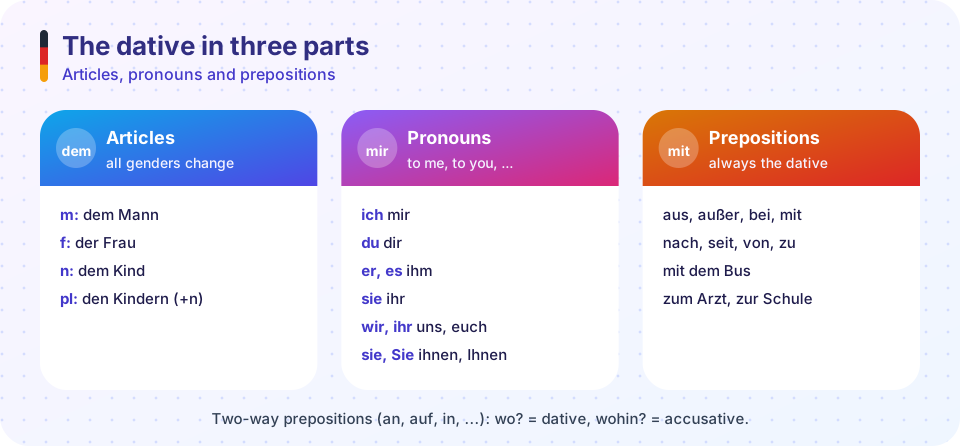
What you will learn
- how to spot an indirect object with the question "wem?" (to whom?)
- the dative articles dem, der, dem, den and einem, einer, einem
- the dative pronouns mir, dir, ihm, ihr, uns, euch, ihnen
- the prepositions aus, bei, mit, nach, seit, von, zu and the verbs that need the dative
- the "two-way" prepositions: location (dative) versus direction (accusative)
Key terms
Dativ: the case of the indirect object, and of certain prepositions and verbs. Indirect object: the person or thing that receives the direct object, or who benefits. Wechselpräposition (two-way preposition): a preposition that takes the dative for location and the accusative for direction. Contraction: a short form like zum (zu dem), im (in dem).
The indirect object
Ask "Wem?" (to whom? for whom?). In Ich gebe dem Kind einen Apfel (I give the child an apple), the apple is the direct object (accusative: einen Apfel), and the child is the indirect object (dative: dem Kind). Typical verbs with both: geben (give), schenken (give as a gift), zeigen (show), schicken (send), erklären (explain), sagen (say), kaufen (buy for someone), bringen (bring).
Dative articles
| Masculine | Feminine | Neuter | Plural | |
|---|---|---|---|---|
| Nominative | der | die | das | die |
| Accusative | den | die | das | die |
| Dative | dem | der | dem | den (+ -n) |
| a / an (dative) | einem | einer | einem | — |
| my (dative) | meinem | meiner | meinem | meinen |
| no (dative) | keinem | keiner | keinem | keinen |
Two things to notice. First, the masculine and neuter are the same in the dative: dem. Second, the plural dative adds -n to the noun, unless it already ends in -n or -s: die Kinder becomes den Kindern, die Freunde becomes den Freunden, but die Frauen stays den Frauen and die Autos stays den Autos.
Examples:
- Ich gebe dem Mann das Buch. (masculine)
- Ich gebe der Frau das Buch. (feminine)
- Ich gebe dem Kind das Buch. (neuter)
- Ich gebe den Kindern die Bücher. (plural, with -n on the noun)
The word order of objects
In a normal sentence the dative object comes before the accusative object when both are nouns: Ich gebe dem Kind den Apfel. When both are pronouns, the order flips: accusative first: Ich gebe ihn ihm. (I give it to him.) When one is a pronoun, the pronoun comes first: Ich gebe ihm den Apfel and Ich gebe ihn dem Kind. A simple rule: pronouns before nouns, and short before long.
Dative pronouns
| Nominative | Accusative | Dative | Example (dative) |
|---|---|---|---|
| ich | mich | mir | Du hilfst mir. (You help me.) |
| du | dich | dir | Ich gebe dir das Buch. |
| er | ihn | ihm | Ich zeige ihm das Foto. |
| sie (she) | sie | ihr | Ich schenke ihr Blumen. |
| es | es | ihm | Das Kind ist müde. Ich helfe ihm. |
| wir | uns | uns | Sie hilft uns. |
| ihr | euch | euch | Ich danke euch. |
| sie (they) | sie | ihnen | Ich antworte ihnen. |
| Sie (formal) | Sie | Ihnen | Wie geht es Ihnen? |
A very common sentence puts the dative in the question Wie geht es dir? ("How is it going to you?"), and Mir ist kalt (I am cold, literally "to me is cold").
Verbs that take the dative only
Some verbs take only a dative object. These are worth learning as pairs, with a person in the dative: helfen (help), danken (thank), gefallen (please), gehören (belong to), antworten (answer), gratulieren (congratulate), passen (fit), schmecken (taste good to), fehlen (be missing to), glauben (believe someone), folgen (follow).
| German | English |
|---|---|
| Ich helfe dem Lehrer. | I help the teacher. |
| Das Buch gehört mir. | The book belongs to me. |
| Der Film gefällt ihr. | She likes the film. |
| Wir danken Ihnen. | We thank you. |
| Die Suppe schmeckt dem Kind. | The child likes the soup. |
| Die Jacke passt mir nicht. | The jacket doesn't fit me. |
Note the logic: Der Film gefällt ihr is literally "the film pleases her", so the thing that pleases is the subject and the person is dative. This reversal is why English speakers say "I like it" and Germans say "es gefällt mir".
Dative prepositions
The following prepositions are always followed by the dative. A rhyme: aus, außer, bei, mit, nach, seit, von, zu.
| Preposition | Meaning | Example |
|---|---|---|
| aus | out of, from | Ich komme aus der Schweiz. Der Apfel ist aus dem Garten. |
| außer | except | Alle außer dem Lehrer. |
| bei | at, near, with (a person or place) | Ich wohne bei meinen Eltern. Er arbeitet bei der Post. |
| mit | with, by (transport) | Ich fahre mit dem Bus. Ich esse mit dem Löffel. |
| nach | after; to (cities, countries) | Nach dem Essen. Ich fliege nach Berlin. |
| seit | since, for (a time) | Ich lerne seit einem Monat Deutsch. |
| von | from, of, by | Das Geschenk ist von meiner Oma. |
| zu | to (people, places) | Ich gehe zum Arzt. Ich gehe zur Schule. |
Contractions you will hear every day: zu dem → zum, zu der → zur, bei dem → beim, von dem → vom. For "at home" and "going home", use two special words: zu Hause (at home) and nach Hause (home, direction).
Two-way prepositions: Wo? or Wohin?
Nine prepositions can take the dative or the accusative: an, auf, hinter, in, neben, über, unter, vor, zwischen. The case depends on the question:
- Wo? (where, location, no movement) takes the dative.
- Wohin? (where to, movement to a new place) takes the accusative.
| Wo? (dative) | Wohin? (accusative) |
|---|---|
| Ich bin im Park. (in dem) | Ich gehe in den Park. |
| Das Buch liegt auf dem Tisch. | Ich lege das Buch auf den Tisch. |
| Die Katze sitzt unter dem Bett. | Die Katze läuft unter das Bett. |
| Das Bild hängt an der Wand. | Ich hänge das Bild an die Wand. |
| Er steht vor dem Haus. | Er geht vor das Haus. |
Contractions: in dem → im, an dem → am, in das → ins, an das → ans, auf das → aufs. The famous trick: liegen, stehen, sitzen, hängen (positions) go with the dative; legen, stellen, setzen (putting actions) go with the accusative.
Dialogue: a birthday gift
Anna: Was schenkst du deinem Bruder zum Geburtstag? — What are you giving your brother for his birthday? Max: Ich schenke ihm ein Buch. Und du, was kaufst du deiner Mutter? — I am giving him a book. And you, what are you buying for your mother? Anna: Ich kaufe ihr einen Schal. Er gefällt ihr bestimmt. — I am buying her a scarf. She will certainly like it. Max: Das ist eine gute Idee. Hilfst du mir bitte? — That is a good idea. Will you help me, please? Anna: Natürlich helfe ich dir. — Of course I will help you.
Why English speakers find the dative hard
In English the dative is mostly invisible. You say "I give the child a book" and the only clue that "the child" is the recipient is its position. German makes the role visible through the article, and also through the verb: some verbs simply take the dative, even where English would use a direct object ("I help him" becomes Ich helfe ihm). Three habits help. First, whenever you see "to" or "for" a person in English, ask yourself wem? and use the dative. Second, learn the dative verbs as short phrases with a person: Ich helfe dir. Das gehört mir. Es gefällt mir. Third, learn the prepositions in the rhyme aus, außer, bei, mit, nach, seit, von, zu together with a typical phrase: mit dem Bus, bei meiner Oma, nach dem Essen, zum Arzt. After a few weeks, phrases like mit dem will feel as natural as "with the" in English.
Common misconceptions
"The dative is only for 'to'." It also follows many prepositions (mit, bei, nach...) and some verbs (helfen, gefallen).
"The dative plural looks the same as the nominative plural." The article changes to den and the noun gets -n: den Kindern.
"in, auf, an always take the dative." Only for location. For direction they take the accusative: Ich gehe in den Park.
"nach is always 'after'." It also means "to" with cities and countries: nach Berlin.
Try it
Press Run (or Ctrl + Enter) to see the result here.
Program input · what you'd type while the program runs
Type the answers before you press Run, one per line. Each time the program reads a line (with input()), it gets the next line from this box.
Check your understanding
Quick check · 6 questions
of 6 answered You scored / 6 · perfect!
-
1. Which sentence is correct?
helfen takes the dative; masculine dative is dem. -
2. What is the dative plural of 'die Kinder'?
The dative plural article is den, and the noun adds -n. -
3. Which sentence means 'I am going into the park' (movement)?
Direction (wohin?) takes the accusative: in den Park. -
4. Which pronoun completes 'Das Buch gehört ___'?
gehören takes the dative: mir. -
5. What is 'zum' short for?
zum = zu dem; zur = zu der. -
6. Which preposition takes the dative?
mit is always followed by the dative.
Summary
- The dative marks the indirect object (wem?) and follows certain prepositions and verbs.
- Dative articles: dem, der, dem, den (+n on plural nouns); einem, einer, einem.
- Pronouns: mir, dir, ihm, ihr, ihm, uns, euch, ihnen, Ihnen.
- Dative prepositions: aus, außer, bei, mit, nach, seit, von, zu.
- Two-way prepositions: dative for location (wo?), accusative for direction (wohin?).
- Word order: pronouns before nouns; two pronouns put the accusative first.
Next: Plural nouns
Track your progress
Create a free account to tick off lessons and pick up where you left off on any device.
of German for Beginners lessons completed