


















Lesson 16 of 50 · Cases and Articles
Plural nouns
Learn how German forms plurals: the five patterns -e, -er, -(e)n, no ending and -s, with umlauts, helpful rules of thumb and how to read a dictionary entry.
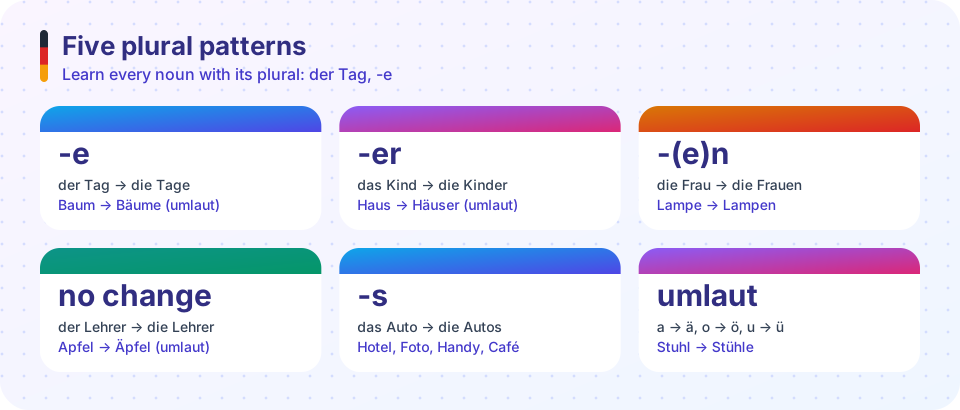
English makes almost every plural by adding -s: one book, two books. German is richer. It has five main ways to form a plural, and the form is usually not predictable from the singular. That sounds daunting, but there is a practical solution. Most plurals fall into a handful of families, certain endings and genders strongly favor certain patterns, and you can learn each noun with its plural from the start, the way you learn it with its article. In this lesson you will see all five patterns, the umlaut changes, a set of rules of thumb that are right most of the time, and how to read dictionary entries.
What you will learn
- the five plural patterns and examples of each
- how the umlaut works in plurals
- rules of thumb by gender and ending
- how to read dictionary notation such as "Tag, -e"
- a few special cases: plural-only nouns, foreign words and double plurals
Key terms
Plural (Mehrzahl): more than one; the definite article is always die in the nominative and accusative. Umlaut: the change a, o, u to ä, ö, ü, often added in plurals. Singular (Einzahl): one. Pluralwort: a noun that exists only in the plural, such as die Eltern (parents).
The five patterns
1. Add -e (often with umlaut). Common for masculine nouns and for many short feminine and neuter nouns.
| Singular | Plural | Meaning |
|---|---|---|
| der Tag | die Tage | day |
| der Hund | die Hunde | dog |
| der Stuhl | die Stühle (umlaut) | chair |
| der Baum | die Bäume (umlaut) | tree |
| die Stadt | die Städte (umlaut) | town |
| die Hand | die Hände (umlaut) | hand |
| das Jahr | die Jahre | year |
2. Add -er (usually with umlaut where possible). Typical for neuter nouns and a few masculine nouns. No feminine nouns use this pattern.
| Singular | Plural | Meaning |
|---|---|---|
| das Kind | die Kinder | child |
| das Buch | die Bücher (umlaut) | book |
| das Haus | die Häuser (umlaut) | house |
| das Bild | die Bilder | picture |
| das Land | die Länder (umlaut) | country |
| der Mann | die Männer (umlaut) | man |
3. Add -n or -en. The big family of feminine nouns, plus weak masculine nouns.
| Singular | Plural | Meaning |
|---|---|---|
| die Frau | die Frauen | woman |
| die Lampe | die Lampen | lamp |
| die Zeitung | die Zeitungen | newspaper |
| die Tür | die Türen | door |
| der Student | die Studenten | student |
| das Auge | die Augen | eye |
4. No change (or only an umlaut). Typical for masculine and neuter nouns ending in -er, -el, -en, and neuter nouns in -chen and -lein.
| Singular | Plural | Meaning |
|---|---|---|
| der Lehrer | die Lehrer | teacher |
| das Zimmer | die Zimmer | room |
| das Mädchen | die Mädchen | girl |
| der Apfel | die Äpfel (umlaut) | apple |
| der Bruder | die Brüder (umlaut) | brother |
| die Mutter | die Mütter (umlaut) | mother |
5. Add -s. Mostly for words from other languages, abbreviations and names.
| Singular | Plural | Meaning |
|---|---|---|
| das Auto | die Autos | car |
| das Hotel | die Hotels | hotel |
| das Foto | die Fotos | photo |
| das Handy | die Handys | mobile phone |
| der Park | die Parks | park |
| das Café | die Cafés | café |
The -s plural is the least common in native words, but the most productive for new ones. Note that Handy gets Handys, not Handies.
Rules of thumb that work most of the time
The shape of the plural is not random. These tendencies help you guess:
- Feminine nouns almost always take -n or -en (the large majority). Lampe → Lampen, Zeitung → Zeitungen. Exceptions are short ones: Hand → Hände, Nacht → Nächte, Stadt → Städte, Mutter → Mütter, Tochter → Töchter.
- Nouns ending in -in add -nen: Lehrerin → Lehrerinnen, Studentin → Studentinnen (the n doubles).
- Nouns ending in -ung, -heit, -keit, -schaft, -tion, -tät add -en: Zeitungen, Freiheiten, Möglichkeiten, Freundschaften, Nationen, Universitäten.
- Masculine and neuter nouns ending in -er, -el, -en and -chen/-lein do not change (sometimes with an umlaut for masculine): Lehrer, Zimmer, Mädchen; but Apfel → Äpfel, Garten → Gärten, Vater → Väter.
- Neuter nouns of one syllable often take -er (with umlaut) or -e: Kind → Kinder, Buch → Bücher, but Jahr → Jahre, Bein → Beine.
- Masculine nouns of one syllable often take -e, often with umlaut: Hund → Hunde, Baum → Bäume, Stuhl → Stühle, Tag → Tage.
- Foreign words and abbreviations often take -s: Autos, Hotels, Pizzas (also Pizzen), Computer (no change), LKWs.
Some special patterns: -nis → -nisse (das Ergebnis → die Ergebnisse); -um/-ium → -en (das Museum → die Museen, das Studium → die Studien); -a → -en (das Thema → die Themen); -us → -en (der Rhythmus → die Rhythmen); and the two plurals of das Wort: die Wörter (separate words) and die Worte (connected speech, "words" as in a message).
Reading a dictionary entry
German dictionaries give the plural right after the noun. Knowing the code is a superpower:
| Entry | Meaning |
|---|---|
| Tag, -e | die Tage (add -e) |
| Stuhl, ¨-e | die Stühle (umlaut + -e) |
| Kind, -er | die Kinder |
| Haus, ¨-er | die Häuser (umlaut + -er) |
| Frau, -en | die Frauen |
| Lehrer, – | die Lehrer (no change) |
| Apfel, ¨ | die Äpfel (umlaut only) |
| Auto, -s | die Autos |
When you learn a new noun, write it in this form: "der Tag, -e". That packs the article, the singular and the plural pattern into one line.
Nouns without a normal plural
- Only plural: die Eltern (parents), die Ferien (holidays), die Leute (people), die Geschwister (siblings), die Kosten (costs), die Möbel (furniture).
- Only singular (uncountable): das Wasser, die Milch, das Geld (money), die Musik, das Wetter, die Hilfe. To count them, use a container: zwei Glas Wasser, zwei Tassen Kaffee. In everyday speech, units of measure and drinks often stay singular: zwei Kaffee, drei Glas, zehn Euro, fünf Kilo.
- No indefinite plural article: the plural of ein Buch is just Bücher. Say Ich habe Bücher. (I have books.) and Das sind Bücher. (Those are books.)
Plurals in the cases
The plural article is always die in the nominative and accusative, and den in the dative (plus -n on the noun unless it already ends in -n or -s): die Kinder / die Kinder / den Kindern. Adjectives and verbs agree with the plural: Die Kinder sind laut. (The children are loud.)
A routine for learning plurals
Plural forms are best learned in the same way as genders: one noun at a time, with spaced review. Make flash cards with the singular and its article on the front (das Kind) and the plural plus pattern on the back (die Kinder, -er). When you add a new noun, say it aloud in three forms: der Tag, die Tage; ein Tag, zwei Tage. Sort your cards into piles by pattern at the end of each week: all the -e plurals, all the -er plurals and so on. Seeing the families together helps your brain build rules of its own. When reading, look at the numbers: after zwei, drei, vier the plural is normal (except for measures like zwei Glas Wasser), so every number is a free plural exercise. Finally, try to notice the dative plural: mit den Kindern, bei den Eltern. That small -n is a mark of careful German.
Common misconceptions
"Add -s to everything." Only in a minority of words, usually from other languages. Native words use -e, -er, -(e)n or no ending.
"The umlaut always appears." It is not predictable: Hund → Hunde (no umlaut), Baum → Bäume (umlaut).
"Feminine nouns can take -er." No. -er plurals are only masculine and neuter.
"Wort has one plural." It has two: Wörter and Worte.
Try it
Press Run (or Ctrl + Enter) to see the result here.
Program input · what you'd type while the program runs
Type the answers before you press Run, one per line. Each time the program reads a line (with input()), it gets the next line from this box.
Press Run (or Ctrl + Enter) to see the result here.
Program input · what you'd type while the program runs
Type the answers before you press Run, one per line. Each time the program reads a line (with input()), it gets the next line from this box.
Check your understanding
Quick check · 5 questions
of 5 answered You scored / 5 · perfect!
-
1. What is the plural of 'das Kind'?
Neuter nouns often take -er: das Kind, die Kinder. -
2. What is the plural of 'die Lehrerin'?
Nouns in -in double the n and add -en: Lehrerinnen. -
3. Which nouns normally take the -s plural?
The -s plural is mainly used with foreign words: Autos, Hotels, Fotos. -
4. How do you read the dictionary entry 'Haus, ¨-er'?
The ¨ means umlaut, so the plural is Häuser. -
5. What is the article in the nominative plural?
All plurals take die in the nominative and accusative.
Summary
- German has five plural patterns: -e, -er, -(e)n, no change and -s, with umlaut often added.
- Feminine nouns usually take -n or -en; -in becomes -innen.
- Nouns in -er, -el, -en and diminutives -chen, -lein stay the same in the plural.
- Foreign words often take -s; some nouns are plural-only (Eltern) or uncountable (Wasser).
- Learn every noun with its plural, for example "der Tag, -e".
Next: Chapter 3 review
Track your progress
Create a free account to tick off lessons and pick up where you left off on any device.
of German for Beginners lessons completed