


















Lesson 9 of 50 · Sounds, Greetings and Basics
Greetings and introductions
Learn how to greet people, say goodbye, choose between du and Sie, introduce yourself and ask where someone is from, with two full dialogues.
The first thirty seconds of a conversation follow a script, and in German the script has one special feature that English does not have: two words for "you". Choose the wrong one and you may sound cold, or too familiar. This lesson gives you the phrases for saying hello and goodbye at different times of day, the rule for choosing du or Sie, and the questions and answers for introducing yourself. By the end you can have a short, correct conversation with a stranger, a classmate and a colleague.
What you will learn
- greetings and goodbyes for morning, day, evening and night
- when to use du (informal) and Sie (formal)
- how to say your name, where you come from, where you live and what you do
- how to ask the same questions politely
- how to read two complete dialogues
Key terms
duzen / siezen: to address someone with du / with Sie. Anrede: the form of address, such as Herr Müller or Frau Becker. heißen: to be called; kommen aus: to come from; wohnen: to live (reside). Beruf: occupation, job.
Hello and goodbye
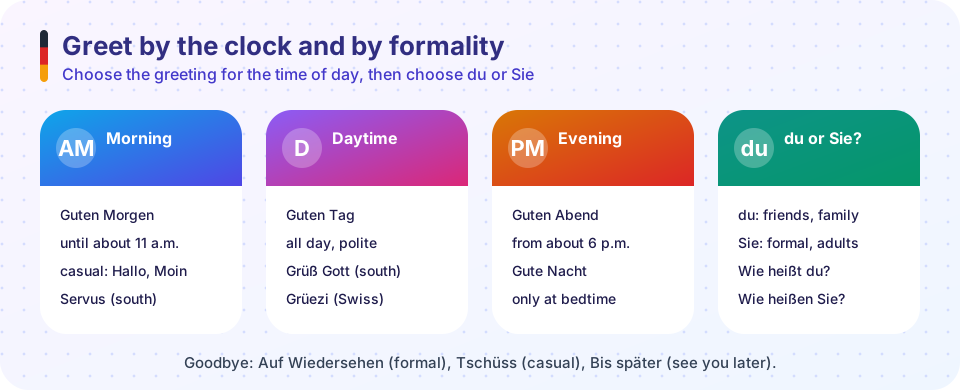
German greetings depend on the time of day and how formal the situation is. These are the most common:
| German | Respelling | Meaning | When |
|---|---|---|---|
| Guten Morgen | GOO-ten MOR-gen | good morning | until about 10 or 11 a.m. |
| Guten Tag | GOO-ten tahk | good day / hello | from late morning to evening, formal and neutral |
| Guten Abend | GOO-ten AH-bent | good evening | from about 6 p.m. |
| Gute Nacht | GOO-teh nakht | good night | only when someone goes to bed |
| Hallo | HAL-loh | hello | informal, any time |
| Hi | hy | hi | informal, young people |
| Servus | ZAIR-voos | hello / bye | Bavaria and Austria, informal |
| Moin | moyn | hello | northern Germany, all day |
| Grüß Gott | grüss got | hello | Bavaria, Austria, polite |
| Grüezi | GRÜ-et-see | hello | Switzerland |
For goodbyes:
| German | Respelling | Meaning | Style |
|---|---|---|---|
| Auf Wiedersehen | owf VEE-der-zay-en | goodbye | formal and neutral |
| Auf Wiederhören | owf VEE-der-hur-en | goodbye (on the phone) | formal |
| Tschüss | chüss | bye | informal |
| Tschau / Ciao | chow | bye | informal, Italian loan |
| Bis später | biss SHPAY-ter | see you later | informal |
| Bis morgen | biss MOR-gen | see you tomorrow | any |
| Bis bald | biss balt | see you soon | any |
| Mach's gut | makhs goot | take care | informal |
Notice that "Guten" is accusative and has -n: you say "Guten Tag", but "Gute Nacht" has no -n because Nacht is feminine. You will learn why in chapter 3. For now, memorize the phrases as chunks.
A tip about time: Guten Tag is the safest greeting. It is understood in all regions and works from late morning until evening, in shops, offices, classrooms and on the street. When you walk into a small shop, doctor's waiting room or lift in Germany, it is normal to greet the people there. Not doing so can seem rude.
How are you?
| German | Meaning | Style |
|---|---|---|
| Wie geht's? | How are you? | informal |
| Wie geht es dir? | How are you? | informal, full form |
| Wie geht es Ihnen? | How are you? | formal |
| Gut, danke. Und dir? / Und Ihnen? | Fine, thanks. And you? | informal / formal |
| Sehr gut! / Super! / Prima! | Very good! / great! | |
| Es geht. | So-so. | |
| Nicht so gut. | Not so good. |
An honest German might actually tell you how they are if you ask. The question "Wie geht's?" is more sincere than English "How are you?" in a shop, which is why people in shops usually skip it.
du or Sie?
German has two "you" words for one person:
- du (informal): for family, friends, children, classmates, pets, and, among young people, nearly anyone of similar age. Plural: ihr.
- Sie (formal, always with a capital S): for adults you do not know well, officials, customers, doctors, teachers (students usually say Sie to them), bosses in many workplaces. It is used for one person or many.
The choice affects the verb: Wie heißt du? (du), Wie heißen Sie? (Sie). If you are unsure, use Sie and wait until someone says "Wir können uns duzen" ("We can use du with each other") or just switches to du. Being too formal is safer than being too casual. The older person or the person in the higher position usually offers du first. Some places are casual by default: sports clubs, student groups, many start-ups, hostels, and online communities use du from the start. And the shop IKEA famously addresses all customers with du.
When you use Sie, add a title and a surname: Herr Müller (Mr Müller), Frau Becker (Ms/Mrs Becker). The word Fräulein is obsolete. In Austria and Germany, academic titles are often included: Frau Doktor Schmidt.
Introducing yourself
| Question | Informal answer | Formal answer |
|---|---|---|
| Wie heißt du? / Wie heißen Sie? (What is your name?) | Ich heiße Lena. / Ich bin Lena. | Ich heiße Becker. / Mein Name ist Becker. |
| Woher kommst du? / Woher kommen Sie? (Where are you from?) | Ich komme aus Kanada. | Ich komme aus der Schweiz. |
| Wo wohnst du? / Wo wohnen Sie? (Where do you live?) | Ich wohne in Wien. | Ich wohne in München. |
| Was machst du? / Was sind Sie von Beruf? (What do you do?) | Ich bin Studentin. | Ich bin Ingenieur. |
| Sprichst du Deutsch? / Sprechen Sie Englisch? | Ja, ein bisschen. | Ja, ein bisschen. |
A few notes on these sentences:
- Verb endings. The verb changes with the person: ich heiße, du heißt, Sie heißen; ich komme, du kommst, Sie kommen; ich wohne, du wohnst, Sie wohnen. Chapter 4 gives you the full system.
- Countries. After aus (from) and in (in), many countries need no article: aus Kanada, aus England, aus Italien, in Spanien. A few take an article: aus der Schweiz, aus der Türkei (feminine), aus den USA (plural), aus dem Iran (masculine). The article changes after aus, so just learn those few as phrases for now.
- Professions. In German you say Ich bin Lehrer with no "a": Ich bin Ingenieur, Ich bin Arzt. Female forms usually end in -in: Lehrerin (teacher), Studentin (student), Ärztin (doctor), Ingenieurin, Schülerin (pupil).
- Nice to meet you. Say "Freut mich." or "Angenehm." or, more formally, "Nett, Sie kennenzulernen."
Please, thanks and sorry
| German | Meaning |
|---|---|
| bitte | please; you're welcome; here you go |
| danke / danke schön / vielen Dank | thank you / thank you very much |
| bitte schön / gern geschehen | you're welcome |
| Entschuldigung | excuse me (to get attention); sorry |
| Es tut mir leid | I am sorry (an apology) |
| Kein Problem | no problem |
| Wie bitte? | Pardon? |
| Ich verstehe nicht. | I do not understand. |
| Sprechen Sie bitte langsam. | Please speak slowly. |
Two dialogues
Informal: two students meet
Lena: Hallo! Ich bin Lena. Und du? — Hello! I'm Lena. And you? Tom: Hi, Lena! Ich heiße Tom. Freut mich. — Hi, Lena! My name is Tom. Nice to meet you. Lena: Freut mich auch. Woher kommst du, Tom? — Nice to meet you too. Where are you from, Tom? Tom: Ich komme aus Kanada, aus Toronto. Und du? — I come from Canada, from Toronto. And you? Lena: Ich komme aus Hamburg, aber ich wohne jetzt in Wien. — I come from Hamburg, but I live in Vienna now. Tom: Cool! Ich lerne Deutsch. — Cool! I am learning German. Lena: Dein Deutsch klingt gut! — Your German sounds good!
Formal: two adults at a conference
Frau Becker: Guten Tag. Mein Name ist Becker. Wie heißen Sie? — Good day. My name is Becker. What is your name? Herr Aydın: Guten Tag, Frau Becker. Ich heiße Aydın, Mehmet Aydın. — Good day, Ms Becker. My name is Aydın, Mehmet Aydın. Frau Becker: Nett, Sie kennenzulernen, Herr Aydın. Woher kommen Sie? — Nice to meet you, Mr Aydın. Where do you come from? Herr Aydın: Ich komme aus der Türkei, aber ich wohne in München. — I come from Turkey, but I live in Munich. Frau Becker: Was sind Sie von Beruf? — What do you do for a living? Herr Aydın: Ich bin Ingenieur. Und Sie? — I am an engineer. And you? Frau Becker: Ich bin Lehrerin. Auf Wiedersehen! — I am a teacher. Goodbye!
Read both aloud. Then replace the names, countries and jobs with your own, and notice that only the verb forms and the greeting change between informal and formal.
Common misconceptions
"Sie always means 'she'." sie with a lowercase s means "she" or "they". Sie with a capital S, as a form of address, means the formal "you".
"Guten Tag is only for noon." It is the standard daytime greeting from late morning to evening.
"I can use du with everyone because it is friendlier." With strangers, older people and in formal situations, du may sound disrespectful.
"Ich bin ein Lehrer." Grammatically possible but unusual for a profession; native speakers say Ich bin Lehrer.
Try it
Press Run (or Ctrl + Enter) to see the result here.
Program input · what you'd type while the program runs
Type the answers before you press Run, one per line. Each time the program reads a line (with input()), it gets the next line from this box.
Check your understanding
Quick check · 6 questions
of 6 answered You scored / 6 · perfect!
-
1. When do you say 'Gute Nacht'?
'Gute Nacht' is a farewell for the night, said when someone goes to sleep. -
2. Which form would you use with your doctor at the first visit?
Sie is the formal 'you' for adults you do not know well. -
3. How do you say 'I come from Canada'?
'Ich komme aus Kanada.' The verb ending after ich is -e. -
4. What is correct for 'I am a teacher' (male)?
Professions normally take no article: Ich bin Lehrer. -
5. Which greeting is typical for Bavaria and Austria?
'Grüß Gott' (and 'Servus') are Bavarian and Austrian; 'Moin' is northern German. -
6. What does 'Wie bitte?' mean?
It asks the speaker to repeat what they said.
Summary
- Greet by time of day: Guten Morgen, Guten Tag, Guten Abend; say Gute Nacht only at bedtime.
- Use Sie (capital S) with strangers and in formal situations; du with family, friends and peers; ihr is plural du.
- Introduce yourself: Ich heiße ..., Ich komme aus ..., Ich wohne in ..., Ich bin ... (no article before a profession).
- Ask: Wie heißt du? / Wie heißen Sie? Woher kommst du? / Woher kommen Sie?
- Say bitte, danke, Entschuldigung and Wie bitte? all the time.
Next: Numbers, days and time
Track your progress
Create a free account to tick off lessons and pick up where you left off on any device.
of German for Beginners lessons completed