


















Lesson 12 of 50 · Cases and Articles
Chapter 3 overview: Cases and articles
Overview of German cases and articles: gender, the nominative, accusative and dative, plurals, and the article table you will master in chapter 3.
This is the chapter learners fear, and also the chapter that, once you understand it, makes German feel logical. The idea is simple. In English, you know who does what from the word order: "The dog bites the man" and "The man bites the dog" mean different things because the nouns swap places. German also uses word order, but its main tool is the article: small words like der, den, dem change their form to show the job of the noun in the sentence. These jobs are called cases.
What you will learn
- why German has gender, number and case
- what the nominative, accusative and dative do
- the shape of the article table you will learn step by step
- what each lesson in chapter 3 covers
Key terms
Gender (Genus): masculine (der), feminine (die) or neuter (das), a fixed property of each noun. Number (Numerus): singular or plural. Case (Kasus): the role of a noun phrase in the sentence. Article: the little word before a noun: der, die, das (definite), ein, eine (indefinite).
Three questions every noun answers
A German noun comes with three pieces of information, and the article tells you all of them.
- Gender. Is the noun masculine, feminine or neuter? der Tisch (table), die Lampe (lamp), das Buch (book). The gender is mostly arbitrary, so learn it with the noun. English has lost grammatical gender, but you can see traces in "he" and "she" for people and ships.
- Number. One or more? das Buch (the book) becomes die Bücher (the books). All plurals share the same article: die.
- Case. What job does the noun do? In Der Mann sieht den Hund, "the man" is the subject (the doer) and "the dog" is the direct object (the thing seen). The article den shows that Hund is the object.
German has four cases: nominative, accusative, dative and genitive. In this course the first three are taught in chapter 3, and the genitive (possession) is introduced later, because it is rarer in everyday speech and often replaced by von + dative.
What each case does
| Case | Job | Question | Example |
|---|---|---|---|
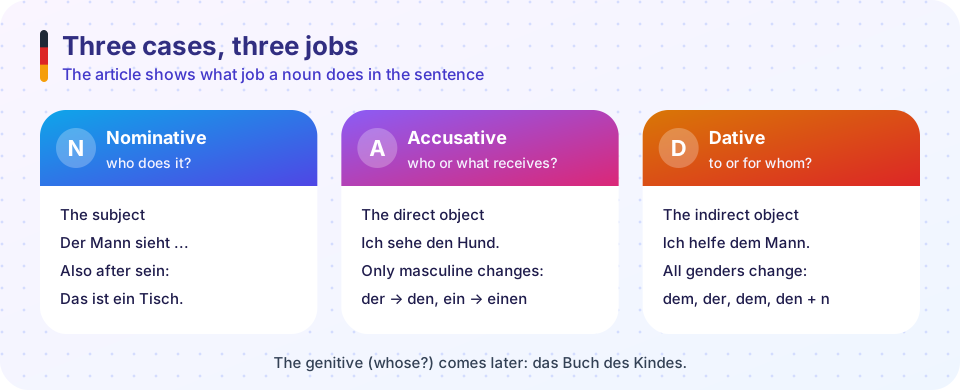
| Nominative | the subject: who or what does the action; also after sein | Who? What? | Der Mann sieht den Hund. |
| Accusative | the direct object: who or what receives the action; after some prepositions | Whom? What? | Der Mann sieht den Hund. |
| Dative | the indirect object: to or for whom; after some prepositions and verbs | To whom? | Der Mann gibt dem Kind das Buch. |
| Genitive | possession: whose | Whose? | das Buch des Kindes (later) |
English shows the same distinctions only in pronouns: I see him, he sees me. German does it with articles too, and the beautiful result is flexible word order: Den Hund sieht der Mann means exactly the same as Der Mann sieht den Hund, because the articles show the roles. In English, swapping them would change the meaning.
The article table at a glance
You will learn this table piece by piece in the next lessons. Do not memorize it yet; just see its shape.
| Masculine | Feminine | Neuter | Plural | |
|---|---|---|---|---|
| Nominative | der | die | das | die |
| Accusative | den | die | das | die |
| Dative | dem | der | dem | den (+ n) |
Look at this table: only a few cells differ from the nominative. The accusative changes only the masculine (der becomes den). That is a huge simplification: feminine, neuter and plural look the same in the nominative and the accusative. The dative changes all genders, and the plural dative adds an -n to the noun when possible.
Three jobs for nouns
The articles
Accusative changes one thing
Dative changes all
Your roadmap through chapter 3
- Gender and the nominative. How to learn genders, clues from word endings, definite and indefinite articles, and the verb sein.
- The accusative case. Direct objects, den and einen, accusative prepositions and the verb haben.
- The dative case. Indirect objects, dem/der/dem/den, dative prepositions and verbs, and personal pronouns.
- Plural nouns. The five plural patterns and how to learn them.
- Chapter 3 review. A summary table, a poster and a ten-question quiz.
How to learn the article table
Learn in chunks and sentences, not as a grid of 16 forms. Ich sehe den Mann. Ich kaufe einen Apfel. Ich gebe dem Kind ein Buch. Each sentence carries a case marker in its natural place. Make a habit: when you meet a new noun, say it with der/die/das and with a verb that needs it: der Hund, ich sehe den Hund. Mistakes with cases are very common and are usually not a barrier to understanding, so do not let fear of the table stop you from speaking.
Common misconceptions
"Cases are pure decoration." They carry meaning: they show who does what, so word order can vary.
"I must memorize 16 forms." The grid has many repeats; only a few cells are new in the accusative and the dative.
"Gender follows logic." It does not. A girl is das Mädchen (neuter), a spoon is der Löffel, a fork is die Gabel, a knife is das Messer. Learn the article with the noun.
Try it
Press Run (or Ctrl + Enter) to see the result here.
Program input · what you'd type while the program runs
Type the answers before you press Run, one per line. Each time the program reads a line (with input()), it gets the next line from this box.
Check your understanding
Quick check · 4 questions
of 4 answered You scored / 4 · perfect!
-
1. What does the nominative case mark?
The nominative is the case of the subject: Der Mann sieht den Hund. -
2. In 'Ich sehe den Hund', what shows that 'Hund' is the object?
'den' is the accusative masculine article, so Hund is the object. -
3. Which article is the plural nominative?
All plurals take 'die' in the nominative and accusative. -
4. Which is correct: 'Den Hund sieht der Mann' means ...?
The articles mark den Hund as the object and der Mann as the subject, so the meaning is unchanged.
Summary
- Every noun has a gender and a number; the article also shows the case.
- Nominative = subject, accusative = direct object, dative = indirect object; genitive = possession (later).
- Only the masculine changes from nominative to accusative: der/den, ein/einen.
- The dative changes all genders: dem, der, dem, den(+n).
- Learn nouns with their article, in short sentences.
Track your progress
Create a free account to tick off lessons and pick up where you left off on any device.
of German for Beginners lessons completed