Ask for and give directions in German, use zum and zur, the Sie imperative, place prepositions, and buy tickets for trains, buses and trams.
You arrive in a German-speaking city, your phone has no signal, and you need the train station. What do you say? Entschuldigung, wie komme ich zum Bahnhof? And what do you hear back? Probably something like Gehen Sie geradeaus und biegen Sie an der Ampel links ab. This lesson gives you both sides of that conversation.
Directions use grammar you already know: the imperative with Sie, separable verbs like abbiegen, and the dative after zu, mit and place prepositions. You will also learn transport vocabulary and how to buy a ticket.
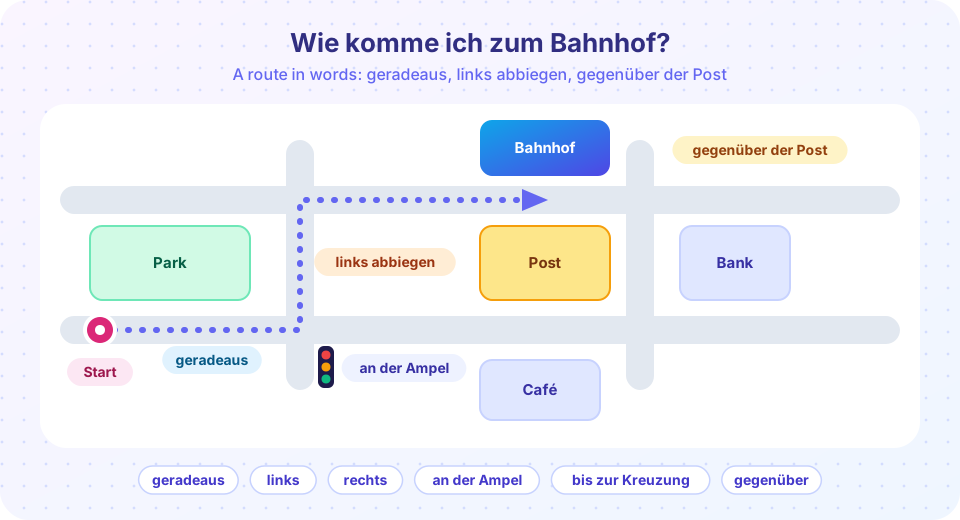
Caption: A route in words: geradeaus, an der Ampel links abbiegen, then the station is gegenüber der Post.
Start with Entschuldigung (excuse me) and then choose a question:
Wo ist der Bahnhof? (Where is the station?)
Wie komme ich zum Bahnhof? (How do I get to the station?)
Gibt es hier in der Nähe eine Apotheke? (Is there a pharmacy near here?)
Ist es weit von hier? (Is it far from here?)
Wie lange dauert das? (How long does that take?)
Können Sie mir bitte helfen? (Can you help me, please?)
Answer phrases: Das ist nicht weit. (It is not far.) Zu Fuß sind es zehn Minuten. (It is ten minutes on foot.) Tut mir leid, ich bin nicht von hier. (Sorry, I am not from here.)
The preposition zu (to) always takes the dative. It contracts with the article:
zu dem → zum (masculine and neuter): zum Bahnhof, zum Rathaus
zu der → zur (feminine): zur Post, zur Apotheke
So Wie komme ich zum Bahnhof? Wie komme ich zur Post? Wie komme ich zum Rathaus? The question word wohin asks for the target; wo asks where something is. For people and some places zu appears without the article: Ich gehe zu Fuß. (I walk.)
To tell someone what to do, use the imperative. In the formal form, put the infinitive first and Sie after it:
Infinitive
Imperative (Sie)
Meaning
gehen
Gehen Sie ...
go
fahren
Fahren Sie ...
drive, go (by vehicle)
nehmen
Nehmen Sie ...
take
abbiegen
Biegen Sie ... ab.
turn
überqueren
Überqueren Sie ...
cross
folgen
Folgen Sie ...
follow
The separable verb splits, with the prefix at the end: Biegen Sie links ab. Typical phrases:
Gehen Sie geradeaus. (Go straight ahead.)
Biegen Sie links / rechts ab. (Turn left / right.)
Gehen Sie bis zur Ampel / Kreuzung. (Go as far as the traffic light / the intersection.)
Nehmen Sie die erste / zweite / dritte Straße links. (Take the first / second / third street on the left.)
Gehen Sie über die Brücke. (Cross the bridge.)
Gehen Sie am Park vorbei. (Go past the park.)
Dann sehen Sie den Bahnhof auf der linken Seite. (Then you will see the station on the left.)
With friends and children you use the du imperative: the stem without ending, Geh geradeaus! Nimm die erste Straße links! Fahr nach rechts! Note nehmen → nimm and fahren → fahr. For separable verbs: Bieg links ab.
To say where something is, use prepositions with the dative: neben (next to), gegenüber (opposite), hinter (behind), vor (in front of), zwischen (between), an (at), in (in).
Phrase
Example
neben dem / der / dem
Die Bank ist neben dem Supermarkt.
gegenüber dem / der / dem
Das Hotel ist gegenüber der Post.
hinter dem / der / dem
Das Café ist hinter dem Rathaus.
vor dem / der / dem
Der Bus hält vor der Schule.
zwischen dem / der / dem
Die Apotheke ist zwischen der Bank und dem Café.
Remember the dative articles: dem (masculine, neuter), der (feminine), den (plural, with -n on the noun).
Vehicles take the preposition mit and the dative: mit dem Bus, mit dem Zug, mit der Straßenbahn, mit der U-Bahn, mit dem Auto, mit dem Fahrrad. Walking is zu Fuß.
Eine Fahrkarte nach München, bitte. (A ticket to Munich, please.)
Einfach oder hin und zurück? (One way or return?)
Einmal einfach, bitte. / Hin und zurück, bitte.
Was kostet das? — Das macht 45 Euro.
Von welchem Gleis fährt der Zug ab? (Which platform does the train leave from?)
Der Zug hat zehn Minuten Verspätung. (The train is ten minutes late.)
Wo muss ich umsteigen? (Where do I have to change?)
In some German cities, paper tickets for buses and trams must be validated (entwerten) in a machine before the ride; check the rules in each city or use the app of the transport company. Many people also use digital tickets.
Touristin:Entschuldigung, wie komme ich zum Bahnhof?
Passant:Gehen Sie hier geradeaus bis zur Ampel. Dort biegen Sie links ab. Dann nehmen Sie die zweite Straße rechts. Der Bahnhof ist gegenüber der Post.
Touristin:Ist es weit?
Passant:Nein, zu Fuß etwa zehn Minuten.
Touristin:Vielen Dank!
Passant:Gern geschehen!
English: Tourist: Excuse me, how do I get to the station? Passer-by: Go straight ahead to the traffic light. There turn left. Then take the second street on the right. The station is opposite the post office. Tourist: Is it far? Passer-by: No, about ten minutes on foot. Tourist: Thank you very much! Passer-by: You are welcome!
<style>:root{--ink:#1e1b4b;--mut:#475569;--acc:#6366f1;--bd:#c7d2fe}*{box-sizing:border-box}body{margin:0;padding:14px;font-family:system-ui,-apple-system,'Segoe UI',sans-serif;color:var(--ink);background:linear-gradient(135deg,#faf5ff,#eff6ff)}.card{background:#fff;border-radius:18px;box-shadow:0 8px 22px rgba(67,56,202,.15);padding:16px}button{font:inherit;cursor:pointer;border:0;border-radius:999px;padding:8px 14px;background:linear-gradient(135deg,#6366f1,#8b5cf6);color:#fff;font-weight:600}button.alt{background:#eef2ff;color:#3730a3}button:disabled{opacity:.5;cursor:default}.row{display:flex;gap:8px;flex-wrap:wrap;align-items:center;margin-top:10px}.mut{color:var(--mut);font-size:.9rem}</style><style>.q{font-size:1.15rem;font-weight:600;margin:6px 0 12px}.opts{display:flex;gap:10px;flex-wrap:wrap}.opts button{background:#fff;color:var(--ink);border:2px solid var(--bd);border-radius:14px;padding:10px 18px}.opts button.good{background:#ecfdf5;border-color:#10b981;color:#047857}.opts button.bad{background:#fef2f2;border-color:#ef4444;color:#b91c1c}.fb{min-height:2.6em;margin-top:10px;font-size:.95rem}</style><divclass="card"><divclass="mut"id="prog"></div><divclass="q"id="q"></div><divclass="opts"id="opts"></div><divclass="fb"id="fb"></div><divclass="row"><buttonid="nx"disabled>Next</button><spanclass="mut"id="sc"></span></div></div><script>var items=[{"q":"Wie komme ich ___ Bahnhof? (der Bahnhof)","o":["zum","zur","zu den"],"a":0,"w":"Masculine: zu dem = zum."},{"q":"Wie komme ich ___ Post? (die Post)","o":["zum","zur","zu den"],"a":1,"w":"Feminine: zu der = zur."},{"q":"Wie komme ich ___ Rathaus? (das Rathaus)","o":["zum","zur","zu den"],"a":0,"w":"Neuter: zu dem = zum."},{"q":"Wo ist der Weg ___ Apotheke? (die Apotheke)","o":["zum","zur","zu den"],"a":1,"w":"Feminine: zur."},{"q":"Ich gehe ___ Supermarkt. (der Supermarkt)","o":["zum","zur","zu den"],"a":0,"w":"Masculine: zum."},{"q":"Wir fahren ___ Schule. (die Schule)","o":["zum","zur","zu den"],"a":1,"w":"Feminine: zur."},{"q":"Wie komme ich ___ Flughafen? (der Flughafen)","o":["zum","zur","zu den"],"a":0,"w":"Masculine: zum."},{"q":"Wo ist der Weg ___ Bank? (die Bank)","o":["zum","zur","zu den"],"a":1,"w":"Feminine: zur."}];var i=0,score=0,answered=false;functionshow(){var it=items[i];answered=false;
document.getElementById('prog').textContent='Question '+(i+1)+' of '+items.length;
document.getElementById('q').textContent=it.q;
document.getElementById('fb').textContent='';
document.getElementById('nx').disabled=true;var box=document.getElementById('opts');box.innerHTML='';
it.o.forEach(function(t,k){var b=document.createElement('button');b.textContent=t;
b.onclick=function(){if(answered)return;answered=true;var ok=k===it.a;if(ok)score++;
b.className=ok?'good':'bad';if(!ok){box.children[it.a].className='good';}
document.getElementById('fb').textContent=(ok?'Correct. ':'Not quite. ')+(it.w||'');
document.getElementById('sc').textContent='Score: '+score+' / '+(i+1);
document.getElementById('nx').disabled=false;
document.getElementById('nx').textContent=(i===items.length-1)?'Start again':'Next';};
box.appendChild(b);});}
document.getElementById('nx').onclick=function(){if(i===items.length-1){i=0;score=0;document.getElementById('sc').textContent='';}else{i++;}show();};show();</script>
Build the instructions with the verb first.
Give directions
<style>:root{--ink:#1e1b4b;--mut:#475569;--acc:#6366f1;--bd:#c7d2fe}*{box-sizing:border-box}body{margin:0;padding:14px;font-family:system-ui,-apple-system,'Segoe UI',sans-serif;color:var(--ink);background:linear-gradient(135deg,#faf5ff,#eff6ff)}.card{background:#fff;border-radius:18px;box-shadow:0 8px 22px rgba(67,56,202,.15);padding:16px}button{font:inherit;cursor:pointer;border:0;border-radius:999px;padding:8px 14px;background:linear-gradient(135deg,#6366f1,#8b5cf6);color:#fff;font-weight:600}button.alt{background:#eef2ff;color:#3730a3}button:disabled{opacity:.5;cursor:default}.row{display:flex;gap:8px;flex-wrap:wrap;align-items:center;margin-top:10px}.mut{color:var(--mut);font-size:.9rem}</style><style>.tgt{min-height:54px;border:2px dashed var(--bd);border-radius:14px;padding:8px;display:flex;gap:6px;flex-wrap:wrap;align-items:center;background:#fff}.w{background:#eef2ff;color:#3730a3;border:2px solid var(--bd);border-radius:12px;padding:6px 12px;font-weight:600;cursor:pointer}.w.used{opacity:.3;cursor:default}.t{background:linear-gradient(135deg,#6366f1,#8b5cf6);color:#fff;border-radius:12px;padding:6px 12px;font-weight:600}.en{font-size:1.1rem;font-weight:600;margin-bottom:10px}.fb{min-height:1.6em;margin-top:8px}</style><divclass="card"><divclass="mut"id="prog"></div><divclass="en"id="en"></div><divclass="tgt"id="tgt"aria-live="polite"></div><divclass="row"id="bank"style="margin-top:12px"></div><divclass="fb"id="fb"></div><divclass="row"><buttonid="chk">Check</button><buttonclass="alt"id="clr">Clear</button><buttonclass="alt"id="nx">Next</button><spanclass="mut"id="sc"></span></div></div><script>var items=[{"en":"Go straight ahead.","words":["Gehen","Sie","geradeaus"],"ok":["Gehen Sie geradeaus"]},{"en":"Turn left at the traffic light.","words":["Biegen","Sie","an","der","Ampel","links","ab"],"ok":["Biegen Sie an der Ampel links ab"]},{"en":"Take the second street on the right.","words":["Nehmen","Sie","die","zweite","Straße","rechts"],"ok":["Nehmen Sie die zweite Straße rechts"]},{"en":"The station is opposite the post office.","words":["Der","Bahnhof","ist","gegenüber","der","Post"],"ok":["Der Bahnhof ist gegenüber der Post","Gegenüber der Post ist der Bahnhof"]},{"en":"I go to school by bus.","words":["Ich","fahre","mit","dem","Bus","zur","Schule"],"ok":["Ich fahre mit dem Bus zur Schule","Mit dem Bus fahre ich zur Schule"]},{"en":"Where do I have to change trains?","words":["Wo","muss","ich","umsteigen"],"ok":["Wo muss ich umsteigen"]}];var i=0,score=0,picked=[],solved=false;functionnorm(s){return s.toLowerCase().replace(/[.,?!]/g,'').replace(/s+/g,' ').trim();}functionshuffle(a){a=a.slice();for(var k=a.length-1;k>0;k--){var r=Math.floor(Math.random()*(k+1));var t=a[k];a[k]=a[r];a[r]=t;}return a;}functionrender(){var it=items[i];
document.getElementById('prog').textContent='Sentence '+(i+1)+' of '+items.length;
document.getElementById('en').textContent=it.en;var tg=document.getElementById('tgt');tg.innerHTML='';
picked.forEach(function(k){var s=document.createElement('span');s.className='t';s.textContent=it.shuf[k];tg.appendChild(s);});var bank=document.getElementById('bank');bank.innerHTML='';
it.shuf.forEach(function(w,k){var b=document.createElement('button');b.className='w'+(picked.indexOf(k)>=0?' used':'');b.textContent=w;
b.onclick=function(){if(solved||picked.indexOf(k)>=0)return;picked.push(k);render();};
bank.appendChild(b);});}functionload(){var it=items[i];it.shuf=shuffle(it.words);picked=[];solved=false;document.getElementById('fb').textContent='';render();}
document.getElementById('clr').onclick=function(){picked=[];solved=false;document.getElementById('fb').textContent='';render();};
document.getElementById('chk').onclick=function(){if(solved)return;var it=items[i];var s=norm(picked.map(function(k){return it.shuf[k];}).join(' '));var good=it.ok.some(function(o){returnnorm(o)===s;});if(good){solved=true;score++;document.getElementById('fb').textContent='Correct! '+it.ok[0]+'.';}else{document.getElementById('fb').textContent='Not quite. Check the verb position and try again.';}
document.getElementById('sc').textContent='Score: '+score;};
document.getElementById('nx').onclick=function(){i=(i+1)%items.length;load();};load();</script>
Fill in the gaps.
Directions: fill the gaps
<style>:root{--ink:#1e1b4b;--mut:#475569;--acc:#6366f1;--bd:#c7d2fe}*{box-sizing:border-box}body{margin:0;padding:14px;font-family:system-ui,-apple-system,'Segoe UI',sans-serif;color:var(--ink);background:linear-gradient(135deg,#faf5ff,#eff6ff)}.card{background:#fff;border-radius:18px;box-shadow:0 8px 22px rgba(67,56,202,.15);padding:16px}button{font:inherit;cursor:pointer;border:0;border-radius:999px;padding:8px 14px;background:linear-gradient(135deg,#6366f1,#8b5cf6);color:#fff;font-weight:600}button.alt{background:#eef2ff;color:#3730a3}button:disabled{opacity:.5;cursor:default}.row{display:flex;gap:8px;flex-wrap:wrap;align-items:center;margin-top:10px}.mut{color:var(--mut);font-size:.9rem}</style><style>.q{display:flex;gap:8px;align-items:center;flex-wrap:wrap;padding:8px 0;border-bottom:1px solid #eef2ff;font-size:1.05rem}input{font:inherit;padding:6px 10px;border:2px solid var(--bd);border-radius:10px;width:9em}input.ok{border-color:#10b981;background:#ecfdf5}input.no{border-color:#ef4444;background:#fef2f2}.h{font-size:.85rem;color:var(--mut)}</style><divclass="card"><divid="list"></div><divclass="row"><buttonid="chk">Check answers</button><buttonclass="alt"id="rev">Show answers</button><spanid="score"class="mut"></span></div><divclass="mut"style="margin-top:8px">Capitals do not matter. Type ä ö ü ß, or use ae oe ue ss.</div></div><script>var items=[{"s":"Wie komme ich ___ Bahnhof?","a":"zum"},{"s":"Gehen Sie ___ bis zur Ampel.","a":"geradeaus"},{"s":"Biegen Sie links ___.","a":"ab"},{"s":"Die Bank ist neben ___ Supermarkt.","a":"dem","h":"der Supermarkt"},{"s":"Das Hotel ist gegenüber ___ Post.","a":"der","h":"die Post"},{"s":"Ich fahre mit ___ Bus.","a":"dem","h":"der Bus"},{"s":"Ich fahre mit ___ U-Bahn.","a":"der","h":"die U-Bahn"},{"s":"Eine Fahrkarte nach München, ___.","a":"bitte"},{"s":"___ oder hin und zurück?","a":"Einfach"},{"s":"Von welchem ___ fährt der Zug ab?","a":"Gleis"}];functionnorm(s){return s.toLowerCase().trim().replace(/\s+/g,' ').replace(/ae/g,'ä').replace(/oe/g,'ö').replace(/ue/g,'ü').replace(/ss/g,'ß');}functionnormAns(s){returnnorm(s).replace(/ß/g,'ß');}var list=document.getElementById('list');
items.forEach(function(it,n){var d=document.createElement('div');d.className='q';var parts=it.s.split('___');
d.appendChild(document.createTextNode(parts[0]));var inp=document.createElement('input');inp.id='i'+n;inp.setAttribute('aria-label','Answer '+(n+1));d.appendChild(inp);
d.appendChild(document.createTextNode(parts[1]||''));if(it.h){var h=document.createElement('span');h.className='h';h.textContent='('+it.h+')';d.appendChild(h);}
list.appendChild(d);});functionok(it,v){var arr=Array.isArray(it.a)?it.a:[it.a];var x=normAns(v);return arr.some(function(a){returnnormAns(a)===x;});}
document.getElementById('chk').onclick=function(){var right=0;
items.forEach(function(it,n){var e=document.getElementById('i'+n);var g=ok(it,e.value);e.className=g?'ok':'no';if(g)right++;});
document.getElementById('score').textContent=right+' of '+items.length+' correct';};
document.getElementById('rev').onclick=function(){
items.forEach(function(it,n){var e=document.getElementById('i'+n);e.value=Array.isArray(it.a)?it.a[0]:it.a;e.className='ok';});};</script>
And flash cards for the key words.
Directions and transport
<style>:root{--ink:#1e1b4b;--mut:#475569;--acc:#6366f1;--bd:#c7d2fe}*{box-sizing:border-box}body{margin:0;padding:14px;font-family:system-ui,-apple-system,'Segoe UI',sans-serif;color:var(--ink);background:linear-gradient(135deg,#faf5ff,#eff6ff)}.card{background:#fff;border-radius:18px;box-shadow:0 8px 22px rgba(67,56,202,.15);padding:16px}button{font:inherit;cursor:pointer;border:0;border-radius:999px;padding:8px 14px;background:linear-gradient(135deg,#6366f1,#8b5cf6);color:#fff;font-weight:600}button.alt{background:#eef2ff;color:#3730a3}button:disabled{opacity:.5;cursor:default}.row{display:flex;gap:8px;flex-wrap:wrap;align-items:center;margin-top:10px}.mut{color:var(--mut);font-size:.9rem}</style><style>.fc{height:150px;display:flex;align-items:center;justify-content:center;text-align:center;font-size:1.5rem;font-weight:700;border-radius:18px;cursor:pointer;padding:12px;user-select:none}.front{background:linear-gradient(135deg,#6366f1,#8b5cf6);color:#fff}.back{background:#fff;color:var(--ink);border:2px solid var(--bd)}</style><divclass="card"><divid="fc"class="fc front"tabindex="0"role="button"aria-label="Flash card, press to flip"></div><divclass="mut"id="cnt"style="margin-top:8px"></div><divclass="row"><buttonclass="alt"id="prev">Back</button><buttonid="flip">Flip</button><buttonclass="alt"id="next">Next</button><buttonclass="alt"id="shuf">Shuffle</button><buttonclass="alt"id="say">Listen</button></div><divclass="mut"id="note"style="margin-top:8px">Click the card to flip it. Listen uses your browser's voice if it is available.</div></div><script>var cards=[["geradeaus","straight ahead"],["links / rechts","left / right"],["die Ampel","traffic light"],["die Kreuzung","intersection"],["die Haltestelle","stop"],["der Bahnhof","station"],["Wie komme ich zum ...?","How do I get to ...?"],["Biegen Sie links ab.","Turn left."],["Ist es weit?","Is it far?"],["einfach / hin und zurück","one way / return"],["das Gleis","platform"],["die Verspätung","delay"],["umsteigen","to change (trains)"]];var i=0,showBack=false;var fc=document.getElementById('fc');functiondraw(){var c=cards[i];fc.textContent=showBack?c[1]:c[0];fc.className='fc '+(showBack?'back':'front');document.getElementById('cnt').textContent='Card '+(i+1)+' of '+cards.length;}functionflip(){showBack=!showBack;draw();}
fc.onclick=flip;fc.onkeydown=function(e){if(e.key==='Enter'||e.key===' '){e.preventDefault();flip();}};
document.getElementById('flip').onclick=flip;
document.getElementById('next').onclick=function(){i=(i+1)%cards.length;showBack=false;draw();};
document.getElementById('prev').onclick=function(){i=(i-1+cards.length)%cards.length;showBack=false;draw();};
document.getElementById('shuf').onclick=function(){for(var k=cards.length-1;k>0;k--){var r=Math.floor(Math.random()*(k+1));var t=cards[k];cards[k]=cards[r];cards[r]=t;}i=0;showBack=false;draw();};
document.getElementById('say').onclick=function(){try{var u=newSpeechSynthesisUtterance(cards[i][0]);u.lang='de-DE';window.speechSynthesis.cancel();window.speechSynthesis.speak(u);}catch(e){document.getElementById('note').textContent='Speech is not available in this preview.';}};draw();</script>