


















Lesson 22 of 50 · Present Tense and Word Order
Negation with nicht and kein
Learn how to say no in German: when to use nicht or kein, where nicht goes in the sentence, other negative words, and when to answer doch.
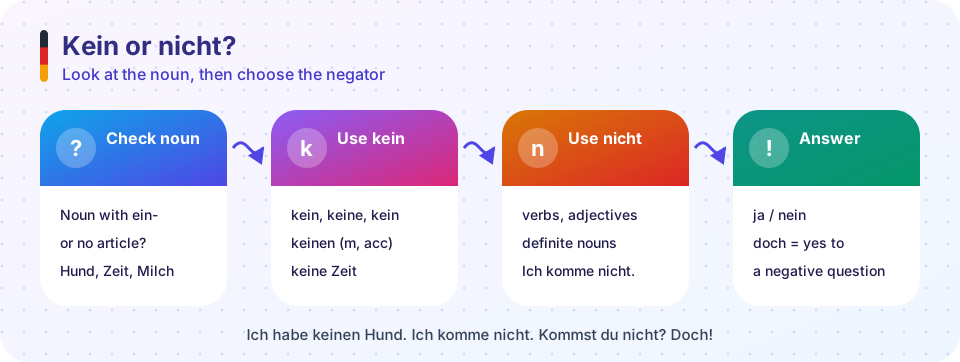
English has one small word for negation ("not") plus "no", and it needs "do" to help: "I do not have a dog." German has two main negators with a clear division of labor: kein negates nouns, and nicht negates everything else. There is no helper verb. There is also a lovely little word, doch, that gives a positive answer to a negative question. This lesson explains how to choose between nicht and kein, where to put nicht, the other negative words (nie, nichts, niemand), and how to answer correctly.
What you will learn
- the rule: kein for nouns with ein or no article, nicht for the rest
- the endings of kein in all cases
- where nicht goes in the sentence
- other negative words: nie, nichts, niemand, nirgends, noch nicht, nicht mehr
- how to answer with ja, nein and doch
Key terms
Negation (Verneinung): saying that something is not true. nicht: "not", used with verbs, adjectives, adverbs and definite nouns. kein: "no, not a, not any", used with indefinite nouns. doch: a positive answer to a negative question or statement.
kein: negating a noun
Use kein when the noun would otherwise have ein (a/an) or no article at all. The word kein is built like ein, so the endings are exactly the same as for ein, plus a plural form:
| Masculine | Feminine | Neuter | Plural | |
|---|---|---|---|---|
| Nominative | kein | keine | kein | keine |
| Accusative | keinen | keine | kein | keine |
| Dative | keinem | keiner | keinem | keinen |
Compare each positive sentence with its negative:
| Positive | Negative |
|---|---|
| Ich habe einen Hund. (acc. masc.) | Ich habe keinen Hund. (I have no dog.) |
| Das ist ein Tisch. | Das ist kein Tisch. (That is not a table.) |
| Sie hat eine Schwester. | Sie hat keine Schwester. |
| Wir haben Zeit. (no article) | Wir haben keine Zeit. (We have no time.) |
| Ich trinke Milch. | Ich trinke keine Milch. |
| Er hat Hunger. (masc.) | Er hat keinen Hunger. |
| Ich esse Äpfel. (plural) | Ich esse keine Äpfel. |
Notice: with a missing article, you choose the kein form that matches the noun's gender and case (Hunger is masculine, so keinen Hunger in the accusative). For nouns that cannot be counted (Zeit, Milch, Geld) English says "no" or "any" as well: "I have no money". For plural nouns, keine. And kein can stand alone as a pronoun: Hast du einen Stift? Nein, ich habe keinen. (No, I have none.)
nicht: negating everything else
Nicht is used in all other cases:
- Verbs: Ich komme nicht. (I am not coming.) Er arbeitet nicht. (He doesn't work.)
- Adjectives and adverbs: Das ist nicht gut. (That is not good.) Sie spricht nicht schnell. (She does not speak fast.)
- Nouns with a definite article, a possessive or a name: Das ist nicht der Bus. (That is not the bus.) Ich sehe meinen Bruder nicht. (I don't see my brother.) Ich kenne Anna nicht. (I don't know Anna.)
- Prepositional phrases: Er wohnt nicht in Berlin. (He doesn't live in Berlin.)
The question is always: does the noun have ein or no article? Then kein. Otherwise nicht.
Where does nicht go?
The exact place depends on what is negated. The practical rules:
- Negating the whole sentence (the verb): nicht goes to the end: Ich komme heute nicht. Ich kenne den Mann nicht. Ich verstehe das nicht.
- Negating one element (adjective, adverb, phrase): nicht goes right before it: Das ist nicht gut. Er kommt nicht heute, sondern morgen. (not today but tomorrow)
- Before a second verb part, a separable prefix or a place: nicht goes before it: Ich stehe nicht auf. (I'm not getting up.) Ich fahre nicht nach Berlin. Er ist nicht zu Hause.
- With sein + adjective or noun: nicht goes before the adjective: Er ist nicht müde. Das Wasser ist nicht kalt.
A good habit: put nicht as late as possible but before adjectives, adverbs of manner, places and separable prefixes. You do not need to memorize every case; you will get a feel for it.
nicht ... sondern
To contrast, use nicht ... sondern (not ... but rather): Ich bin nicht müde, sondern hungrig. (I'm not tired, but hungry.) Das ist kein Kaffee, sondern Tee. (That is not coffee but tea.) Use aber to add a contrast without a negation; use sondern after a negation to replace the first idea. Also: nicht nur ... sondern auch (not only ... but also): Er spricht nicht nur Deutsch, sondern auch Spanisch.
Other negative words
| Word | Meaning | Example |
|---|---|---|
| nie / niemals | never | Ich trinke nie Kaffee. |
| nichts | nothing | Ich weiß nichts. |
| niemand | nobody | Niemand ist hier. |
| nirgends / nirgendwo | nowhere | Ich finde ihn nirgends. |
| nicht mehr | no longer | Er wohnt nicht mehr hier. |
| kein ... mehr | no more | Wir haben kein Brot mehr. |
| noch nicht | not yet | Ich bin noch nicht fertig. (I am not finished yet.) |
| gar nicht | not at all | Das ist gar nicht schlimm. |
| überhaupt nicht | not at all | Ich mag das überhaupt nicht. |
Do not stack negatives: say Ich sehe niemanden (I see nobody; niemanden is the accusative), never Ich sehe nicht niemanden. Words like nie and niemand already contain the negation.
ja, nein and doch
You answer a positive question with ja or nein: Kommst du? Ja, ich komme. / Nein, ich komme nicht. For a negative question, German has a special word for "yes, I do": doch.
- Kommst du nicht? (Aren't you coming?) → Doch, ich komme. (Yes, I am.) or Nein, ich komme nicht. (No, I'm not.)
- Hast du keinen Hunger? (Aren't you hungry?) → Doch, ich habe Hunger. (Yes, I am hungry.)
- Das stimmt nicht! (That's not true!) → Doch, das stimmt! (Yes, it is!)
Think of doch as "on the contrary, yes". In English, "yes" and "no" are confusing after a negative question ("Don't you like it?" "Yes" could mean either); German removes the ambiguity with doch. It is also used as a small word to make requests friendlier (Komm doch mit! = come along, why don't you) and to express contrast (Es ist doch klar!).
Dialogue: an invitation
Lena: Kommst du heute nicht zur Party? — Aren't you coming to the party today? Tom: Doch, ich komme. Aber ich habe kein Geschenk. — Yes, I am coming. But I have no present. Lena: Das macht nichts. Du brauchst kein Geschenk. — It doesn't matter. You don't need a present. Tom: Und Essen? Hat jemand Essen? — And food? Does anyone have food? Lena: Nein, niemand. Wir bestellen Pizza. — No, nobody. We are ordering pizza.
Common misconceptions
"nicht always goes before the noun." It goes mostly at the end or before the adjective/adverb; nouns with ein use kein.
"Ich habe nicht einen Hund." Use Ich habe keinen Hund. (nicht einen means "not one single dog" and is a special emphasis.)
"I answer Ja to Kommst du nicht?" Use Doch for "yes, I am coming".
"Double negatives are acceptable like in some English dialects." In standard German, do not stack them.
Try it
Press Run (or Ctrl + Enter) to see the result here.
Program input · what you'd type while the program runs
Type the answers before you press Run, one per line. Each time the program reads a line (with input()), it gets the next line from this box.
Check your understanding
Quick check · 5 questions
of 5 answered You scored / 5 · perfect!
-
1. How do you say 'I have no brother'?
Bruder is masculine, accusative: keinen Bruder. -
2. Which negation is correct for 'Das ist mein Buch'?
With a possessive, use nicht. -
3. 'Kommst du nicht?' How do you answer 'Yes, I am coming'?
doch is the positive answer to a negative question. -
4. What does 'noch nicht' mean?
Ich bin noch nicht fertig = I am not finished yet. -
5. Where does 'nicht' go in 'Ich verstehe das ...'?
To negate the whole sentence, nicht usually goes at the end: Ich verstehe das nicht.
Summary
- Use kein for nouns with ein or no article; use nicht for verbs, adjectives, adverbs and nouns with the, my or a name.
- kein declines like ein: kein, keine, kein, keine; keinen in the accusative masculine; keinem, keiner, keinem, keinen in the dative.
- nicht goes at the end for whole-sentence negation and before adjectives, places and separable prefixes.
- Other negatives: nie, nichts, niemand, nirgends, noch nicht, nicht mehr.
- Answer a negative question with doch (yes) or nein (no).
Next: Separable verbs
Track your progress
Create a free account to tick off lessons and pick up where you left off on any device.
of German for Beginners lessons completed