


















Lesson 26 of 50 · Daily Life and Questions
Questions: W-Words and Yes/No Questions
Learn how to ask questions in German: the W-words (wer, was, wo, wann, warum, wie), verb-first yes/no questions, the answer doch, and classroom phrases.
Asking questions is the fastest way to learn any language. In German you only need to master two patterns. A W-question starts with a question word, and a yes/no question starts with the verb. Almost everything else you already know: the verb forms from the present tense and the cases you met earlier work in questions exactly as they do in statements.
This lesson gives you the question words, the word order, the three "where" words that confuse everyone at first (wo, wohin, woher), the special answer doch, and a set of phrases you can use in a classroom or when you are lost in a conversation.
What you will learn
- how to build W-questions and yes/no questions with the right word order
- the main question words and what each one asks for
- the difference between wo, woher and wohin
- when to answer with doch instead of ja
- useful phrases for asking someone to repeat or explain
Key terms
- das Fragewort (question word): the first word of a W-question.
- die Ergänzungsfrage (W-question): a question with a question word, answered with information.
- die Entscheidungsfrage (yes/no question): a question answered with ja or nein.
- doch: the answer that says "yes" to a negative question.
- das Verb an erster Stelle (verb in first place): the signal of a yes/no question.
W-questions: question word, then the verb
A W-question puts the question word first and the conjugated verb second, then the subject. That is exactly the "verb in second place" rule of normal German statements. You only add a question word in front.
| Question word | Meaning | Example | Possible answer |
|---|---|---|---|
| wer | who | Wer ist das? | Das ist Anna. |
| was | what | Was machst du? | Ich lerne Deutsch. |
| wo | where (position) | Wo wohnst du? | Ich wohne in Hamburg. |
| woher | where from | Woher kommst du? | Ich komme aus Kanada. |
| wohin | where to | Wohin fährst du? | Ich fahre nach Berlin. |
| wann | when | Wann kommt der Zug? | Um zehn Uhr. |
| warum | why | Warum lernst du Deutsch? | Für meine Arbeit. |
| wie | how | Wie geht es dir? | Gut, danke. |
| wie viel | how much | Wie viel kostet das? | Fünf Euro. |
| wie viele | how many | Wie viele Geschwister hast du? | Zwei. |
| wie lange | how long | Wie lange bleibst du? | Eine Woche. |
| wie oft | how often | Wie oft fährst du Rad? | Jeden Tag. |
Notice the pattern in every example: question word, verb, subject. Was machst du? has machst in second position, the same place it takes in Du machst viel. If you remember "verb second", you cannot go wrong.
Wie viel or wie viele?
Use wie viel with something you cannot count or a single amount of money: Wie viel Zeit hast du? Wie viel kostet der Kaffee? Use wie viele with a plural noun: Wie viele Kinder hast du? Both are written as two words.
Wer, wen, wem: cases inside questions
Wer asks about the subject (the nominative): Wer wohnt hier? If the person you ask about is the direct object, German uses wen: Wen siehst du? (Whom do you see?). For the indirect object, use wem: Wem gehört das Buch? (Who does the book belong to?). These are the same cases you already know, in question form.
Welch- and was für ein
Welcher, welche, welches means "which" and takes the ending of der, die, das: Welcher Tag ist heute? (der Tag), Welche Farbe magst du? (die Farbe), Welches Buch liest du? (das Buch). To ask about the kind of thing, use was für ein: Was für ein Auto hast du? (What kind of car do you have?).
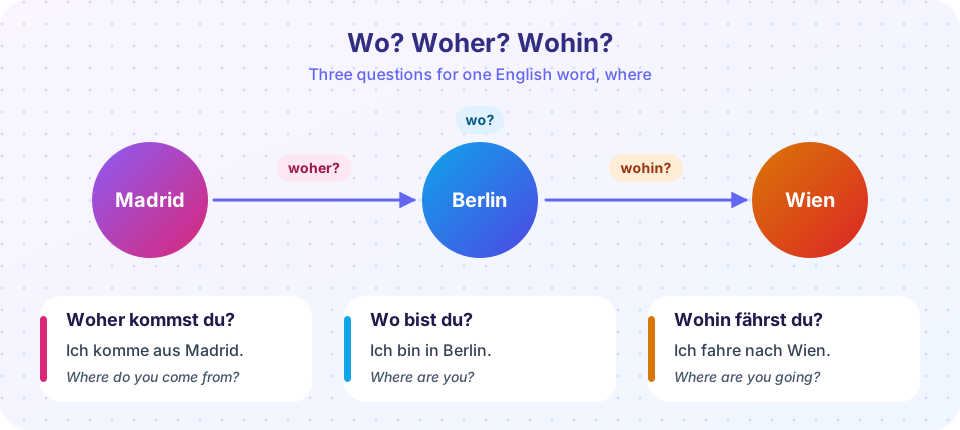
Wo, wohin, woher: the great trio
English has just one word, "where", for three different questions. German splits them:
- Wo? asks about a position, the place where something is: Wo ist der Bahnhof? (Where is the station?)
- Woher? asks about the origin, the place something comes from: Woher kommst du?
- Wohin? asks about the destination, the place something goes to: Wohin gehst du?
The little words -her and -hin are the key. Her means "toward the speaker" or "from there", and hin means "away from the speaker". You can also split the word: Wo kommst du her? and Wo gehst du hin? are very common in speech.
Be careful with answers. After wohin, many prepositions behave differently: Ich gehe in die Schule (accusative, movement), but Ich bin in der Schule (dative, position). You will study that pairing later; for now, notice that the question word already tells you which one to use.
Yes/no questions: the verb jumps to the front
For a yes/no question, move the conjugated verb to the first place and keep everything else in the same order:
| Statement | Yes/no question |
|---|---|
| Du kommst aus Kanada. | Kommst du aus Kanada? |
| Sie spricht Deutsch. | Spricht sie Deutsch? |
| Das ist teuer. | Ist das teuer? |
| Ihr habt Hunger. | Habt ihr Hunger? |
No helper verb like English "do" is needed. Do you speak German? is just Sprichst du Deutsch? The voice also rises at the end, as in English. In a W-question the voice usually falls.
You can add oder? or nicht wahr? to a statement to ask for agreement: Das Wetter ist schön, oder? In speech you will also hear ne? in northern Germany and gell? in the south and in Austria.
Ja, nein and doch
When someone asks a normal question, you answer with ja or nein: Bist du müde? Ja, ich bin müde. But when the question is negative, German has a third answer. If you want to disagree with the negative and say "yes, it is", use doch:
- Hast du keinen Hunger? (Aren't you hungry?) — Doch, ich habe Hunger! (Yes, I am hungry.)
- Hast du keinen Hunger? — Nein, ich habe keinen Hunger. (No, I am not.)
Doch means "on the contrary". It is easy to misuse, because English says "yes" in both cases. Think of doch as "yes, despite what you assumed."
When you are unsure, answer the question with a full short sentence: Doch, ich habe Hunger. or Nein, ich habe keinen Hunger. A full sentence is never confusing.
Polite phrases for learners
These ready-made questions will save you in the first months. Learn them as chunks.
| German | English |
|---|---|
| Wie bitte? | Pardon? / What was that? |
| Können Sie das bitte wiederholen? | Could you repeat that, please? |
| Können Sie langsamer sprechen? | Could you speak more slowly? |
| Was bedeutet das? | What does that mean? |
| Wie sagt man „thank you“ auf Deutsch? | How do you say "thank you" in German? |
| Wie schreibt man das? | How do you spell that? |
| Sprechen Sie Englisch? | Do you speak English? |
| Ich verstehe nicht. | I do not understand. |
Use Sie (formal) with strangers, shop assistants and older people, and du (informal) with friends, children and fellow students. Chapter 8 returns to this choice.
Common misconceptions
- "I need a word like 'do' to ask a question." No. German questions use word order only: Sprichst du Deutsch?
- "Wo means both where and where to." In German wo is only the position. For a destination use wohin, for an origin use woher.
- "I always answer a negative question with ja or nein." To contradict the negative, say doch.
Try it
First practice the question words in context. Type the missing question word in each gap.
Now drill the phrases for classroom survival with flash cards.
Check your understanding
Quick check · 5 questions
of 5 answered You scored / 5 · perfect!
-
1. Which is the correct W-question?
The question word comes first, then the verb in second place, then the subject. -
2. You want to ask where someone is traveling to. Which question word do you use?
Wohin asks about the destination (movement towards a place). -
3. How do you turn 'Sie spricht Deutsch' into a yes/no question?
Move the conjugated verb to the front: Spricht sie Deutsch? -
4. Someone asks 'Hast du keine Zeit?' and you actually do have time. What do you say?
Doch is the yes that contradicts a negative question. -
5. Which phrase asks someone to repeat what they said politely?
Wie bitte? means 'Pardon?' and is the standard polite request to repeat.
Summary
- A W-question is: question word, verb, subject. The verb stays in second place.
- A yes/no question starts with the verb: Kommst du aus Kanada?
- Wo = where (position), woher = where from, wohin = where to.
- Wie viel goes with amounts, wie viele with plurals.
- Say doch to say yes to a negative question.
- Wie bitte? and Können Sie das wiederholen? are your best friends while learning.
Next: Numbers, time and dates
Track your progress
Create a free account to tick off lessons and pick up where you left off on any device.
of German for Beginners lessons completed