


















Lesson 6 of 50 · Sounds, Greetings and Basics
Chapter 2 overview: Sounds, greetings and basics
Overview of chapter 2: how German spelling maps to sound, the vowels, consonants, greetings, introductions, numbers, days and time, with a preview of each lesson.
Now you start to speak. Chapter 2 gives you the sounds of German, the first real conversations, and the small set of words that appear in every day: numbers, days of the week, and the clock. The most encouraging fact about German pronunciation is that it is far more regular than English. English spelling is full of surprises (think of "though, through, tough"), but German letters nearly always make the same sound. Once you know the rules, you can read any German word aloud, even one you have never met.
What you will learn
- the big picture of German pronunciation and how this chapter is organized
- eight spelling-to-sound patterns that surprise English speakers most
- what each lesson in chapter 2 will teach you
Key terms
Phoneme: a distinct sound of a language. IPA: the International Phonetic Alphabet, a standard way to write sounds, shown in square brackets like [aɪ]. Respelling: an English-friendly way to show a sound, like "eye" for ei. Stress: the syllable that is said louder and longer.
The big picture
A sound system has three layers: vowels, consonants and rhythm. German has more vowel sounds than most English learners expect, because every vowel can be long or short and three have umlaut versions. Its consonants include a few you may not have in English, mainly the ch sound (in ich and Buch) and the clear r. The rhythm is simple: in most German words the first syllable is stressed, and words are pronounced without the slurring that English uses for unstressed vowels.
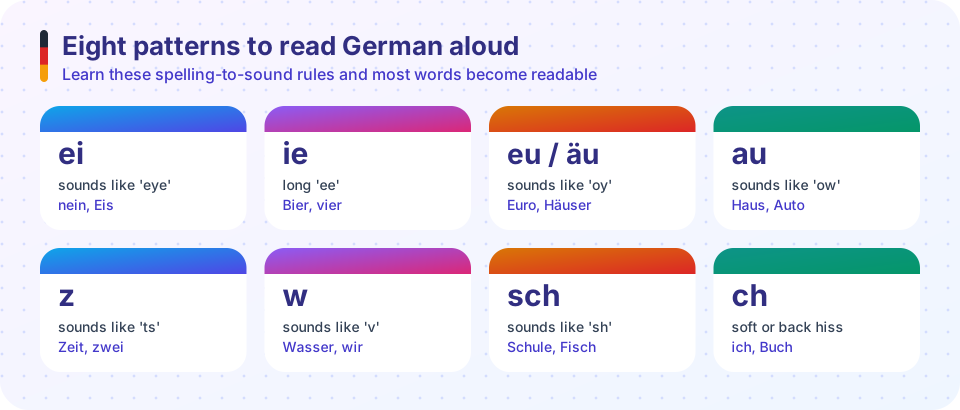
Here are the eight patterns that matter most. Each is explained in detail in the next two lessons.
| Spelling | Sounds like | Example |
|---|---|---|
| ei | "eye" | ein (one), nein (no) |
| ie | "ee" (long) | Bier (beer), vier (four) |
| eu, äu | "oy" | Euro, Häuser (houses) |
| au | "ow" as in "cow" | Auto, Haus (house) |
| z | "ts" | Zeit (time), zwei (two) |
| w | "v" | Wasser (water), wie (how) |
| sch | "sh" | Schule (school), Fisch (fish) |
| ch | a hiss in the throat, not "k" | ich (I), Buch (book) |
Reading rules like these are called grapheme-phoneme correspondences, and they are consistent. If you learn them once, you will never again need to ask how a German word is pronounced. A few foreign loanwords break the rules, but they are rare.
Why start with sounds?
Because pronunciation is a form of memory. When you learn a word by looking at it only, your brain stores the English-reading version, and that is how people end up saying "Wasser" like "wasser" with a W. When you learn it with the right sounds, you also notice the spelling patterns, and listening gets easier. Poor pronunciation in German usually does not stop people from understanding you, but good pronunciation gets you much better reactions: people answer you in German instead of switching to English.
Say what you see
Vowels
Consonants and stress
Greetings
Numbers and time
Your roadmap through chapter 2
- Vowels and umlauts. Long and short vowels, diphthongs (ei, ie, eu, au) and the three umlauts, with minimal pairs to train your ear.
- Consonants and stress. The ich-sound and ach-sound, sch, sp and st, the German r, z, w, v and s, final devoicing and where to stress a word.
- Greetings and introductions. Hello and goodbye for different times and places, the formal and informal "you" (Sie and du), telling your name, origin and job, and your first dialogue.
- Numbers, days and time. Counting from zero to one hundred, the strange order of two-digit numbers, days, months and telling the time.
- Chapter 2 review. A summary poster, a recap table and a ten-question quiz.
How to use this chapter
Do not try to perfect every sound on the first pass. Read each lesson, say the examples aloud, and move on. Then return in a few days: your ear will have improved, and the second pass is much faster. Record yourself on your phone and compare it with a native speaker video or the optional "Listen" buttons in the drills. If you can find a language partner, ask them to correct the three sounds that matter most: the ch, the ü and the r.
Common misconceptions
"German is harsh and guttural." Only a few sounds are throaty, and most of German is clear and rhythmic. The reputation comes from film and cartoons.
"I must roll my r." No. In standard German the r is made in the back of the throat or vocalized, not rolled with the tongue tip. Lesson 3 explains.
"I can guess the vowel length from English." Not always. German has clear rules: vowels before a double consonant are short; vowels followed by h or a single consonant are usually long.
Try it
Press Run (or Ctrl + Enter) to see the result here.
Program input · what you'd type while the program runs
Type the answers before you press Run, one per line. Each time the program reads a line (with input()), it gets the next line from this box.
Check your understanding
Quick check · 4 questions
of 4 answered You scored / 4 · perfect!
-
1. How is German 'ei' (as in 'nein') pronounced?
'ei' always sounds like English 'eye': nein (nine), Eis (ice). -
2. How is the German 'w' in 'Wasser' pronounced?
German w sounds like English v: 'VAS-ser'. -
3. Which syllable is usually stressed in German words?
Most native German words carry the stress on the first syllable, though loanwords can differ. -
4. Is German spelling more or less regular than English spelling?
German letters and letter groups nearly always make the same sound, so you can read new words aloud.
Summary
- German pronunciation is regular, so a handful of rules lets you read any word aloud.
- Eight patterns (ei, ie, eu, au, z, w, sch, ch) cover the most common surprises.
- Chapter 2 teaches vowels, consonants and stress, greetings, introductions, numbers, days and time.
- Practice aloud and revisit the sounds after a few days.
Next: Vowels and umlauts
Track your progress
Create a free account to tick off lessons and pick up where you left off on any device.
of German for Beginners lessons completed