Lesson 35 of 50 · Modal Verbs, Adjectives and Subordinate Clauses
Chapter 7 Overview: Modal Verbs, Adjectives and Subordinate Clauses
See the big picture of Chapter 7: modal verbs like können and müssen, adjective endings, and subordinate clauses with weil, dass and wenn.
Chapter 7 is the chapter where German starts to sound like German. You will learn three tools that turn short sentences into real, flexible speech: modal verbs (ich kann, ich muss, ich will), adjective endings (ein großer Hund, die neue Wohnung) and subordinate clauses (..., weil ich müde bin).
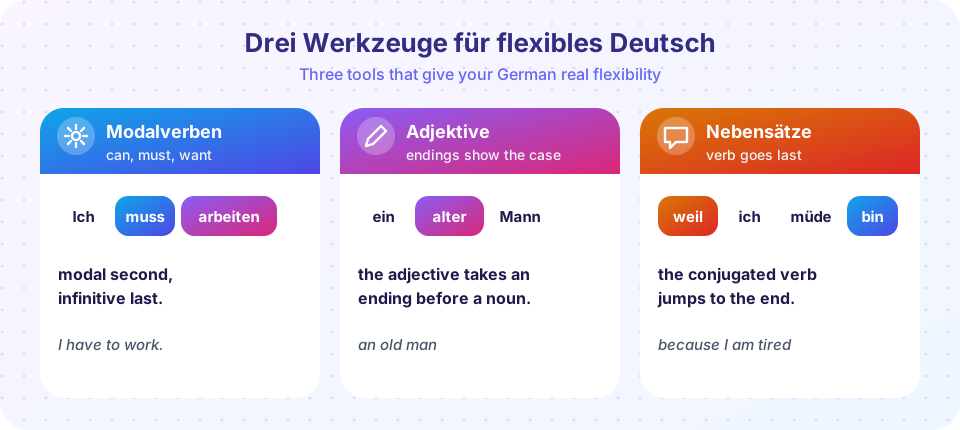
They look unrelated, but they share one idea: small words change the shape of the sentence. A modal verb pushes the main verb to the end. An adjective takes a suffix that depends on the noun. A conjunction like weil sends the verb to the end of its clause. Once you see this, the "difficult" parts of German grammar become manageable, because there are only a handful of patterns.
Caption: Three tools that give you real flexibility: modals for ability and duty, adjective endings for description, and subordinate clauses for reasons.
Compare three sentences, all with the verb arbeiten:
Plain statement:Ich arbeite heute. The verb is second.
With a modal verb:Ich muss heute arbeiten. The modal is second, the main verb is at the end.
In a subordinate clause:..., weil ich heute arbeite. The verb goes to the end of its own clause.
German uses the end of the clause for the "other" verb, which is why it is so important to listen to the end of a German sentence. A good habit when you read: look for the verb at the end of the clause, because it often carries the most important information.
English adjectives never change. German adjectives do: ein großer Hund, einen großen Hund, einem großen Hund. But you do not need to memorize a huge table. Chapter 7 shows you the idea behind the endings: the case and gender must be visible once in the noun phrase. If the article shows it, the adjective takes a plain -e or -en. If there is no article, the adjective shows it. You will practice with a small machine that builds the correct form for you.
<style>:root{--ink:#1e1b4b;--mut:#475569;--acc:#6366f1;--bd:#c7d2fe}*{box-sizing:border-box}body{margin:0;padding:14px;font-family:system-ui,-apple-system,'Segoe UI',sans-serif;color:var(--ink);background:linear-gradient(135deg,#faf5ff,#eff6ff)}.card{background:#fff;border-radius:18px;box-shadow:0 8px 22px rgba(67,56,202,.15);padding:16px}button{font:inherit;cursor:pointer;border:0;border-radius:999px;padding:8px 14px;background:linear-gradient(135deg,#6366f1,#8b5cf6);color:#fff;font-weight:600}button.alt{background:#eef2ff;color:#3730a3}button:disabled{opacity:.5;cursor:default}.row{display:flex;gap:8px;flex-wrap:wrap;align-items:center;margin-top:10px}.mut{color:var(--mut);font-size:.9rem}</style><style>.fc{height:150px;display:flex;align-items:center;justify-content:center;text-align:center;font-size:1.5rem;font-weight:700;border-radius:18px;cursor:pointer;padding:12px;user-select:none}.front{background:linear-gradient(135deg,#6366f1,#8b5cf6);color:#fff}.back{background:#fff;color:var(--ink);border:2px solid var(--bd)}</style><divclass="card"><divid="fc"class="fc front"tabindex="0"role="button"aria-label="Flash card, press to flip"></div><divclass="mut"id="cnt"style="margin-top:8px"></div><divclass="row"><buttonclass="alt"id="prev">Back</button><buttonid="flip">Flip</button><buttonclass="alt"id="next">Next</button><buttonclass="alt"id="shuf">Shuffle</button><buttonclass="alt"id="say">Listen</button></div><divclass="mut"id="note"style="margin-top:8px">Click the card to flip it. Listen uses your browser's voice if it is available.</div></div><script>var cards=[["Ich kann schwimmen.","I can swim."],["Ich muss arbeiten.","I have to work."],["Ich will schlafen.","I want to sleep."],["Ich möchte einen Kaffee.","I would like a coffee."],["ein großer Hund","a big dog"],["weil","because"],["dass","that"],["wenn","if, when"],["ob","whether, if"],["Ich weiß, dass er kommt.","I know that he is coming."]];var i=0,showBack=false;var fc=document.getElementById('fc');functiondraw(){var c=cards[i];fc.textContent=showBack?c[1]:c[0];fc.className='fc '+(showBack?'back':'front');document.getElementById('cnt').textContent='Card '+(i+1)+' of '+cards.length;}functionflip(){showBack=!showBack;draw();}
fc.onclick=flip;fc.onkeydown=function(e){if(e.key==='Enter'||e.key===' '){e.preventDefault();flip();}};
document.getElementById('flip').onclick=flip;
document.getElementById('next').onclick=function(){i=(i+1)%cards.length;showBack=false;draw();};
document.getElementById('prev').onclick=function(){i=(i-1+cards.length)%cards.length;showBack=false;draw();};
document.getElementById('shuf').onclick=function(){for(var k=cards.length-1;k>0;k--){var r=Math.floor(Math.random()*(k+1));var t=cards[k];cards[k]=cards[r];cards[r]=t;}i=0;showBack=false;draw();};
document.getElementById('say').onclick=function(){try{var u=newSpeechSynthesisUtterance(cards[i][0]);u.lang='de-DE';window.speechSynthesis.cancel();window.speechSynthesis.speak(u);}catch(e){document.getElementById('note').textContent='Speech is not available in this preview.';}};draw();</script>
Then match each conjunction with its English meaning.
Conjunctions and modals
<style>:root{--ink:#1e1b4b;--mut:#475569;--acc:#6366f1;--bd:#c7d2fe}*{box-sizing:border-box}body{margin:0;padding:14px;font-family:system-ui,-apple-system,'Segoe UI',sans-serif;color:var(--ink);background:linear-gradient(135deg,#faf5ff,#eff6ff)}.card{background:#fff;border-radius:18px;box-shadow:0 8px 22px rgba(67,56,202,.15);padding:16px}button{font:inherit;cursor:pointer;border:0;border-radius:999px;padding:8px 14px;background:linear-gradient(135deg,#6366f1,#8b5cf6);color:#fff;font-weight:600}button.alt{background:#eef2ff;color:#3730a3}button:disabled{opacity:.5;cursor:default}.row{display:flex;gap:8px;flex-wrap:wrap;align-items:center;margin-top:10px}.mut{color:var(--mut);font-size:.9rem}</style><style>.cols{display:grid;grid-template-columns:1fr 1fr;gap:10px}.it{padding:10px 12px;border-radius:12px;background:#fff;border:2px solid var(--bd);cursor:pointer;font-weight:600;text-align:center}.it.sel{border-color:#6366f1;background:#eef2ff}.it.done{border-color:#10b981;background:#ecfdf5;color:#047857;cursor:default}.it.bad{border-color:#ef4444;background:#fef2f2}</style><divclass="card"><divclass="mut">Click a German item, then its English match.</div><divclass="cols"style="margin-top:10px"><divid="L"></div><divid="R"></div></div><divclass="row"><buttonclass="alt"id="again">Shuffle again</button><spanid="msg"class="mut"></span></div></div><script>var pairs=[["weil","because"],["dass","that"],["wenn","if, when (repeated)"],["ob","whether"],["obwohl","although"],["können","can, to be able to"],["müssen","must, to have to"],["dürfen","may, to be allowed to"]];var left=null,solved=0;functionshuffle(a){a=a.slice();for(var k=a.length-1;k>0;k--){var r=Math.floor(Math.random()*(k+1));var t=a[k];a[k]=a[r];a[r]=t;}return a;}functionbuild(){
solved=0;left=null;document.getElementById('msg').textContent='';varL=document.getElementById('L'),R=document.getElementById('R');L.innerHTML='';R.innerHTML='';var idx=pairs.map(function(_,k){return k;});shuffle(idx).forEach(function(k){L.appendChild(mk(pairs[k][0],k,'L'));});shuffle(idx).forEach(function(k){R.appendChild(mk(pairs[k][1],k,'R'));});}functionmk(text,k,side){var d=document.createElement('div');d.className='it';d.textContent=text;d.style.marginBottom='8px';d.dataset.k=k;d.dataset.side=side;
d.onclick=function(){if(d.classList.contains('done'))return;if(side==='L'){document.querySelectorAll('#L .it').forEach(function(e){e.classList.remove('sel');});d.classList.add('sel');left=d;return;}if(!left)return;if(left.dataset.k===d.dataset.k){left.className='it done';d.className='it done';left=null;solved++;if(solved===pairs.length)document.getElementById('msg').textContent='All matched. Well done!';}else{d.classList.add('bad');setTimeout(function(){d.classList.remove('bad');},500);}};return d;}
document.getElementById('again').onclick=build;build();</script>