


















Lesson 3 of 49 · Getting Started
What is entrepreneurship?
Learn what entrepreneurship really means, how economists define it, what entrepreneurs actually do each day, and which popular myths to ignore.
The word entrepreneur comes from the French verb entreprendre, meaning to undertake. An entrepreneur is someone who undertakes a venture, accepting the uncertainty that comes with it. Today the word is used for everyone from a market-stall trader to the founder of a global software company, which can make it hard to know what it really means.
This lesson builds a working definition, shows how scholars have described the entrepreneur, follows three founders with very different paths, and clears away the myths that make beginners either overconfident or afraid. By the end you should be able to explain entrepreneurship in your own words and recognize it in the world around you.
What you will learn
- A practical definition of entrepreneurship and how it differs from running an established business.
- The ideas of Schumpeter, Kirzner and Knight about what entrepreneurs do.
- What entrepreneurs actually do in a typical week.
- The most common myths and the facts that replace them.
Key terms
Entrepreneur: a person who starts and organizes a new venture, accepting uncertainty about the result.
Opportunity: a gap between what customers need and what is currently offered.
Innovation: a new or noticeably improved product, process, market or method of organizing work.
Profit: revenue minus all costs; the reward and the signal that value is being created.
Intrapreneur: an employee who acts like an entrepreneur inside an existing organization.
A working definition
Textbooks offer many definitions. A useful one for this course is: entrepreneurship is the process of pursuing an opportunity by organizing resources to create value for others, under uncertainty. Four words in that sentence matter.
Opportunity means the venture starts from a real need or gap, not from a product looking for a purpose. Organizing resources means entrepreneurs often start with little: they borrow, partner, improvise and assemble money, skills and equipment from many places. Value for others means customers must gain something, because they will not pay otherwise. And uncertainty means nobody, including experts, knows in advance whether the venture will work.
Notice what the definition leaves out. It does not require employees, outside investors, a registered company or a technological invention. A person who starts a weekend repair service for bicycles pursues an opportunity, organizes resources and creates value under uncertainty. That is entrepreneurship.
How scholars describe the entrepreneur
Different thinkers emphasize different parts of the story.
Frank Knight (1921) separated measurable risk from true uncertainty. An insurer can calculate the risk of house fires; nobody can calculate the chance that a brand-new kind of product will find customers. Knight argued that entrepreneurs earn profit as a reward for bearing that uncertainty. You will study this distinction in Chapter 2.
Joseph Schumpeter (1942) saw the entrepreneur as an innovator who creates new combinations and disrupts existing patterns, the process he called creative destruction. In his view, profit comes from doing something new.
Israel Kirzner emphasized alertness. Markets are always out of balance in small ways: a product is expensive in one place and cheap in another, or a group of customers is ignored. The entrepreneur notices and acts.
Saras Sarasvathy studied experienced founders and described effectuation: instead of picking a goal and searching for means, many expert entrepreneurs start from what they have (who they are, what they know, whom they know) and see what can be built with it. You will return to this idea when you meet the entrepreneurial mindset.
These views are complementary. A single founder may bear uncertainty, innovate and notice gaps all in the same week.
What entrepreneurs actually do
Imagine a founder named Amina who runs a small company that refurbishes used laptops for schools. Her week is not glamorous. On Monday she calls three schools to learn their budgets. On Tuesday she tests a batch of repaired batteries. On Wednesday she negotiates a better price from a parts supplier. On Thursday she posts her accounts into a spreadsheet and sees that one repair type loses money. On Friday she decides to stop offering it.
Notice the mix: talking to customers, solving practical problems, negotiating, checking numbers and making decisions with incomplete information. Few of these tasks require genius; all of them require attention and follow-through. Surveys of founders often find that most of their time goes to selling, managing people and handling money rather than to the "big idea".
Three founders, three paths
- A solo service founder. Lucas cleans solar panels for homeowners. He starts with a bucket, a ladder and a phone. He has no employees, keeps all profit and grows slowly by word of mouth.
- A product founder. In 2007, Drew Houston, who later co-founded Dropbox, tested interest in his file-sync idea by posting a short demonstration video before the full product existed. Signups from the video told him that people wanted it.
- A social founder. Muhammad Yunus began lending tiny amounts to poor villagers in Bangladesh in the 1970s, a start that grew into microfinance and the Grameen Bank. His aim was social benefit, but the venture still had to cover its costs.
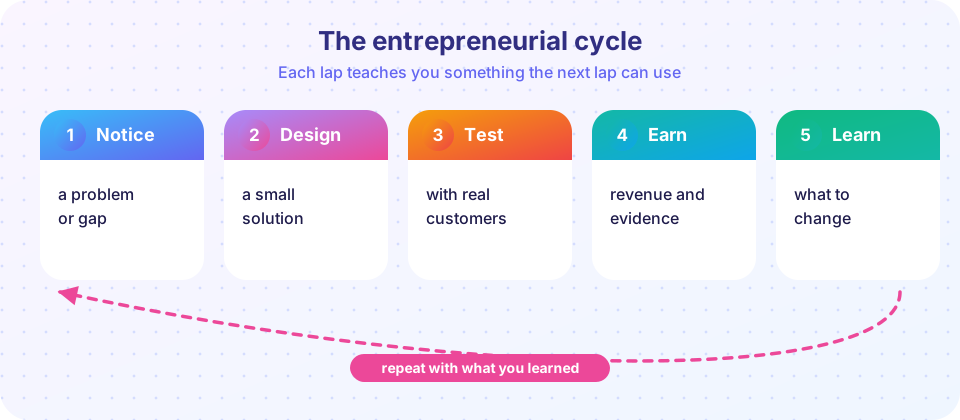
The scale, funding and goals differ, yet each began with a real need, started small, and learned from customers.
Common misconceptions
"Entrepreneurs love risk." Studies of founders describe them as careful about what they can control and as people who break big risks into small experiments. Many dislike gambling; they simply accept uncertainty when the possible reward and their ability to influence the result justify it.
"You must be young and have no obligations." Founders start ventures at every age. Having work experience, savings and industry contacts is often an advantage.
"A venture needs a patent or a new invention." Most ventures succeed by serving customers better, not by inventing a technology. A well-run laundry is entrepreneurship without a single new invention.
Why profit and purpose are not enemies
Beginners sometimes believe that earning money and doing good pull in opposite directions. In practice, a venture that cannot cover its costs cannot keep helping anyone. A clinic that runs out of money closes; a school-supplies shop that loses money on each sale disappears. Profit, for most small ventures, is not the goal itself but the proof that customers value what you offer more than what it costs you to provide it. Social enterprises, which you will meet in the next lesson, make this link explicit.
Try it
The first tool is a self-reflection exercise. Count how many of the following real founder activities you have already done in some form, such as selling something at school or organizing an event. The count shows the skills you already own.
Press Run (or Ctrl + Enter) to see the result here.
Program input · what you'd type while the program runs
Type the answers before you press Run, one per line. Each time the program reads a line (with input()), it gets the next line from this box.
The second tool compares the three founders' resource needs. It is a stylized illustration: the numbers are invented to show that different ventures need different amounts of money and time before the first sale.
Press Run (or Ctrl + Enter) to see the result here.
Program input · what you'd type while the program runs
Type the answers before you press Run, one per line. Each time the program reads a line (with input()), it gets the next line from this box.
Check your understanding
Quick check · 5 questions
of 5 answered You scored / 5 · perfect!
-
1. Which statement best matches the working definition in this lesson?
The definition has four key parts: opportunity, organizing resources, value for others and uncertainty. Inventions and investors are optional. -
2. What distinction did Frank Knight draw?
Knight argued that entrepreneurs earn profit for bearing uncertainty that cannot be calculated in advance. -
3. Which scholar emphasized alertness to gaps that others miss?
Israel Kirzner described the entrepreneur as alert to profit opportunities in markets that are out of balance. -
4. Which is a common myth about entrepreneurs?
Founders start at all ages and typically manage risk through small experiments rather than seeking it. -
5. Why is profit important even for a social venture?
A venture that cannot cover its costs cannot continue helping anyone.
Summary
- Entrepreneurship is pursuing an opportunity by organizing resources to create value for others under uncertainty.
- Knight stressed uncertainty, Schumpeter innovation, Kirzner alertness and Sarasvathy starting from what you have.
- Real founder work mixes customers, problem solving, negotiation and numbers.
- Ventures differ widely in the money and time they need, but all start from a real need.
- Myths about risk-loving, young genius inventors are wrong; profit is the proof of value, not the enemy of purpose.
Next: Types of ventures
Track your progress
Create a free account to tick off lessons and pick up where you left off on any device.
of Entrepreneurship lessons completed