


















Lesson 13 of 49 · Finding and Validating Ideas
Customer interviews
Learn how to run customer interviews that reveal real behavior: past-tense questions, avoiding compliments, taking notes and analyzing patterns across conversations.
Imagine you tell a friend, "I am thinking of making a meal-planning app. Would you use it?" Almost certainly the answer will be "Sure, sounds great!" Your friend is being kind. They are also guessing about a hypothetical future, which people do badly. If you build the app on that answer, you may find that "sure" meant "I do not want to hurt your feelings".
Customer interviews are conversations designed to avoid this trap. Their goal is not to pitch or to be encouraged; it is to learn how people actually behave, what they have already tried and what the problem costs them. Done well, ten interviews can teach you more than months of guessing. This lesson explains how.
What you will learn
- The goal of a discovery interview and why compliments are worthless.
- Good and bad question types, with rewrites.
- How to run, record and analyze ten interviews.
- How to recognize real commitment versus polite interest.
Key terms
Discovery interview: a short conversation to learn about a person's problems and behavior, not to sell.
Compliment: a positive remark that costs the speaker nothing and tells you little.
Commitment: a step that costs the customer time, money or reputation, such as paying a deposit or introducing you to a colleague.
Leading question: a question that suggests the answer you hope to hear.
Pattern: a theme that recurs across several interviews.
The central rule: ask about the past, not the future
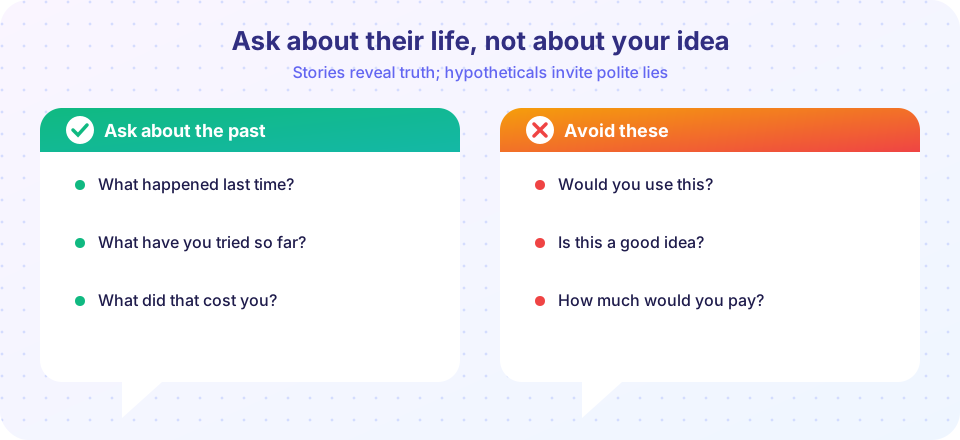
Rob Fitzpatrick's short book The Mom Test (2013) popularized a rule: ask questions so good that even your mother could not lie to you. His key advice is to talk about their life instead of your idea, to ask about specifics in the past instead of generics or opinions about the future, and to talk less and listen more.
Compare these pairs:
| Weak question | Why it fails | Better question |
|---|---|---|
| "Would you use an app that plans your meals?" | Hypothetical; invites a polite yes | "Tell me about the last time you decided what to cook for dinner." |
| "Do you think this is a good idea?" | Asks for a compliment | "What have you tried so far to make this easier?" |
| "How much would you pay for it?" | Guesswork about the future | "What do you spend on this today, including your time?" |
| "Do you have problems with meal planning?" | Leading; invites agreement | "What is the most annoying part of getting dinner on the table?" |
Notice that the better questions ask for stories: "the last time", "what did you do", "what happened next". Stories contain facts you did not think to ask about, and facts are what you need.
Structure of a 20-minute interview
- Open (2 minutes). Thank them, explain that you are learning about a topic and are not selling anything, and ask permission to take notes.
- Context (3 minutes). "Tell me a little about your day / work / home" relevant to the topic.
- Story (10 minutes). Ask about the last time the problem occurred. "What happened? What did you do? What was hard? What did it cost you?" Follow with "why" and "tell me more". Pay attention to emotion; a heavy sigh signals pain.
- Past solutions (3 minutes). "What have you tried? What do you use now? What do you like or dislike?"
- Close (2 minutes). "Is there anything else I should have asked?" and "Who else should I talk to?" The second question produces introductions, which are a form of commitment.
Do not pitch your solution until the end, and even then only briefly, to watch for a reaction. If you pitch early, the person will start reacting to the pitch rather than describing their life.
Reading answers: compliments, fluff and commitment
Learn to recognize three kinds of responses.
Compliments ("That sounds great!") carry no information. Politely move on: "Thanks. Tell me about the last time this happened."
Fluff includes generic claims ("I always cook at home"), hypotheticals ("I would definitely use that") and opinions about what others might want. Respond by asking for a specific example or the last time it occurred.
Commitment is a cost the person pays: time (agreeing to a follow-up or to test a prototype), reputation (introducing you to a boss or a friend) or money (a deposit, a pre-order, a letter of intent). If a conversation ends with warm words but no next step, treat the signal as weak. A meeting that ends with "can I show you a prototype next week?" and a "yes" is a good sign.
Whom to interview and how many
Interview people in the segment you defined, not just friends. Reach them through communities, clubs, social groups, local businesses or introductions from earlier interviews. Aim for about ten interviews to start. After five to eight conversations in a tight segment, patterns often begin to repeat; if every interview tells a different story, your segment may be too broad. Continue until new interviews stop surprising you.
Be honest and respectful. Tell people how you will use their information, keep their names private and thank them. Do not pretend to be someone you are not. If you interview minors, get permission from a parent or teacher according to local rules.
Taking notes and finding patterns
Take notes during or immediately after each interview. Record the person's words, not your interpretations: "She said she spends two hours each Sunday planning meals and still orders takeaway three nights a week." Mark strong emotions, workarounds, spending and any commitments.
After several interviews, build a simple table with one row per person and columns for the problem, the workaround, spending and commitment. Count how many interviews mention each problem. A problem mentioned by seven of ten people deserves attention; one mentioned once is an anecdote. Also note surprises: surprises are where you learn.
A worked example
A founder interviews eight shift workers about getting meals. Six say they skip proper meals during night shifts; five already buy expensive vending-machine food; two say they have paid for a meal delivery to the workplace; one introduced the founder to a canteen manager. The pattern: the problem is real, there is spending, and one person has made a commitment by an introduction. The founder's next step might be a test with the canteen manager, not building an app.
Common misconceptions
"I need many interviews before I can learn anything." Even five well-run conversations can reveal strong patterns, and you can keep going as you learn.
"Interviews are for selling." A sales pitch disguised as an interview teaches you nothing. Save the pitch for later tests.
"Customers will tell me what to build." They are experts in their problems, not in solutions. Use their stories to design your own solution, then test it.
Try it
The first tool is an interview note analyser. It takes a small table of interview notes (invented here) and counts how many people mentioned each problem and commitment so you can see the pattern at a glance.
Press Run (or Ctrl + Enter) to see the result here.
Program input · what you'd type while the program runs
Type the answers before you press Run, one per line. Each time the program reads a line (with input()), it gets the next line from this box.
The second tool is a question checker. Paste your planned questions; it flags the common mistakes from this lesson: hypotheticals, leading wording and requests for opinions. It is a simple keyword rule set, so use your own judgment too.
Press Run (or Ctrl + Enter) to see the result here.
Program input · what you'd type while the program runs
Type the answers before you press Run, one per line. Each time the program reads a line (with input()), it gets the next line from this box.
Check your understanding
Quick check · 5 questions
of 5 answered You scored / 5 · perfect!
-
1. Which interview question is best?
A request for a specific past story reveals real behavior; the others invite polite or hypothetical answers. -
2. What is a compliment in the sense of this lesson?
Compliments feel good but carry almost no evidence. -
3. Which is a form of real commitment?
Commitments cost the customer time, reputation or money. -
4. When should you pitch your solution in a discovery interview?
Pitching early makes the person react to your idea instead of describing their life. -
5. Seven out of ten interviewees mention the same problem. What does this suggest?
Problems that recur across interviews are strong candidates for further testing.
Summary
- Discovery interviews aim to learn about the person's life, not to sell or collect compliments.
- Ask about specific past events, existing workarounds and spending.
- Distinguish compliments, fluff and genuine commitment.
- Interview about ten people in a narrow segment, take factual notes and count patterns.
- Be honest, respectful and careful with privacy.
Next: Market sizing
Track your progress
Create a free account to tick off lessons and pick up where you left off on any device.
of Entrepreneurship lessons completed