


















Lesson 45 of 49 · Projects and Practice
Project: a pitch deck
Turn your model into a pitch: eight story beats, bottom-up market sizing with TAM, SAM and SOM, a use-of-funds plan and delivery practice with a timer.
A pitch is a short, structured story that asks someone to give you something: money, a partnership, a job, or simply their next ten minutes. The audience might be an investor, a bank, a competition jury, or the colleague whose help you need. They are busy and skeptical, and they decide quickly whether to listen harder. Your job is to make their decision easy by answering the questions they are already asking.
In this project you will turn the financial model from the previous lesson into a pitch. You will give the story eight beats, size the market from the bottom up, plan how the money will be used, and practice the delivery with a timer. The company is the same invented invoicing app for freelancers, and all numbers are examples.
What you will learn
- The eight beats of a pitch and the question each one answers
- How to estimate market size bottom-up (TAM, SAM, SOM)
- How to write a specific ask and a use-of-funds plan
- How to practice delivery and prepare for questions
- Common pitch mistakes and how to avoid them
Key terms
Pitch deck: a short set of slides that supports a spoken pitch.
TAM (total addressable market): the total yearly revenue if every possible customer bought from you.
SAM (serviceable addressable market): the part of TAM you can actually reach with your product and channels.
SOM (serviceable obtainable market): the share of SAM you can realistically win in the next few years.
Use of funds: a breakdown of how the raised money will be spent.
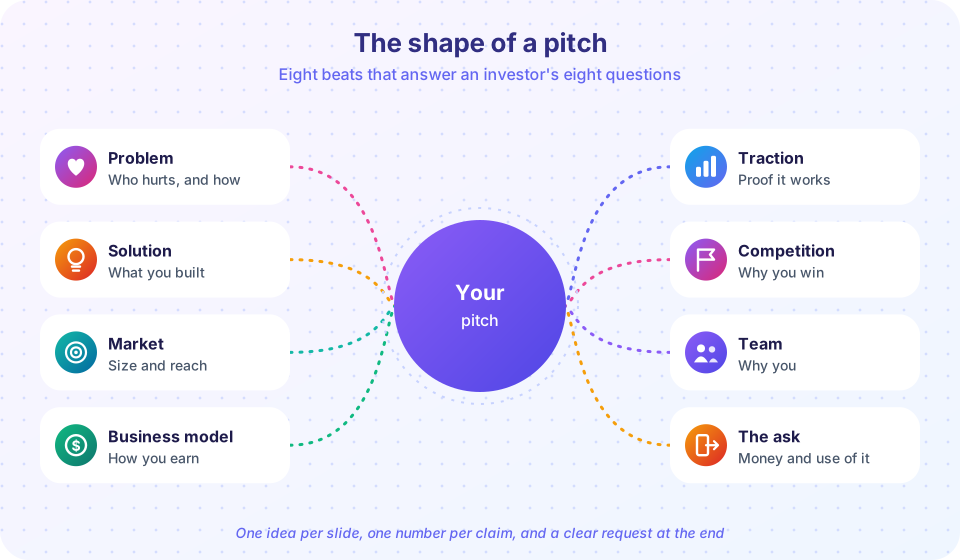
The eight beats
A pitch is not a list of facts but a sequence in which each beat answers the next question.
- Problem. Who hurts, and how much? Describe one specific person and the cost of their problem in time or money. "Freelancers wait an average of 40 days to be paid" is stronger than "invoicing is hard", provided you can source the number (this one is invented for the example).
- Solution. What have you built, and why is it better? Show it. A single screenshot or a 30-second demo beats three paragraphs.
- Market. Is it big enough, and can you reach it? Use a bottom-up estimate, described below.
- Business model. How do you earn? State price, margin and the unit economics from chapter 6: CAC, LTV and payback.
- Traction. What proof do you have that it works? Customers, revenue, retention, waiting-list sign-ups, pilot results. Early companies with little traction show learning: what you tested, what you found, what you changed.
- Competition. Why will you win? Name the real alternatives, including spreadsheets and doing nothing, and show the one dimension where you are distinctly better. "We have no competitors" tells investors you have not looked.
- Team. Why you? Two or three sentences per person on the experience that makes them the right people for this problem.
- The ask. What do you want, and what will it achieve? A specific amount, what it buys, and the milestone it reaches (for example "break-even in 21 months" or "10,000 paying customers").
Many decks add a title slide, a vision slide and a financials slide, and 10 to 12 slides is a common upper limit. Fewer, clearer slides usually work better than many dense ones.
Start with the person
Then the size and the money
Prove it
Close strong
Every slide answers one question and carries one idea.
Sizing the market
Investors want to know whether the market is large enough to matter, but they distrust numbers that begin "if we capture just 1% of a huge market". Use two methods and see whether they agree.
Top-down starts from a big published figure and narrows it. It is easy and weak, because you rely on a number someone else computed for a different purpose.
Bottom-up starts from what you can count: the number of reachable customers and what each pays. For example, suppose you identify the relevant group:
- TAM: all freelancers who invoice clients in your target countries, say 2,000,000 people, each could pay $240 a year (12 × $20). TAM =
2,000,000 × 240 = $480 milliona year. - SAM: those you can serve with your product and channels today: say 400,000 who invoice at least monthly in languages you support. SAM =
400,000 × 240 = $96 million. - SOM: what you could win in a few years. Your model's steady state of 1,500 customers gives
1,500 × 240 = $360,000a year.
(All of these counts are invented for the example. In a real pitch, show where each number comes from: a government survey, a trade association, your own channel tests.)
The jump from SAM to SOM shows the next honest question: can a business of $360,000 a year interest an investor? If not, either the plan is a different kind of business (profitable and small) or the SOM must grow with more channels, products or regions. Better to see this yourself than to hear it from the audience.
Press Run (or Ctrl + Enter) to see the result here.
Program input · what you'd type while the program runs
Type the answers before you press Run, one per line. Each time the program reads a line (with input()), it gets the next line from this box.
The log scale keeps all three bars visible, but remember that each step is a hundred-fold difference. Say so plainly in the deck.
The ask and the use of funds
State the amount, the use and the milestone. A vague "we are raising money" invites no action. A good ask reads: "We are raising $120,000 to reach break-even, which our model projects in month 21. 40% goes to product, 30% to customer acquisition, 10% to operations and 20% to a safety reserve."
Choose the amount from your model: the funding need plus a cushion. Choose the milestone for what the money proves. If the next round needs 1,000 paying customers to be credible, the amount must carry you there.
Press Run (or Ctrl + Enter) to see the result here.
Program input · what you'd type while the program runs
Type the answers before you press Run, one per line. Each time the program reads a line (with input()), it gets the next line from this box.
Delivery and practice
The best content falls flat if it is delivered poorly. Some practical points:
- Time it. A typical pitch lasts 5 to 10 minutes plus questions. People speak at roughly 130 words a minute, so a five-minute pitch is about 650 words.
- One idea per slide. Large type, few words, one chart. The slide supports you; you are the pitch.
- Open with the person, not the company. "Meet Dana, a freelance designer who is owed $4,200" holds attention better than "We are an invoicing platform".
- Practice out loud, with a timer, on friends who will interrupt. Record yourself once; it is uncomfortable and useful.
- Prepare for questions. List the ten hardest questions (churn, competitors, why now, what if a large company copies you) and write short answers. Answer honestly; "we do not know yet, here is how we will find out" is a good answer.
- Know your numbers. Be able to explain CAC, LTV, payback, runway and the biggest assumption without looking at notes.
Common pitch mistakes
- The hockey stick with no reason. A forecast that is flat and then rockets upward needs a stated cause (a channel, a contract, a launch).
- "1% of a huge market". Replace with a bottom-up estimate.
- No competition. Name the real alternatives.
- Too much text. If people read the slide, they stop listening to you.
- Hiding the risk. Name the biggest risk and your plan for it; investors will find it anyway.
- No clear ask. End with the amount, the use and the milestone.
Common misconceptions
"A pitch is about convincing." It is about helping the right audience see a fit, or discover there is none. A "no" with a reason is useful.
"The deck is the pitch." The deck supports a conversation. Many investors read it before the meeting and want you to speak to the gaps.
"A bigger market always looks better." An inflated estimate reduces credibility. A believable smaller market with a clear path often wins.
Check your understanding
Quick check · 5 questions
of 5 answered You scored / 5 · perfect!
-
1. Which market-sizing method starts from what you can count, such as reachable customers times price?
Bottom-up estimates multiply real, sourced counts by a price, which is more credible than narrowing a big published number. -
2. 400,000 reachable users each pay $150 a year. What is the SAM?
400,000 x 150 = $60,000,000. -
3. Roughly how many words is a five-minute pitch at 130 words per minute?
130 x 5 = 650 words. -
4. Which is the best ask?
A good ask states amount, use and milestone. -
5. Why is 'we have no competitors' a weak statement?
Naming the real alternatives shows you understand the market.
Summary
- A pitch follows eight beats: problem, solution, market, business model, traction, competition, team and the ask.
- Size the market bottom-up with TAM, SAM and SOM, and source every count.
- State the amount, the use of funds and the milestone in the ask.
- Time yourself, keep one idea per slide, prepare for the hardest questions and know your numbers.
- Avoid unsupported hockey sticks, "1% of a huge market" and a missing ask.
Next: Practice problems
Track your progress
Create a free account to tick off lessons and pick up where you left off on any device.
of Entrepreneurship lessons completed