


















Lesson 5 of 49 · Getting Started
Chapter 1 review: getting started
Review Chapter 1 of the entrepreneurship course: definition, key thinkers, venture types and break-even, with a one-page summary picture and a ten-question quiz.
Chapter 1 gave you the basic map of entrepreneurship. You learned a working definition, met the thinkers who shaped the field, saw what founders actually do with their days and compared five types of venture. This review pulls it all together in one picture and one table, and then tests you with a longer quiz that mixes the lessons.
Use this page the way you would use a study sheet before an exam: first read the picture and the table, then try the quiz without looking back, and finally reread only the lessons where you made mistakes.
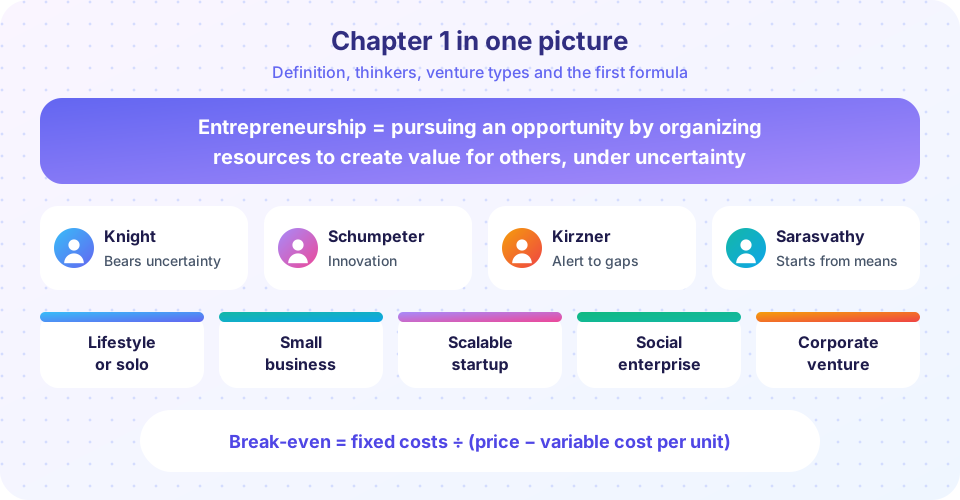
The chapter in one table
| Idea | Core point | Where you learned it |
|---|---|---|
| Definition | Pursuing an opportunity by organizing resources to create value for others under uncertainty | What is entrepreneurship? |
| Knight | Entrepreneurs bear true uncertainty, not just measurable risk | What is entrepreneurship? |
| Schumpeter | New combinations and creative destruction | What is entrepreneurship? |
| Kirzner | Alertness to gaps others miss | What is entrepreneurship? |
| Sarasvathy | Effectuation: start from the means you already have | What is entrepreneurship? |
| Venture types | Lifestyle, small business, scalable startup, social enterprise, corporate venture | Types of ventures |
| Scalability | Serving many more customers without costs rising at the same pace | Types of ventures |
| Break-even | The sales volume where revenue equals total costs | Chapter 1 overview |
Three ideas to remember
First, entrepreneurship is a process, not a personality. It starts from a real need, organizes whatever resources are available and learns from customers in a loop. Second, there is no single "right" kind of venture. Matching the type to your goals, risk tolerance and mission matters more than copying a famous founder. Third, numbers come early. Even a stall selling food needs to know its break-even point.
Putting the chapter to work
The best test of Chapter 1 is whether you can explain entrepreneurship to someone else without jargon. Try it with a relative or a classmate. Say what a venture is, give one example of each type, and describe a founder's week. If you hear yourself saying "it is about taking big risks" or "you need a brilliant invention", go back to the lessons: those are the myths the chapter set out to correct.
Next, apply the vocabulary to your own life. Write down one problem you noticed this week. Ask which of the four forces (founder, customers, resources, society) would matter most if you tried to solve it. A problem you care about but that nobody would pay for points to a social enterprise or a hobby. A problem many people pay to solve, but which needs expensive equipment, points to the resources question. The point is not to decide anything yet, only to practice seeing ventures as combinations of forces.
Common mistakes to avoid
Three mistakes show up again and again among beginners. The first is confusing activity with progress: designing a logo, registering a name and printing cards feel like starting a business, yet none of them tells you whether anyone wants what you plan to sell. The second is copying the wrong example. Reading the story of a famous startup founder and imitating it, when your own goal is a stable neighborhood business, leads to the wrong funding, the wrong pace and a lot of stress. The third is ignoring numbers until later. Even a rough break-even calculation, done on the first day, shows whether the idea can work at the prices and costs you expect.
Try it
This tool lets you practice break-even calculations for a fictional venture. Change the three inputs and compare the printed result with your own mental estimate before running it.
Press Run (or Ctrl + Enter) to see the result here.
Program input · what you'd type while the program runs
Type the answers before you press Run, one per line. Each time the program reads a line (with input()), it gets the next line from this box.
This second tool tests the chapter's vocabulary like flash cards, printing a prompt and its answer so you can cover the answer and self-test.
Press Run (or Ctrl + Enter) to see the result here.
Program input · what you'd type while the program runs
Type the answers before you press Run, one per line. Each time the program reads a line (with input()), it gets the next line from this box.
Check your understanding
Quick check · 10 questions
of 10 answered You scored / 10 · perfect!
-
1. Which part of the working definition explains why customers must benefit?
Customers only pay when they gain something, so value for others is essential. -
2. Who argued that entrepreneurs are rewarded for bearing true, uncalculable uncertainty?
Knight separated measurable risk from uncertainty and linked profit to bearing the latter. -
3. What is creative destruction?
Schumpeter used it for the churn that innovation causes in an economy. -
4. Effectuation, studied by Saras Sarasvathy, means experienced founders often
Effectuation starts from who you are, what you know and whom you know. -
5. Which is the best example of a social enterprise?
A social enterprise earns most of its income by selling, while pursuing a mission. -
6. A freelance illustrator whose income is capped by hours worked is mainly limited by
When the founder is the product, income is capped by the hours available unless the work becomes scalable. -
7. Fixed costs are $1,800 per month and each repair contributes $30. What is the break-even number of repairs?
1,800 divided by 30 equals 60 repairs. -
8. Which statement about venture types is correct?
No type is ranked above the others, and ventures often change type over time. -
9. Why do founders often combine profit and purpose?
A venture that cannot cover its costs cannot keep serving its purpose. -
10. Which belief is a myth?
Founders start at every age and usually break large risks into small experiments.
Summary
- Entrepreneurship is a process: opportunity, resources, value for others, under uncertainty.
- Knight, Schumpeter, Kirzner and Sarasvathy describe different sides of the same activity.
- Five venture types differ in goals, funding, growth ambition and control.
- Break-even equals fixed costs divided by the contribution of each sale.
- Chapter 2 turns from what entrepreneurship is to how entrepreneurs think.
Track your progress
Create a free account to tick off lessons and pick up where you left off on any device.
of Entrepreneurship lessons completed