


















Lesson 16 of 49 · Finding and Validating Ideas
Chapter 3 review: finding and validating ideas
Review Chapter 3: problems worth solving, customer interviews, market sizing and MVP tests, with a one-page summary and a ten-question mixed quiz.
Chapter 3 gave you the working method of early entrepreneurship: find a problem that is frequent, intense and paid for; talk to real customers about their past behavior; estimate whether the market is big enough; and test with the smallest experiment that gives a believable answer. Together these steps turn "I have an idea" into "I have evidence".
This review shows the whole method in one picture, summarizes it in a table and checks your understanding with ten mixed questions.
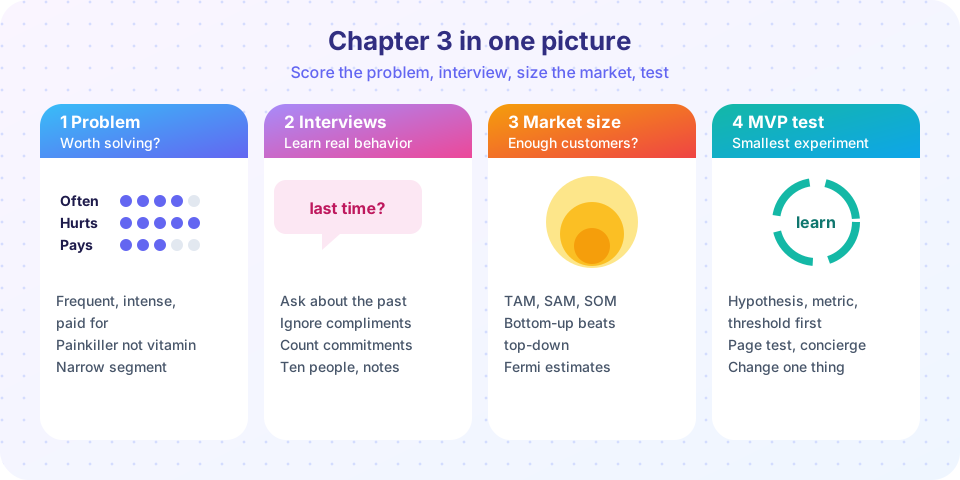
The chapter in one table
| Step | Key question | Main tool | Lesson |
|---|---|---|---|
| Problem | Is it frequent, intense and paid for? | Three-test scorecard | Finding problems |
| Customers | What do they do today, and what does it cost them? | Past-tense interview questions | Customer interviews |
| Market | Are there enough of them? | TAM, SAM, SOM and Fermi estimates | Market sizing |
| Test | Will they take a costly step? | MVP, landing page, concierge test | Testing with an MVP |
Rules to carry forward
- Problem first, solution second.
- Ask about the past, not the future; ignore compliments, count commitments.
- Prefer bottom-up estimates and test the assumption that moves the result most.
- Write the hypothesis, metric and threshold before the test.
- Change one thing at a time and collect enough data.
A worked pass through the method
Follow a fictional founder, Tomas, through the whole chapter in one paragraph each. Problem. Tomas notices that his neighbors struggle to find someone to look after pets during short trips. He scores the problem: frequency 2 (a few trips a year), intensity 4 (people worry a lot), willingness to pay 4 (they already pay friends with gifts). Total 10 out of 15, promising but infrequent, so he will need many customers.
Interviews. He talks to ten pet owners in his street and a nearby block. He asks about the last trip, who looked after the pet and what went wrong. Seven describe a stressful arrangement, five paid someone, two ask him to call them when he starts. He has one real commitment and a pattern.
Market. He estimates 600 households in his area, 40 percent with pets, 30 percent who travel more than twice a year, and a price of 25 dollars per visit with six visits a year. His bottom-up estimate is about 600 x 0.4 x 0.3 x 150 = 10,800 dollars a year for the area: enough for a side income, not a full salary. He decides this is a lifestyle venture.
Test. He builds a one-page sign-up, delivers it by hand to 100 mailboxes and sets a pass mark of eight bookings in a month. He gets five. Rather than quit, he changes one thing, the message, and retests. The method did what it should: it cost him a few weeks and a few dollars instead of a year.
Common mistakes to avoid
The most common errors in validation are asking friends instead of strangers, treating a polite "interesting" as a yes, stopping after one test and setting the pass mark after seeing the data. A quieter mistake is testing the wrong assumption: spending days perfecting a prototype when the real doubt is whether anyone will pay. Always ask which single assumption would sink the idea if it were false, and test that one first.
Try it
The first tool is a validation checklist. Tick what you have completed for your own idea; it tells you which step to do next.
Press Run (or Ctrl + Enter) to see the result here.
Program input · what you'd type while the program runs
Type the answers before you press Run, one per line. Each time the program reads a line (with input()), it gets the next line from this box.
The second tool turns the chapter's numbers into a single decision. It combines the SOM estimate with a test result to say whether the venture clears your own bar. All inputs are invented examples.
Press Run (or Ctrl + Enter) to see the result here.
Program input · what you'd type while the program runs
Type the answers before you press Run, one per line. Each time the program reads a line (with input()), it gets the next line from this box.
Check your understanding
Quick check · 10 questions
of 10 answered You scored / 10 · perfect!
-
1. Which problem is the strongest candidate?
A strong problem scores well on all three tests: frequency, intensity and willingness to pay. -
2. A friend says 'I would totally use that'. How should you treat this?
Compliments cost nothing and do not reveal behavior. -
3. Which interview question reveals the most?
Stories about specific past events show real behavior. -
4. TAM is 4,000,000 dollars. The product fits 50% of customers and you can win 5% of those. What is the SOM?
SAM = 2,000,000; SOM = 5% of that = 100,000 dollars. -
5. What is the main weakness of 'if we capture 1% of a huge market' reasoning?
Capture must be earned through channels, product quality and conversion. -
6. What does a Fermi estimate do?
It gives an order of magnitude and shows the assumptions that matter. -
7. A concierge MVP is
You do by hand what you would later automate. -
8. Which should be fixed before a test starts?
Pre-set criteria prevent talking yourself into a result. -
9. A landing-page test with 30 visitors yields 3 sign-ups. What should you do?
Small samples have wide uncertainty. -
10. Which is a vanity metric?
Page views do not show commitment.
Summary
- Validation replaces guesses with evidence at four steps: problem, customers, market, test.
- Commitments matter; compliments do not.
- Estimate bottom-up, check sensitivity and be honest about small samples.
- Decide go, change or stop using criteria written before you see the data.
- Chapter 4 turns a validated idea into a business model and a plan.
Track your progress
Create a free account to tick off lessons and pick up where you left off on any device.
of Entrepreneurship lessons completed