


















Lesson 27 of 49 · Marketing and Sales
Chapter 5 review: marketing and sales
Review segments, positioning, channels, funnels, CAC, pipelines, pricing and retention with a recap table, a mini calculator and a ten-question quiz.
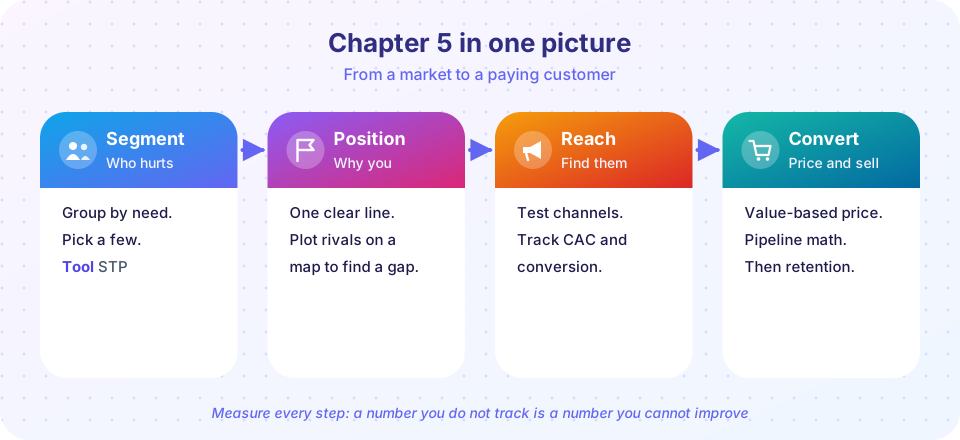
You now have a working toolkit for getting customers: choose a segment, claim a position, test channels, read the funnel, run a pipeline and set a price. This review pulls the chapter into one picture, one table and one quiz. If a row of the table feels shaky, follow the link back to the lesson before you attempt the questions.
What you will learn
- A one-page recap of every idea in the chapter
- Which formula or test to reach for in each situation
- How to check yourself with a mixed set of questions
Recap table
| Topic | Key idea | Formula or test | Lesson |
|---|---|---|---|
| Segmentation | Group buyers by shared need and behavior; start narrow | Weighted score of size, pain, ability to pay, reach | Segments and positioning |
| Positioning | A promise relative to alternatives | "For X who Y, Z is a ... Unlike ..." | Segments and positioning |
| Channels | Paid, owned, earned; test cheaply then focus | Decision rule written before the test | Channels and the funnel |
| Funnel | Multiply stage conversion rates | Overall = product of stage rates | Channels and the funnel |
| CAC | Cost to win one customer | Spend / new customers | Channels and the funnel |
| Pipeline | Forecast from stage win rates | Leads needed = target / overall win rate | Sales and pricing |
| Pricing | Cost is floor, value is ceiling, rivals are the neighborhood | p* = (a/b + c) / 2 for linear demand | Sales and pricing |
| Retention | Customers who stay are worth more | Average lifetime = 1 / churn | Sales and pricing |
The questions an expert asks
When an experienced marketer looks at a stalled business, they work down the same short list.
- Is the segment too wide? If your best customers share a trait you never mentioned in your messages, narrow the target.
- Can a buyer repeat our promise? If five prospects describe you five different ways, positioning is blurry.
- Which channel gives the lowest CAC at a volume that matters? A cheap channel with no capacity cannot carry the business.
- Where is the biggest drop in the funnel? Fix that stage before buying more traffic.
- Does the price match the value we can prove? If you cannot show the buyer's gain, you will end up pricing against cost or rivals.
- Why do customers leave? The answer is often in the first week of use.
Worked example: a launch plan in six steps
Let us run the whole chapter on one invented idea, a booking tool for independent music teachers, so you can see how the pieces constrain each other.
Segment. Three candidate groups come to mind: music teachers working alone, music schools, and parents looking for teachers. You score them on size, pain, ability to pay and reachability. Schools have deep pockets but slow buying cycles and are hard to reach; parents are numerous but have a weak, occasional need. Independent teachers feel the pain weekly (cancellations, reminders, payment chasing) and gather in a handful of online communities, so they win on pain and reach. That is the beachhead.
Position. The statement reads: "For independent music teachers who lose income to last-minute cancellations, Tuneslot is a booking tool that collects deposits automatically. Unlike a paper diary or a general calendar, it charges late cancellers for you." Five teachers repeat it back accurately, which is the test.
Channel. You try three cheap tests: a post in a teachers' forum, a small search ad budget, and an offer to a music-teaching association's newsletter. Spend and customers are logged for each. The newsletter wins at a CAC of $35, search costs $90, and the forum is free but small. The decision rule written beforehand said "double spend on any channel under $60", so the newsletter gets more money and search is dropped.
Funnel. Of 2,000 visitors, 160 sign up (8%), 64 start a trial (40%) and 16 pay (25%), which is 0.8% overall. The weakest step is the trial-to-paid conversion, so you improve onboarding before buying more traffic.
Price. Teachers save perhaps four lost lessons a month, worth about $160, so a price of $12 to $20 captures a modest share of the value. You test $12 and $18 on alternate sign-ups and choose by profit, not by sign-ups.
Retention. You ask every teacher who cancels why, and discover that most leave in the first two weeks because the deposit feature is hidden. Moving it to the first screen lifts week-four retention. The lesson is that no single step of the chapter is the whole answer: each one checks the others.
Notice also the order of the work. Every later step used what the earlier step produced: the position came from the segment, the channel test from the position, the price from the discovery questions. If a step fails, return one step earlier rather than pushing harder on the failing one.
Try it
Use this small calculator to connect the chapter's formulas. Change any number and the results update. The figures are invented examples, so replace them with your own estimates.
Press Run (or Ctrl + Enter) to see the console output here.
No output.
The ratio at the end is the star of the next chapter. For now, notice how sensitive it is to churn: change monthlyChurn from 0.05 to 0.10 and watch the lifetime value halve.
Check your understanding
Quick check · 10 questions
of 10 answered You scored / 10 · perfect!
-
1. Which is the best example of a segment?
A good segment pairs a situation with a need, so you can picture the person and find where they gather. -
2. What does the 'unlike' clause of a positioning statement name?
Positioning is relative: you must state what the buyer might do instead and how you differ. -
3. Which channel family consists of assets such as an email list and your own website?
Owned channels are controlled by you, slower to build but cheap to run. -
4. A funnel has rates of 5%, 40% and 10% across three steps. What is the overall conversion?
0.05 x 0.40 x 0.10 = 0.002, which is 0.2%. -
5. You spend $1,800 and win 30 customers. What is CAC?
1,800 / 30 = $60. -
6. To close 9 deals with an overall win rate of 3%, how many leads do you need?
9 / 0.03 = 300 leads. -
7. In value-based pricing, what is the price anchored to?
Value-based pricing starts from the customer's gain, which you learn through discovery questions. -
8. With demand q = 800 - 20p and a unit cost of 10, what is the profit-maximizing price?
a/b = 800/20 = 40, so p* = (40 + 10) / 2 = 25. -
9. Monthly churn is 2.5%. About how long does an average customer stay?
1 / 0.025 = 40 months. -
10. Which action best improves a funnel whose weakest step is trial-to-paid conversion?
Fix the leakiest step. More traffic would just push more people into the same leak.
Summary
- Choose a narrow segment and a clear position before you spend on channels.
- Test channels cheaply, compute CAC, and focus on the best one.
- Funnels multiply; improve the weakest step first.
- Pipeline math tells you how many leads a revenue target needs.
- Price between your cost floor and the customer's value ceiling, and keep customers by solving their problem early.
Track your progress
Create a free account to tick off lessons and pick up where you left off on any device.
of Entrepreneurship lessons completed