


















Lesson 29 of 49 · Funding and Finance
Unit economics
Learn to compute margin per customer, lifetime value, CAC payback and break-even volume with worked examples, so you know if growth makes or loses money.
Growth feels good, but growth is not the same as success. A shop that sells each sandwich for $4 and spends $5 making and delivering it gets more broke with every extra customer. Unit economics is the discipline of looking at one unit of your business, one customer, one order, one subscription, and asking: after all the costs that come with it, do I keep anything?
If the answer is yes, scaling is a matter of time and money. If the answer is no, scaling just makes the loss bigger and faster. This lesson gives you the four numbers that answer the question: margin, lifetime value, CAC payback and break-even.
What you will learn
- How to compute contribution margin per unit
- How to estimate customer lifetime value (LTV) from margin and churn
- What the LTV to CAC ratio and payback period tell you
- How to find a break-even volume with fixed and variable costs
Key terms
Contribution margin: the money left from one sale after the variable costs of that sale.
Variable cost: a cost that rises with each unit sold, such as materials, shipping or payment fees.
Fixed cost: a cost that stays the same whatever you sell in the period, such as rent or salaries.
LTV (lifetime value): the total margin a customer is expected to produce before leaving.
Payback period: the time a customer takes to repay their acquisition cost.
Step one: margin per unit
Start with one sale and subtract everything that changes because that sale happened. For an online shop that sells a jacket, the list might be the cost of the jacket, shipping to the customer, packaging, the payment processor's fee and an allowance for returns. What remains is the contribution margin: the amount that sale contributes toward paying your fixed costs and, eventually, profit.
Suppose a jacket sells for $80. It costs $32 to buy, $7 to ship, $2 to package, and the payment processor charges 2.9% plus $0.30, which is $2.62 on an $80 sale. If 6% of sales are returned and each return costs you $9 in lost shipping and handling, the expected return cost is $0.54 per order. The contribution margin is 80 − 32 − 7 − 2 − 2.62 − 0.54 = 35.84. That is about 45% of the price.
Note what is not included: your rent, your salary and your software subscriptions. These are fixed costs. They matter, but they are not part of the per-unit picture. If the contribution margin is negative, no volume can fix it.
Press Run (or Ctrl + Enter) to see the result here.
Program input · what you'd type while the program runs
Type the answers before you press Run, one per line. Each time the program reads a line (with input()), it gets the next line from this box.
Change the shipping cost to $14 and rerun. A single extra cost can erase a third of the margin, which is why founders in physical products obsess over logistics.
Step two: lifetime value
For a subscription or a product people buy repeatedly, one sale is not the unit. The unit is the customer's whole relationship with you. The simplest estimate of lifetime value is:
LTV = margin per month ÷ monthly churn
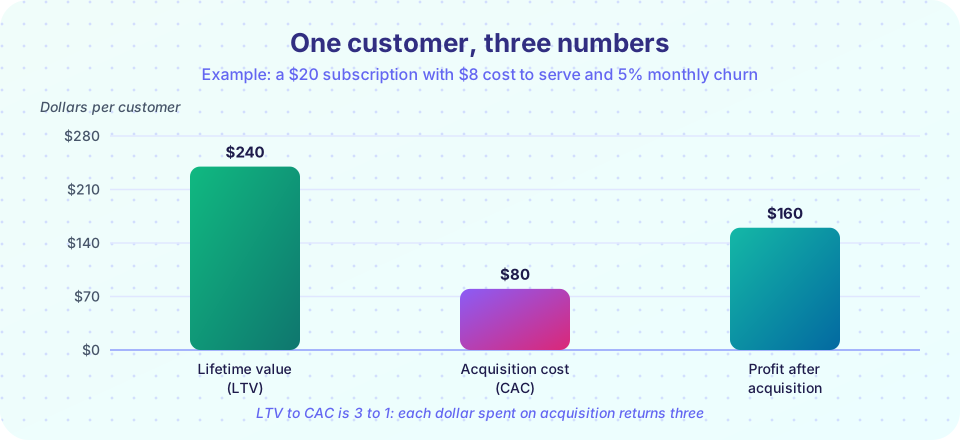
The logic is the one from the previous chapter: if 5% of customers leave each month, the average customer stays 1 ÷ 0.05 = 20 months. So with a $20 monthly price and $8 of cost to serve, the margin is $12 a month and the LTV is 12 × 20 = 240.
This formula has limits. It assumes churn is constant, which is rarely true (many customers leave in the first month, and loyal ones stay for years). It ignores the time value of money: a dollar in two years is worth less than a dollar now. It is a quick estimate for planning and comparing choices, not an accounting figure. For better accuracy, track cohorts (all customers who joined in one month) and watch how many remain each month.
Step three: CAC, ratio and payback
The cost to win that customer is the CAC from the marketing chapter. Suppose it is $80. Two simple measures follow.
LTV to CAC ratio is 240 ÷ 80 = 3. Many software investors use "at least 3 to 1" as a rule of thumb for a healthy business, and "below 1 to 1" is losing money. Treat it as a starting benchmark, not a law: a business with very high margins and fast payback can thrive at a lower ratio, and a business with long contracts may demand a higher one.
Payback period is the time to earn back the CAC from margin: 80 ÷ 12 = 6.7 months. Payback matters because cash you spent today on acquisition does not come back until months later. A short payback lets you recycle money into new customers quickly. A long payback, such as 24 months, means you need lots of funding to grow.
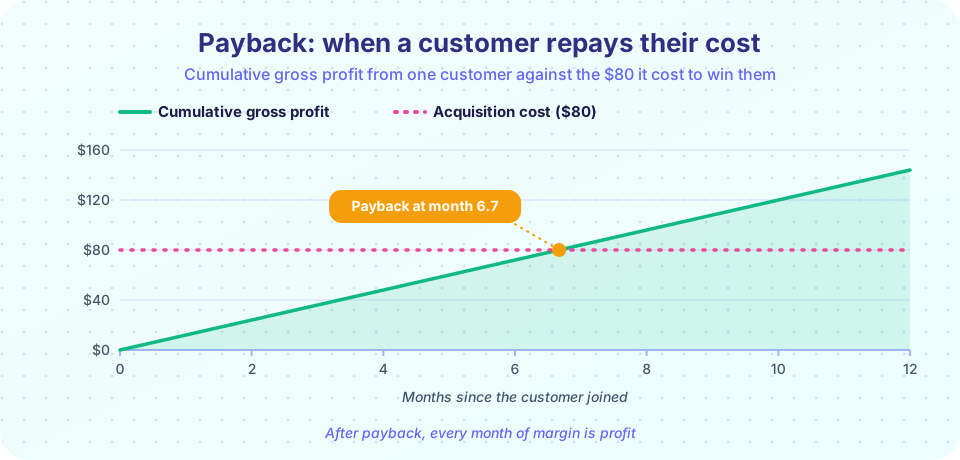
The two measures tell different stories. A business can have an excellent LTV to CAC ratio but a long payback; it is profitable in the long run but hungry for cash in the short run. Always look at both.
Press Run (or Ctrl + Enter) to see the result here.
Program input · what you'd type while the program runs
Type the answers before you press Run, one per line. Each time the program reads a line (with input()), it gets the next line from this box.
Look at the table: churn of 15% leaves an LTV to CAC ratio of just 1, so each customer only earns back what it cost to win them. Halving churn is often the biggest lever in the whole model.
Step four: break-even
Contribution margin also tells you how much you must sell to cover your fixed costs. If fixed costs are F per month and the margin per unit is m, the break-even volume is:
break-even units = F ÷ m
Say a small app company pays $6,000 a month in fixed costs (salaries, hosting, tools), and each customer pays $20 with $8 of variable cost. The margin is $12, so break-even is 6,000 ÷ 12 = 500 customers. Below 500 you lose money, at 500 you break even, and each customer above 500 adds $12 of profit.
Press Run (or Ctrl + Enter) to see the result here.
Program input · what you'd type while the program runs
Type the answers before you press Run, one per line. Each time the program reads a line (with input()), it gets the next line from this box.
Making unit economics a habit
Compute your unit economics every month, per channel and per customer type, because an average hides problems. A product with a strong LTV to CAC ratio overall may have one channel dragging it down and another carrying it. Update your assumptions with real data as it arrives; early estimates of churn are guesses, and a company with six months of history can replace guesses with cohort curves.
Use unit economics to make decisions, too. If payback is too long, you can raise prices, lower cost to serve, move customers to annual plans (cash up front), or cut the most expensive acquisition channel. The model makes each trade-off a number rather than an argument.
Common misconceptions
"We lose money on each customer but will make it up in volume." Volume multiplies whatever is there. If the margin per unit is negative, more units just lose more, unless a specific, believable change (scale discounts, higher price) fixes the margin.
"LTV is a known number." It is an estimate that depends on churn assumptions. Present it as a range and update it with cohort data.
"A high LTV to CAC ratio means we can spend without limit." Ratios say nothing about cash. A long payback may need far more funding than you have.
Check your understanding
Quick check · 5 questions
of 5 answered You scored / 5 · perfect!
-
1. A product sells for $50 with $18 of variable costs. What is the contribution margin per unit?
Contribution margin = price - variable costs = 50 - 18 = $32. -
2. Margin is $15 a month and churn is 3% a month. What is the estimated LTV?
LTV = margin / churn = 15 / 0.03 = $500. -
3. CAC is $120 and margin is $15 per month. What is the payback period?
Payback = CAC / monthly margin = 120 / 15 = 8 months. -
4. Fixed costs are $9,000 a month and margin per customer is $18. What is the break-even number of customers?
Break-even = fixed costs / margin = 9,000 / 18 = 500 customers. -
5. Why can a company with an LTV to CAC ratio of 4 still run out of cash?
The ratio shows long-term profitability, but cash comes back as the customer pays over time. With a long payback you need lots of funding to grow.
Summary
- Contribution margin is price minus every cost that changes with the sale.
- LTV is roughly margin per month divided by monthly churn; it is an estimate, not a fact.
- LTV to CAC (about 3 or more is a common benchmark) shows long-term value; payback shows cash speed.
- Break-even volume equals fixed costs divided by margin per unit.
- Recompute these numbers monthly and by channel.
Next: Cash flow and runway
Track your progress
Create a free account to tick off lessons and pick up where you left off on any device.
of Entrepreneurship lessons completed