


















Lesson 33 of 49 · Teams and Operations
Teams and operations: the big picture
A map of building a startup team: co-founders, equity, hiring, culture, processes and legal setup, with the vocabulary you need for the detailed lessons.
A company is a group of people who have agreed to build something together and to share what comes out of it. Everything in the previous chapters, such as the segment, the channel and the cash forecast, is carried out by people. When an early-stage company fails, the autopsy usually reads less like "the market was wrong" and more like "two founders stopped talking", "the first hire did not fit" or "nobody knew who decided what".
This chapter is about the human and practical machinery of a young business: who the founders are, how ownership is divided, how you hire and keep the next people, how you keep work flowing without drowning in bureaucracy, and what legal shell holds it all together. None of it requires special talent, but all of it benefits from being thought through before an argument forces the issue.
What you will learn
- Why team problems are the most common cause of early failure
- The six topics in this chapter and how they connect
- Vocabulary you will meet in every conversation about founders and hiring
- A mindset for building teams: explicit agreements, early
Key terms
Co-founder: a person who takes on the risk and work of starting the company from the beginning and shares ownership.
Equity: ownership in the company, usually held as shares.
Vesting: earning your shares gradually over time instead of owning them all on day one.
Culture: the unwritten rules for how people behave, decide and treat each other.
Process: a repeatable series of steps that turns an input into a result.
Why people problems dominate
Early startups are small, stressed and uncertain, which is the worst environment for unspoken assumptions. Each founder imagines a slightly different company: one wants to build for ten years, another wants to sell in three; one expects to work weekends, another has a young family. When money is short, those differences surface as arguments, and with no written agreement the arguments have no referee.
The good news is that the fix is cheap: have the uncomfortable conversation early, write down what you agree, and review it every few months. A one-page "founders' agreement" prepared in the first week costs a few hours. A broken partnership can cost the company.
The six topics
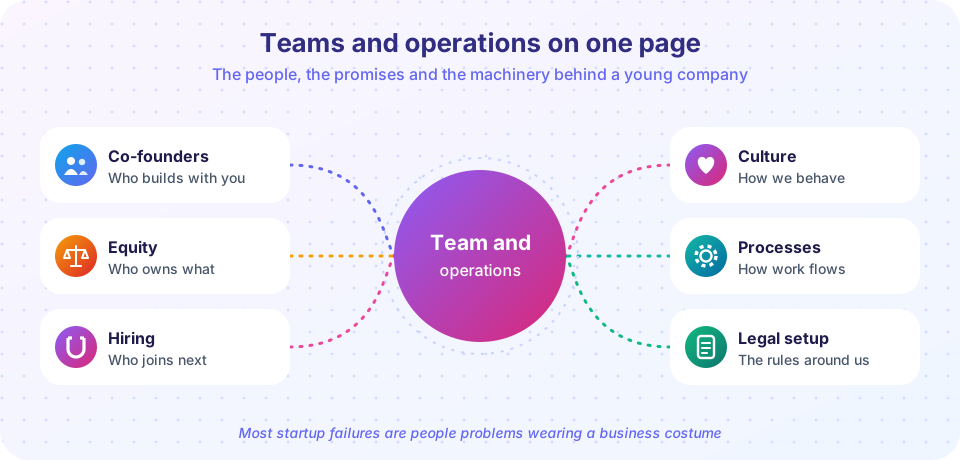
On the left of the picture are the topics about people and ownership.
- Co-founders. Should you have one? Who? Founders complement each other's skills and share the emotional weight, but a mismatch is painful and hard to undo.
- Equity. How should ownership be split between founders, and how do you protect the company if somebody leaves? The tool here is vesting.
- Hiring. Your first employees shape everything. You will learn to look for both skill and values, and to run interviews that predict how someone will actually work.
On the right are the topics about how the company runs.
- Culture. The shared behaviors of the team. Culture is not posters on the wall; it is what you tolerate and reward.
- Processes. The routines that let work flow without relying on one person's memory: how orders are fulfilled, how support requests are answered, how decisions are recorded.
- Legal setup. Registering a business, choosing a structure, signing contracts, protecting intellectual property.
Teams are the first product
Ownership
Growing the team
Keeping it running
Write the agreements down; memory edits history.
How the lessons fit together
| Lesson | What you get |
|---|---|
| Co-founders and equity | Choose a partner, split ownership fairly, and use vesting |
| Hiring and culture | Interview well, hire for skill and values, build a team that lasts |
| Operations and legal basics | Processes, capacity, inventory math and business structures |
| Chapter review | A recap and a ten-question quiz |
What a healthy early team looks like
Healthy early teams share a few observable traits, and you can check for them in your own. People know who decides what, so there is no confusion when a choice is urgent. Disagreements are voiced early and about the work, not about personalities. Commitments are visible: everyone can say what the team is working on this week and why. Credit and blame are spread fairly, and mistakes are discussed as lessons, not hunted for culprits. Finally, there is a way to raise a concern, to a co-founder, a mentor or a regular meeting, without fear of punishment.
Unhealthy teams show the opposite signs: decisions reached in corridors, resentment that nobody states, tasks that fall between two people, and a founder who is always the last to hear bad news. The signs often appear months before the crisis, and a short, honest conversation at that point is much cheaper than a rescue later.
A useful routine is a monthly team check-in of thirty minutes with three questions: what is going well, what is getting in the way, and what should we change next month? Write the answers down and look at them the following month. Teams that keep this simple habit tend to find problems while they are small. As you move through the chapter, think about which of the six topics your own team, or the team you hope to build, has already settled in writing, and which it is still carrying in people's heads.
Common misconceptions
"I must have a co-founder." Many successful companies have a single founder. A co-founder helps if their skills and temperament truly complement yours; a poor co-founder is worse than none.
"Equity should be split evenly to be fair." An even split can be fair or not. Fairness depends on future roles, commitment and risk; a 50/50 split with no vesting can freeze a company when one founder leaves.
"Culture happens by itself." It does, but not always the culture you want. Leaders shape it every day by what they praise, ignore and punish.
Try it
Before you form a team, write down what you expect. The TryIt below asks six questions that founders should answer for themselves and compare. It runs in your browser and stores nothing. The point is to expose differences in expectations, not to score anyone.
Check your understanding
Quick check · 4 questions
of 4 answered You scored / 4 · perfect!
-
1. Why do co-founder disagreements often surface when money is short?
Stress exposes differences in ambition, hours and risk that nobody discussed early. Talking about them in advance is cheap. -
2. What is vesting?
Vesting means your ownership is earned over a schedule, which protects the company if someone leaves early. -
3. Which topic is mainly about 'what you reward and tolerate'?
Culture is the set of behaviors that a team treats as normal, shaped by leaders' reactions every day. -
4. What is the cheapest protection against founder conflict?
Writing down roles, ownership and expectations early costs a few hours and gives later arguments a referee.
Summary
- Early startups usually fail because of people problems, not just market problems.
- The six topics are co-founders, equity, hiring, culture, processes and legal setup.
- Vesting protects the company if a founder leaves early.
- Culture is built from what leaders reward and tolerate.
- Make agreements explicit, early and in writing.
Next: Co-founders and equity
Track your progress
Create a free account to tick off lessons and pick up where you left off on any device.
of Entrepreneurship lessons completed