


















Lesson 10 of 49 · The Entrepreneurial Mindset
Chapter 2 review: the entrepreneurial mindset
Review Chapter 2: risk versus uncertainty, expected value, resilience, learning from failure and opportunity recognition, with a one-page summary and a ten-question quiz.
Chapter 2 asked a deceptively simple question: how do entrepreneurs think? You learned that they separate calculable risk from genuine uncertainty, limit their downside with affordable loss and staged commitments, treat failure as information, and notice opportunities by watching real problems. None of this needs a special personality, only practice.
This review gives you the chapter in a single picture and a table, plus a longer quiz. Work through the quiz first, then check yourself against the table.
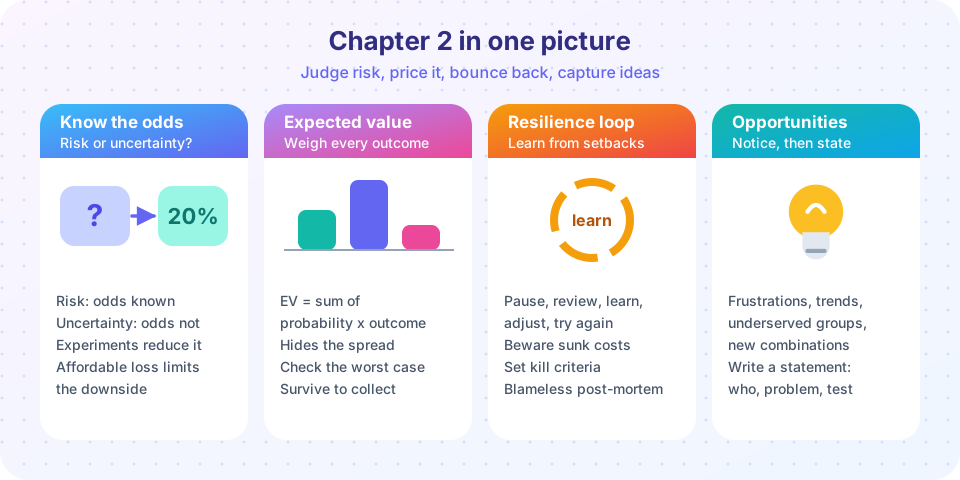
The chapter in one table
| Idea | Core point | Lesson |
|---|---|---|
| Risk | Outcomes and probabilities can be estimated from data | Risk and uncertainty |
| Uncertainty | Outcomes or odds cannot be known; reduce it by learning | Risk and uncertainty |
| Expected value | Sum of probability times outcome; ignores spread and worst case | Risk and uncertainty |
| Affordable loss | Design experiments whose worst case you can bear | Risk and uncertainty |
| Growth mindset | Abilities can develop; effects on results are modest | Resilience |
| Sunk cost | Past spending that should not drive future choices | Resilience |
| Post-mortem / pre-mortem | Structured reviews after or before a setback | Resilience |
| Opportunity sources | Frustrations, trends, underserved groups, combinations | Opportunities |
| Opportunity statement | Customer, problem, workaround and a cheap test | Opportunities |
How the ideas connect
The lessons form a chain. You notice an opportunity (lesson 3), express it as a statement you can test, design the test so that its worst case is affordable (lesson 1), and, whatever happens, review the result so you learn (lesson 2). A venture is essentially this chain repeated many times with growing stakes. Chapter 3 turns the chain into a practical method for finding and validating ideas.
Habits to practice this month
A mindset grows through repetition, so turn the chapter into a short routine. Each week, pick one small uncertain decision and write down three things before acting: the best case, the worst case and the cheapest way to learn more. Then act, and afterwards write one sentence about what you learned, whether the result was good or bad. After four weeks you will have a notebook of small bets, and you will start to see patterns in how you judge risk.
Keep a frustration log as described in the opportunity lesson. Aim for one entry a day, even if it is tiny: a queue that was too long, a form that was confusing, a tool that broke. At the end of the month, count the repeated themes. You are training the noticing habit that Scott Shane's research links to opportunity recognition.
Finally, schedule one review. Choose a recent disappointment, such as a failed test, a lost sale or a project that stalled, and run the four-step post-mortem on it: facts, causes, lessons, next action. Do it in writing and without blaming yourself. The goal is not to feel better but to extract a rule you can use next time.
Limits of what you have learned
Be honest about what this chapter cannot do. Expected value works only when your probabilities are reasonable, and in genuine uncertainty they are guesses. Growth mindset research shows modest effects, so it will not rescue a weak idea. And a pre-mortem can surface worries but cannot guarantee you have found them all. Treat every tool as an aid to judgment, never a substitute for evidence from real customers, which Chapter 3 teaches you to gather.
Try it
Practice the expected-value calculation on a new fictional decision. Change the probabilities and see when the best choice flips.
Press Run (or Ctrl + Enter) to see the result here.
Program input · what you'd type while the program runs
Type the answers before you press Run, one per line. Each time the program reads a line (with input()), it gets the next line from this box.
The second tool draws the review loop as a quick self-assessment: rate each of the five lessons' skills, and a radar-style bar chart shows where to practice.
Press Run (or Ctrl + Enter) to see the result here.
Program input · what you'd type while the program runs
Type the answers before you press Run, one per line. Each time the program reads a line (with input()), it gets the next line from this box.
Check your understanding
Quick check · 10 questions
of 10 answered You scored / 10 · perfect!
-
1. Which situation involves genuine uncertainty rather than calculable risk?
With no past data, outcomes and probabilities cannot be reliably estimated. -
2. Outcomes are 200 dollars (probability 0.4) and 50 dollars (probability 0.6). What is the expected value?
0.4 x 200 + 0.6 x 50 = 80 + 30 = 110. -
3. What does affordable loss change about how you design an experiment?
Affordable loss asks what you can stand to lose and sets the experiment within that limit. -
4. Which statement about growth mindset is most accurate?
Large follow-up studies found small average effects, so treat it as a helpful habit, not a cure-all. -
5. Which decision is a sunk-cost trap?
Money and time already spent cannot be recovered and should not drive the next decision. -
6. What is the purpose of a pre-mortem?
Gary Klein's technique unlocks honest worries early when they are cheap to fix. -
7. A failed but well-designed experiment in new territory is called
Edmondson's taxonomy calls these intelligent failures: they produce new knowledge and are the price of learning. -
8. Which is a source of opportunities listed in this chapter?
Underserved groups are one of four sources, with frustrations, trends and new combinations. -
9. A good opportunity statement includes
It must be precise enough to test cheaply with real people. -
10. Why is a positive expected value not enough by itself?
You must also be able to survive the worst case to collect the long-run average.
Summary
- Risk can be calculated; uncertainty must be reduced through experiments.
- Expected value is helpful but must be paired with affordable loss and survivability.
- Resilience is a practice built from reviews, kill criteria and healthy habits.
- Opportunities come from frustrations, trends, underserved groups and new combinations.
- Chapter 3 shows how to find problems and validate ideas with real customers.
Track your progress
Create a free account to tick off lessons and pick up where you left off on any device.
of Entrepreneurship lessons completed