


















Lesson 20 of 49 · Business Models and Plans
Unit economics
Learn unit economics: contribution margin, customer acquisition cost, customer lifetime value, the LTV to CAC ratio and payback time, with worked examples.
A venture can sell a lot, grow fast and still lose money on every customer. Unit economics is the practice of looking at the money made and spent for one "unit" of the business, usually one product, one order or one customer. If a single unit makes a profit, growth helps. If a single unit loses money, growth just means losing money faster.
This lesson teaches the main unit-economics measures: contribution margin, customer acquisition cost (CAC), customer lifetime value (LTV), the LTV to CAC ratio and payback period. It also shows how small changes in churn or price can transform the result, so you can see which assumptions to test first.
What you will learn
- How to compute contribution margin per unit and per customer.
- What CAC and LTV mean and how to calculate them.
- How to read the LTV to CAC ratio and payback period.
- How churn and price change the result.
Key terms
Unit economics: the revenue and costs of one unit of the business, such as one customer.
Contribution margin: price minus variable cost per unit; what each sale contributes toward fixed costs and profit.
CAC (customer acquisition cost): the total sales and marketing cost divided by the number of new customers it won.
LTV (customer lifetime value): the total contribution margin you expect from a customer over their time with you.
Churn: the share of customers who leave in a period.
Contribution margin
Contribution margin is the starting point. Take the price of one unit and subtract all costs that vary with each unit sold: materials, packaging, delivery, payment fees and the sales commission. What remains contributes toward fixed costs (rent, salaries) and profit.
Example: a fictional meal-box company sells a weekly box for 40 dollars. Ingredients cost 16 dollars, packaging 2, delivery 6 and payment fees 1.20. Variable cost per box is 25.20 dollars, so the contribution margin is 14.80 dollars (37 percent). If the company has 3,000 dollars of fixed costs a month, it must sell about 3,000 / 14.80, roughly 203 boxes, just to break even.
Contribution margin is the number to improve before you worry about scale. Raising it can be done by increasing price, lowering ingredient or delivery cost, or reducing waste.
Customer acquisition cost
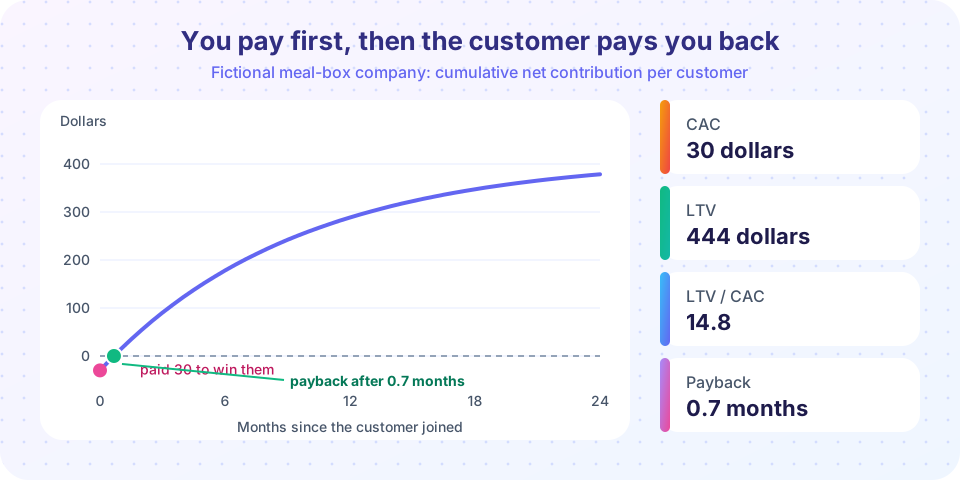
CAC is what you spend to win one new customer. Add up all sales and marketing costs in a period (advertising, salaries of sales staff, discounts, tools) and divide by the number of new customers gained in that period. If the meal-box company spends 1,800 dollars on ads and promotions in a month and gains 60 new customers, CAC is 30 dollars.
Include all the costs. Founders often leave out their own time or the value of free trials. Also separate paid from organic customers: if half of the customers arrived through word of mouth, the blended CAC looks low, but the paid CAC may be much higher. Track both.
Customer lifetime value
LTV estimates how much contribution a customer will bring over the entire relationship. A simple formula for subscription businesses is:
LTV = monthly contribution per customer x expected lifetime in months
Expected lifetime is approximately 1 / monthly churn. If 10 percent of customers leave each month, the expected lifetime is 1 / 0.10 = 10 months. If a meal-box customer orders 3 boxes a month (contribution 14.80 each), monthly contribution is 44.40 dollars and LTV is 444 dollars. This uses contribution margin rather than revenue, because LTV based on revenue overstates what you keep.
This formula is a rough model. It assumes constant churn and constant behavior. Real customers often leave early and then stay long, so it is wise to calculate with actual data from groups of customers (cohorts) once you have them.
The LTV to CAC ratio and payback
A common rule of thumb in subscription businesses is that LTV should be at least about three times CAC. The idea: if you spend 30 dollars to win a customer and they bring back 90 or more, you have room to pay for fixed costs and grow. A ratio below about one means you lose money on each customer; a ratio far above five may suggest you are not investing enough in growth. This is a rule of thumb, not a law, and acceptable levels differ by industry and by how fast you can recover cash.
Payback period is the time needed to earn back CAC from contribution margin. With CAC of 30 dollars and a monthly contribution of 44.40, payback is under one month, which is excellent. If CAC were 400 dollars and monthly contribution 40 dollars, payback would be 10 months, and you would need cash to fund the wait. Payback links unit economics to cash flow, which you will study in Chapter 6.
In our example, LTV to CAC is 444 / 30 = 14.8, a very strong number, but it relies on a 10 percent churn and on customers ordering three boxes a month. Real data may differ, so the next step is to test those two assumptions.
Sensitivity: what moves the result?
Change one input at a time. If churn doubles to 20 percent, expected lifetime halves to 5 months and LTV falls to 222 dollars. If ingredient costs rise by 3 dollars per box, contribution drops to 11.80 dollars and LTV (at 10 percent churn) to 354 dollars. If CAC rises to 120 dollars because the cheapest customers have already been reached, the ratio falls to 3.7. Unit economics that look fine today may shrink as you scale, so monitor them regularly.
Common misconceptions
"Growth fixes bad unit economics." If each customer loses money, more customers means bigger losses. Fix the unit before scaling.
"LTV can use revenue." LTV should use contribution margin. Revenue ignores the cost of delivering the product.
"A 3:1 ratio is a law of nature." It is a rough guide from some subscription businesses. Assess your own cash timing, churn and growth plans.
Try it
The first tool computes contribution, CAC, LTV, the ratio and payback for the meal-box company. Change any input and watch which output moves.
Press Run (or Ctrl + Enter) to see the result here.
Program input · what you'd type while the program runs
Type the answers before you press Run, one per line. Each time the program reads a line (with input()), it gets the next line from this box.
The second tool plots how LTV to CAC changes with churn and CAC, as a heat-style table drawn with matplotlib, so you can see where the model passes the 3:1 rule of thumb.
Press Run (or Ctrl + Enter) to see the result here.
Program input · what you'd type while the program runs
Type the answers before you press Run, one per line. Each time the program reads a line (with input()), it gets the next line from this box.
Check your understanding
Quick check · 5 questions
of 5 answered You scored / 5 · perfect!
-
1. A product sells for 40 dollars with 25.20 dollars of variable cost. What is the contribution margin per unit?
Contribution = price minus variable cost = 40 - 25.20 = 14.80 dollars. -
2. A company spends 1,800 dollars on marketing and wins 60 customers. What is CAC?
1,800 divided by 60 equals 30 dollars. -
3. Monthly churn is 10%. What is the expected customer lifetime in months?
Expected lifetime is about 1 divided by churn: 1 / 0.10 = 10 months. -
4. Why should LTV be based on contribution margin rather than revenue?
Using revenue overstates what the venture keeps. -
5. CAC is 400 and monthly contribution per customer is 40. What is the payback period?
400 / 40 = 10 months.
Summary
- Unit economics examines the money made and spent for one unit, usually one customer.
- Contribution margin is price minus variable cost; improve it before scaling.
- CAC is total acquisition spending divided by new customers; LTV is monthly contribution times lifetime.
- A common rule of thumb is LTV at least three times CAC, with payback short enough to fund.
- Churn and CAC are sensitive assumptions; monitor and test them as you grow.
Next: Business plan and pitch
Track your progress
Create a free account to tick off lessons and pick up where you left off on any device.
of Entrepreneurship lessons completed