


















Lesson 34 of 49 · Teams and Operations
Co-founders and equity
Decide whether you need a co-founder, how to test a partnership, how to split equity by future contribution, and how vesting and cliffs protect the company.
Choosing a co-founder is a little like choosing a spouse for a stressful job. You will spend more waking hours with this person than with almost anyone else, you will make decisions together when money is tight, and if it goes badly the damage reaches the company, your savings and often your friendship. Yet many people choose a co-founder in an afternoon, on the strength of "we get along" and "he knows how to code".
This lesson covers the three decisions that shape a founding team: whether you need a partner at all, how to divide ownership, and how to make ownership earned rather than gifted. The tools are simple. What they require is honesty at a time when everybody is excited and nobody wants to talk about leaving.
What you will learn
- When a co-founder helps and when a solo start is better
- How to test a partnership before committing
- Three ways to split equity, with a weighted calculator
- How vesting, cliffs and leaver rules work
Key terms
Founders' agreement: a written document recording roles, ownership, decision rights and what happens if a founder leaves.
Vesting schedule: the timetable on which a person earns their shares.
Cliff: a period at the start of vesting during which nothing vests, after which a first block vests at once.
Leaver provision: a rule that sets what a departing founder keeps or must sell back.
Option pool: shares set aside for future employees.
Do you need a co-founder?
A solo founder keeps full control and avoids the risk of a partnership gone wrong. But building a company alone is lonely and limited. Investors often prefer teams, partly because a team is more resilient: one person's illness, doubt or burnout does not end the company, and two people cover more ground. Many well-known companies were started by pairs or small groups whose skills complemented each other, such as one person focused on product and another on selling.
A co-founder helps most when:
- you lack a skill the business needs (building the product, selling, running finances) and cannot buy it affordably;
- the work is too large for one person in the time available;
- you want someone to share the emotional load and challenge your thinking.
A co-founder is a mistake when you are adding someone only to feel less alone, to fill a technical gap you could close with a freelancer, or because the person happens to be a friend with free time.
What to look for
Complementary skills. Two engineers have a team that can build but not sell. A good pair usually has different strengths and enough overlap to understand each other's work.
Shared motivation and horizon. Do you both want a large venture or a steady business? Do you both expect to work full time? Differences here become fights later.
Trust and communication. Can you disagree without damage? Do they keep small promises? Reliable behavior in minor matters predicts behavior under pressure.
Complementary temperament. A cautious founder and a bold one can be a strong pair if they respect each other. Two people who both avoid conflict can paper over problems until too late.
Test before you commit
Do not decide on a conversation alone. Work on a small, real project together for a few weeks: build a prototype, run a customer-interview sprint, or enter a hackathon. You will learn how they respond to deadlines, feedback and disagreement. Also check references: talk to people who have worked with them. Starting with a trial period and a clear agreement is far easier than unwinding a 50/50 partnership later.
Splitting equity
There is no formula that every adviser accepts, but three approaches cover most cases.
1. The even split. Everyone gets equal shares. It is simple, signals equal commitment, and avoids haggling at a vulnerable moment. Its weakness is that contributions are never equal forever, and with no adjustment mechanism one person can resent another.
2. The weighted split. Choose factors that matter, such as commitment, skills and role, idea or intellectual property, capital contributed, and risk taken (for example, quitting a well-paid job). Weight them, score each founder, and convert scores to percentages. This forces a discussion about what the team values.
3. The dynamic split. Mike Moyer's book Slicing Pie proposes tracking each person's contributions (time, money, equipment, ideas) in a "pie" that grows as work is done, and splitting ownership by each person's share of the pie when funding arrives. This suits situations where roles are uncertain and people join and leave early. It requires bookkeeping discipline and agreement on how to value contributions.
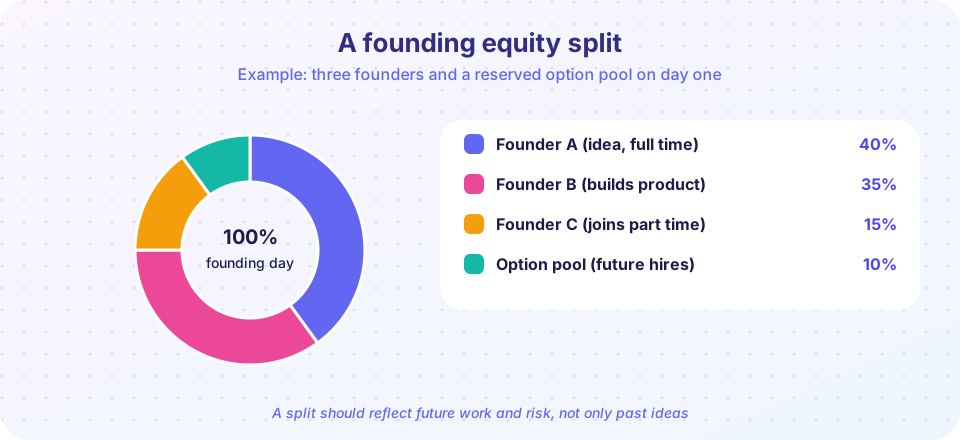
Whichever you pick, two principles help. First, reward the future, not the past: an idea matters, but the years of execution ahead matter more. Second, everyone's share should be earned over time, which is where vesting comes in.
Press Run (or Ctrl + Enter) to see the result here.
Program input · what you'd type while the program runs
Type the answers before you press Run, one per line. Each time the program reads a line (with input()), it gets the next line from this box.
Change a score or a weight and watch the outcome. Notice that the exercise is as valuable for the argument it provokes as for the number it produces: when two founders disagree about a score, they have discovered a real difference in how they see the venture.
Vesting: earning your shares
Imagine two founders each hold 50% from the first day, with no conditions. After four months one of them gets a job offer and leaves. They still own half of the company, perhaps forever, while the remaining founder carries the work for the next decade. The company is stuck with a large shareholder who contributes nothing, and investors will likely refuse to fund it.
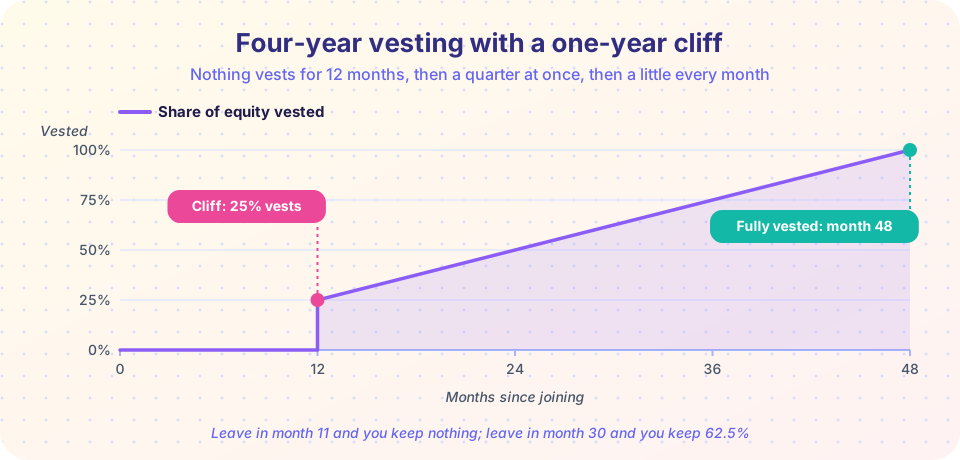
Vesting solves this. Shares are granted on day one but you earn them over a schedule; unvested shares go back to the company if you leave. The common pattern is four-year vesting with a one-year cliff:
- For the first 12 months nothing vests.
- At the end of month 12 a quarter (25%) vests at once.
- After that, 1/48 of the total vests each month until month 48, when 100% is vested.
So someone who leaves in month 11 keeps nothing, and someone who leaves in month 30 keeps 30 ÷ 48 = 62.5%.
Some founders negotiate credit for work already done, for example vesting starting a year before the company was formally set up. Investors often require founders to accept vesting even if they already own shares; in that case remaining unvested shares are typically "re-vested".
Press Run (or Ctrl + Enter) to see the result here.
Program input · what you'd type while the program runs
Type the answers before you press Run, one per line. Each time the program reads a line (with input()), it gets the next line from this box.
Writing it down
A founders' agreement need not be long. Cover these points, and have a lawyer review the final document:
- Roles and decision rights: who decides what, and how deadlocks are broken (a tie-breaker, a mediator, or a defined process).
- Ownership and vesting: each person's shares, the schedule, cliff and acceleration rules (for example, whether vesting speeds up if the company is sold).
- Leaver terms: what happens when someone leaves voluntarily, is dismissed for cause, or becomes unable to work. Many agreements distinguish a "good leaver" who keeps their vested shares from a "bad leaver" who may have to sell them back at a low price.
- Intellectual property: confirm that code, designs and trademarks created for the company belong to the company, not to individuals.
- Time and exclusivity: expected hours, and whether outside work or competing projects are allowed.
- Review dates: schedule a conversation every six months to check that the arrangement still fits.
Common misconceptions
"Equal splits avoid conflict." They avoid the first conflict and postpone the second. Without vesting and review, an equal split can turn bitter when contributions drift apart.
"The idea deserves most of the equity." Ideas are common and valuable only when executed. Most advisers weight execution over the original idea.
"Vesting shows a lack of trust." It is standard and fair; it protects every founder, including the one who stays, and investors will usually ask for it anyway.
Check your understanding
Quick check · 5 questions
of 5 answered You scored / 5 · perfect!
-
1. What does a one-year cliff mean in a four-year vesting schedule?
During the cliff nothing vests. At the end of the cliff the first block (usually 25%) vests at once, then the rest vests monthly. -
2. A founder with 2,400,000 shares on a four-year schedule with a one-year cliff leaves in month 24. How many shares has she vested?
24 / 48 = 50% vested, so 1,200,000 shares. -
3. Which is the strongest reason to test a partnership with a small project first?
Working together shows real behavior under pressure, which is the best predictor of a long partnership. -
4. What principle does a weighted equity split follow?
A weighted split makes the team agree on what matters and scores each person against it. -
5. Why do investors usually ask founders to accept vesting?
Investors want key people to remain committed, and vesting ties ownership to continued contribution.
Summary
- A co-founder helps when skills, workload or resilience call for one; test the partnership with real work first.
- Split equity by future contribution, using an even, weighted or dynamic method, and discuss the scores openly.
- Vesting (commonly four years with a one-year cliff) protects the company if someone leaves.
- Write a founders' agreement covering roles, ownership, leaver terms, intellectual property and review dates.
- Revisit the agreement every six months.
Next: Hiring and culture
Track your progress
Create a free account to tick off lessons and pick up where you left off on any device.
of Entrepreneurship lessons completed