


















Lesson 32 of 49 · Funding and Finance
Chapter 6 review: funding and finance
Review margin, LTV, CAC payback, break-even, burn, runway, funding sources, valuation and dilution with a recap table, a model and a ten-question quiz.
Finance can feel like a wall of jargon until you notice how few formulas carry the load. A founder who can compute margin per customer, months of runway and the ownership left after a round can have a sensible conversation with any accountant, banker or investor. This review collects the formulas in one place and asks you to use them together.
What you will learn
- The formulas of the chapter, in one table
- How the pieces connect in one small model
- How to check yourself with a ten-question mixed quiz
Recap table
| Idea | Meaning | Formula | Lesson |
|---|---|---|---|
| Contribution margin | Money left from a sale after its variable costs | price − variable costs | Unit economics |
| LTV | Total margin from one customer | margin per month ÷ monthly churn | Unit economics |
| LTV to CAC | Value of a customer against cost to win them | LTV ÷ CAC (about 3 or more is a common benchmark) | Unit economics |
| Payback | Months to repay CAC | CAC ÷ monthly margin | Unit economics |
| Break-even | Units needed to cover fixed costs | fixed costs ÷ margin per unit | Unit economics |
| Net burn | Cash spent minus cash received per month | gross burn − cash in | Cash flow and runway |
| Runway | Months until cash runs out | cash ÷ net burn | Cash flow and runway |
| Post-money | Value after the investment | pre-money + investment | Funding and valuation |
| Investor share | Ownership bought | investment ÷ post-money | Funding and valuation |
| Dilution | Existing owners' slice after a round | old share × (1 − share sold) | Funding and valuation |
How the pieces connect
Think of a small subscription company. Unit economics tells you that each customer, after variable costs, leaves $12 a month and stays 20 months on average, so LTV is $240. If CAC is $80 the ratio is 3 and payback is under seven months, which is healthy.
But being healthy per customer does not stop you running dry. Every new customer costs $80 today and repays over seven months, so fast growth consumes cash. This is the heart of the next lesson on cash flow: the faster you grow, the more cash you need up front, even though each customer is profitable. If runway is short, you can slow growth, collect annual prepayments, or raise money.
If you raise, valuation decides the price. A higher valuation means less dilution for the same cash; a lower one gives investors more of the company. The most important check is whether the money buys enough progress (customers, revenue, learning) to raise at a better valuation next time, or to become profitable.
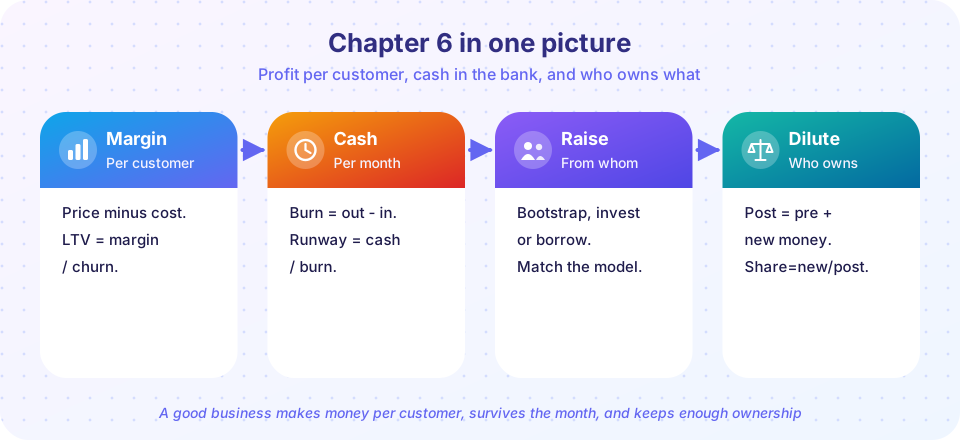
Seen this way, the chapter is one loop: margin per customer → cash consumed by growth → funding to bridge the gap → ownership you give up → more margin and growth with the money.
Reading a business through its numbers
An investor, banker or experienced founder rarely asks for the whole spreadsheet first. They ask four short questions, and you can learn to ask them of your own company.
"What does one customer give you?" This is the margin and the lifetime value. A business with a thin or negative margin per customer cannot be rescued by scale. If the answer is "it depends", you have work to do: split customers into groups and compute each group's margin.
"How quickly do you get your money back?" This is payback. A short payback means each dollar of acquisition returns quickly and can be spent again; a long payback means growth is limited by how much cash you can find. Two companies with the same LTV to CAC ratio can have very different needs for funding because of payback alone.
"How long can you last?" This is runway under a realistic and a pessimistic case. The pessimistic case, where revenue is 30% lower and costs are higher, shows how much slack you have. If the pessimistic case gives you four months, the sensible actions are to cut spending or begin raising now, not in month three.
"What does the money buy?" This connects funding to a milestone. Raising $1,000,000 to hire five people is not a plan; raising it to reach 2,000 paying customers and a payback of five months is. The milestone should make the next round easier or make the company self-sufficient.
Together the four questions describe a chain: margin makes growth worth buying, payback decides how fast cash can be reused, runway decides how long you have, and the funding plan decides who owns what at the end. A weak link anywhere shows up as the same symptom, an empty bank account, which is why it is worth checking each link regularly instead of waiting for the symptom.
One more habit is worth building: always compute at least two scenarios. A single forecast invites wishful thinking, because every assumption is the one you hope for. A pessimistic and an optimistic case force you to ask which assumptions matter and what you would do in each world. If the plan survives the pessimistic case, you can sleep. If it only works in the optimistic case, either change the plan or knowingly accept a gamble.
Try it
This model joins the chapter's three parts. It estimates how many customers a company can afford to win each month with a fixed budget, how runway changes as it spends on acquisition, and what founders keep after a round. All numbers are invented; edit them.
Press Run (or Ctrl + Enter) to see the console output here.
No output.
Experiment. Double the acquisition budget and watch net burn rise and runway shorten, even though each new customer is profitable. Then raise churn to 0.10 and see the LTV to CAC ratio fall below 2.
Check your understanding
Quick check · 10 questions
of 10 answered You scored / 10 · perfect!
-
1. A product sells for $45 and has $17 of variable costs. What is the contribution margin per unit?
45 - 17 = $28. -
2. Margin is $20 a month, monthly churn is 4% and CAC is $250. What is the LTV to CAC ratio?
LTV = 20 / 0.04 = $500. Ratio = 500 / 250 = 2. -
3. CAC is $150 and margin is $25 a month. What is the payback period?
150 / 25 = 6 months. -
4. Fixed costs are $12,000 a month; margin per unit is $15. How many units are needed to break even?
12,000 / 15 = 800 units. -
5. Cash is $240,000, gross burn is $50,000 and customers pay $30,000 a month. What is the runway?
Net burn = 50,000 - 30,000 = 20,000. Runway = 240,000 / 20,000 = 12 months. -
6. Why can a company with strong unit economics still run short of cash while growing fast?
Payback takes time. Each new customer needs cash today and returns it later, so rapid growth stretches the cash position. -
7. Which funding source requires repayment with interest and gives the lender no shares?
Debt financing must be repaid; the lender does not own part of the company. -
8. Pre-money valuation is $6,000,000 and the investment is $2,000,000. What share does the investor own?
Post-money = 8,000,000; 2,000,000 / 8,000,000 = 25%. -
9. Founders own 70% and sell 20% in a new round. What do they own afterward?
70% x (1 - 0.20) = 56%. -
10. What is a main reason to start fundraising when you still have 9 to 12 months of runway?
Fundraising takes time and can fail, so starting early avoids negotiating from desperation.
Summary
- Unit economics decide if each customer pays for itself; check LTV to CAC and payback.
- Break-even volume equals fixed costs divided by margin per unit.
- Net burn and runway measure survival; fast growth can shorten runway even when customers are profitable.
- Equity sells ownership, debt must be repaid; post-money equals pre-money plus investment.
- Dilution multiplies earlier owners by one minus the share sold; raise early enough to avoid desperation.
Track your progress
Create a free account to tick off lessons and pick up where you left off on any device.
of Entrepreneurship lessons completed