


















Lesson 6 of 49 · The Entrepreneurial Mindset
Chapter 2 overview: the entrepreneurial mindset
An overview of how entrepreneurs think about risk, uncertainty, failure and opportunity, with a preview of the three lessons in Chapter 2.
Two people can look at the same empty shop window. One sees a rent bill and a dozen things that could go wrong. The other sees a corner where hungry people walk past every lunchtime. Neither is simply right; they are using different mental habits. This chapter is about those habits, and the good news is that most of them can be learned.
Psychologists and business researchers have studied founders for decades. They have not found one "entrepreneurial personality". What they have found is a cluster of ways of thinking and behaving that experienced entrepreneurs tend to share: they treat uncertainty as something to explore with small tests, they learn from setbacks, and they notice opportunities where others see problems.
What this chapter covers
- Risk and uncertainty separates the two ideas, shows how founders shrink risk with small experiments and teaches a simple expected-value calculation.
- Resilience and learning from failure explains growth mindset, why failure is information and how to run a useful review after a setback.
- Creativity and opportunity recognition shows where ideas come from, how to practice noticing them and how to turn a hunch into a testable statement.
- Chapter 2 review summarizes the chapter and quizzes you.
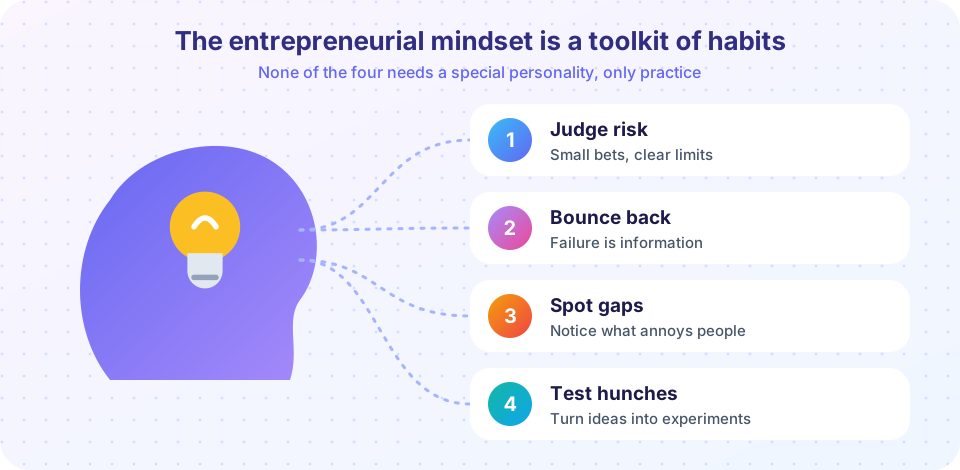
Four habits of the mindset
Mindset is not personality
How to practice
Mindset versus personality
People often assume entrepreneurs are extroverts with huge confidence. Research on founders paints a more mixed picture. Some are outgoing, some quiet; some are risk-tolerant, some careful. What tends to separate people who start and persist is not a fixed trait but a set of attitudes: curiosity about problems, willingness to act before everything is certain, and a habit of learning from outcomes.
This matters for you because it means you are not disqualified by shyness or by never having taken a big gamble. Mindset is built the way a physical skill is built: through repeated small practice with feedback.
A preview of the key tools
You will meet several ideas in this chapter that recur throughout the course. Expected value is a way to compare uncertain choices by weighing each possible result by its chance. Affordable loss is the idea of risking only what you can bear to lose, a principle from effectuation. Growth mindset, popularized by psychologist Carol Dweck, is the belief that abilities can develop through effort and strategy. Pre-mortems and post-mortems are structured conversations that turn setbacks into lessons. Opportunity statements are short sentences that state a customer, a problem and a test.
Common misconceptions
"Mindset means thinking positively all the time." Useful entrepreneurs are often skeptical: they search for reasons an idea might fail and test them early. Optimism helps you keep going; realism helps you choose what to test.
"A growth mindset guarantees success." Mindset helps with persistence and learning, but it does not remove the need for evidence, skills and favorable market conditions. Research on mindset interventions shows modest effects, so treat it as one helpful habit, not a cure-all.
Try it
The first tool is a quick self-reflection on the four habits. Rate yourself from 1 to 5 on each; it highlights the habit to practice first. There are no right answers.
Press Run (or Ctrl + Enter) to see the result here.
Program input · what you'd type while the program runs
Type the answers before you press Run, one per line. Each time the program reads a line (with input()), it gets the next line from this box.
The second tool simulates how repeated small attempts compare with one big attempt. It is a model with invented probabilities, meant only to show why founders prefer many cheap experiments.
Press Run (or Ctrl + Enter) to see the result here.
Program input · what you'd type while the program runs
Type the answers before you press Run, one per line. Each time the program reads a line (with input()), it gets the next line from this box.
Check your understanding
Quick check · 4 questions
of 4 answered You scored / 4 · perfect!
-
1. What does research suggest about an entrepreneurial personality?
Founders vary widely. What they share are habits such as curiosity, acting under uncertainty and learning from outcomes. -
2. What is 'affordable loss'?
Affordable loss is a principle from effectuation: decide how much you can lose and design the experiment within that limit. -
3. Why do founders often prefer several small experiments to one big bet?
More cheap attempts raise the chance of finding something that works while limiting the cost of failure. -
4. Which statement about growth mindset is accurate?
Carol Dweck popularized the idea; effects on outcomes are real but modest, and it does not replace evidence or skill.
Summary
- The entrepreneurial mindset is a set of trainable habits, not one personality type.
- Four habits: judge risk, bounce back, spot gaps and test hunches.
- Expected value, affordable loss, growth mindset and post-mortems are tools you will use in this chapter.
- Many small experiments usually beat one big bet when each attempt is cheap.
- Skepticism and optimism both help: skepticism chooses what to test, optimism keeps you going.
Next: Risk and uncertainty
Track your progress
Create a free account to tick off lessons and pick up where you left off on any device.
of Entrepreneurship lessons completed