


















Lesson 24 of 49 · Marketing and Sales
Segments and positioning
Learn to split a market into segments, score them, pick a beachhead and write a one-sentence positioning statement that separates you from rivals.
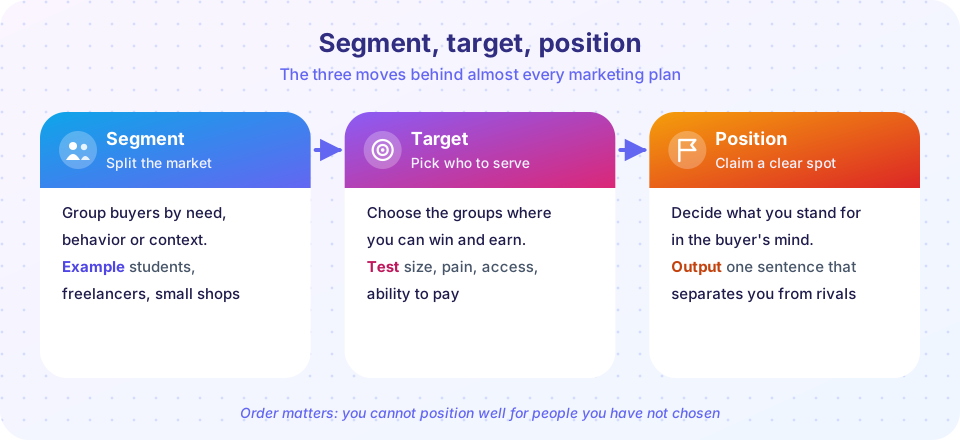
Most failed launches do not fail because the product was bad. They fail because the founder tried to please everybody and ended up meaning nothing to anybody. The cure is to choose: first who you serve, then what you stand for in their eyes. Those two choices, called segmentation and positioning, are the foundation of every message, every channel and every price that follows.
This lesson gives you a method you can apply in an afternoon. You will split a market into groups, score the groups with a transparent formula, pick a first target, and write a positioning statement that you can test on real people.
What you will learn
- Four common ways to segment a market and when each is useful
- How to score segments and choose a beachhead market
- How to write and test a positioning statement
- How to use a positioning map to find space that rivals have left empty
Key terms
Segment: a group of buyers who share a need and respond in a similar way to an offer.
Target market: the segment (or few segments) you decide to serve first.
Beachhead market: a small, winnable first segment that you dominate before expanding.
Positioning: the place your product occupies in the buyer's mind relative to the alternatives.
Value proposition: a short promise of the benefit you deliver and why it is different.
Why a smaller market is a stronger start
"Everyone with a phone is our customer" sounds big and safe. In practice it is weak, because a message that appeals to everyone is general enough to touch no one. A narrow segment lets you write a headline that makes a specific person say "that is exactly my problem". It also lets you pick channels (a single forum, a single trade show) where that person already gathers, so your limited budget goes further.
The strategist Geoffrey Moore described this in his 1991 book Crossing the Chasm with the image of a bowling pin: win the front pin, a narrow group with an urgent need, and the pins behind it fall more easily. The first group is your beachhead. Facebook's early focus on one university at a time and many marketplaces' focus on a single city are well-known examples of the same pattern.
A narrow start is not a permanent limit. It is an ordering decision. You choose the segment where the pain is highest and your product is closest to ready, win it, and use that credibility to widen.
Four ways to cut a market
You can slice the same market in different ways. Choose the cut that best predicts what people will do.
| Basis | Question it answers | Example |
|---|---|---|
| Demographic or firmographic | Who are they on paper? | Age group, or companies with 10 to 50 staff |
| Geographic | Where are they? | One city, one country, one language |
| Behavioral | How do they act now? | Buy weekly, use competitor X, abandon carts |
| Needs-based | What job are they trying to get done? | "Send an invoice in under a minute" |
Demographic cuts are easy to find in data but often poor predictors. Two 30-year-olds may want entirely different things. Needs-based segmentation is harder to measure but usually the most useful; it follows the jobs-to-be-done idea popularized by Clayton Christensen: people "hire" a product to make progress in a situation. A milkshake bought on a morning commute is hired to make a boring drive more interesting, which is a different job from the same milkshake bought for a child after school.
A practical rule: describe each candidate segment as a sentence that contains a situation and a pain. "Freelancers who get paid late and feel awkward chasing clients" is a segment. "Freelancers" is a label.
Scoring segments
When you have three to six candidate segments, compare them with a simple weighted score. Pick criteria that matter for your business, give each segment a score from 1 to 5, and weight the criteria by importance. Typical criteria are:
- Size: how many potential customers are there?
- Pain: how urgent and frequent is the problem?
- Ability to pay: can they afford a price that makes your business work?
- Reachability: can you find and contact them cheaply?
The calculation is a weighted average: multiply each score by its weight, add them up, and divide by the sum of weights. With weights that add to 1, the total is just the sum of products. The numbers are not truth; they are a way of forcing your assumptions into the open so you and a cofounder can argue about the right thing. If two segments score within a few percent of each other, treat it as a tie and let evidence from interviews decide.
Press Run (or Ctrl + Enter) to see the result here.
Program input · what you'd type while the program runs
Type the answers before you press Run, one per line. Each time the program reads a line (with input()), it gets the next line from this box.
Change a weight and watch the ranking move. If one weight change flips the winner, your decision is fragile, and you should collect more evidence (call five people in each of the top two segments).
Positioning: a promise relative to alternatives
Al Ries and Jack Trout popularized the term in their 1981 book Positioning: The Battle for Your Mind. Their central point still holds: buyers do not evaluate your product in isolation, they compare it with whatever else they could do, including a spreadsheet, a notebook or doing nothing. Positioning is the deliberate choice of which comparison you want to win.
A positioning statement is a template that forces clarity. One widely used form, from Moore, reads:
For [target customer] who [need or situation], [product] is a [category] that [key benefit]. Unlike [main alternative], we [primary difference].
For example: "For freelance designers who get paid late, Tally is an invoicing tool that sends polite reminders for you. Unlike a spreadsheet, it chases payment automatically." Every blank must be filled with something specific and true. If you cannot fill the "unlike" slot, you probably have no differentiation yet.
The category choice
The most important blank is the category. If you say "note-taking app", people compare you to every note-taking app. If you say "meeting-notes tool for therapists that keeps records private", you have changed the comparison set to a much smaller field where you may be the best. Choosing the category is choosing your rivals.
Mapping the space
A positioning map plots existing products on two axes that buyers care about, such as price and feature depth. Look for crowded areas to avoid and empty areas that buyers might want but nobody serves.
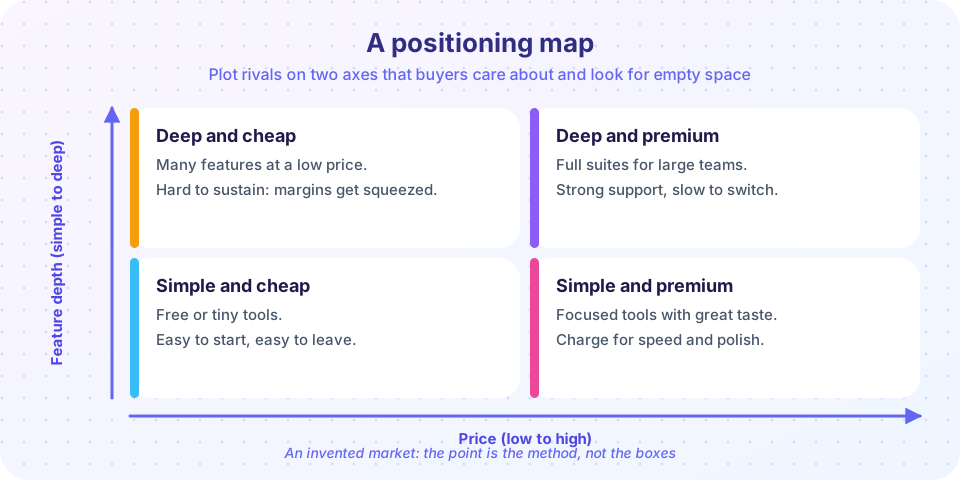
An empty quadrant is only a hypothesis. It may be empty because buyers do not exist there. Test it by talking to people before you build for it.
Writing and testing the statement
Follow these steps:
- Write three versions of the positioning statement with different targets or categories.
- Show each, without explanation, to five people in the target segment and ask them to say it back in their own words.
- Keep the version that people repeat most accurately and ask for the most about.
- Note the words they use for the problem; use those words on your website.
The second TryIt below is a small builder that turns your answers into a statement and flags empty or generic answers. It is a demonstration of the template, not a verdict on your idea.
Common misconceptions
"A bigger segment means a bigger business." Not at the start. A large, vague segment costs more to reach and gives weaker feedback than a small, intense one.
"Positioning is a slogan." A slogan is wording. Positioning is a choice about category and rivals that your product, price and channels must all support. Saying "premium" with a bargain price confuses buyers.
"We have no competitors." Buyers always have an alternative: a spreadsheet, an assistant, a competitor in another category, or simply tolerating the problem. Name it.
Check your understanding
Quick check · 5 questions
of 5 answered You scored / 5 · perfect!
-
1. What is a beachhead market?
The beachhead idea (from Geoffrey Moore) is to win a narrow first group with an urgent need and use that credibility to expand. -
2. Which segmentation basis asks what job the buyer is trying to get done?
Needs-based or jobs-to-be-done segmentation groups people by the progress they want to make, which usually predicts behavior better than age or location. -
3. A segment scores 4.1 and another scores 4.0 in your weighted model. What is the sensible conclusion?
Scores come from rough judgments, so small differences are noise. Interviews are the tie-breaker. -
4. In a positioning statement, why does the 'unlike' slot matter?
Positioning is relative. If you cannot say how you differ from the main alternative, you have no differentiation to communicate yet. -
5. What does an empty quadrant on a positioning map mean?
Gaps are only suggestions. Test with real buyers before building for the gap.
Summary
- A narrow first segment gives sharper messages, cheaper channels and better feedback.
- Segment by needs and behavior when you can; demographics are easy but often weak predictors.
- Score segments with a transparent weighted formula, then confirm with conversations.
- Positioning is a promise relative to alternatives; the category you choose decides your rivals.
- Use the statement template, test it on five people, and use their words.
Next: Channels and the funnel
Track your progress
Create a free account to tick off lessons and pick up where you left off on any device.
of Entrepreneurship lessons completed