


















Lesson 22 of 49 · Business Models and Plans
Chapter 4 review: business models and plans
Review Chapter 4: the business model canvas, revenue models and pricing, unit economics, business plans and pitches, with a one-page summary and a ten-question quiz.
Chapter 4 turned a validated idea into a business you can describe and check with numbers. You learned to sketch a model on the canvas, to choose a revenue model and a price with reasons, to test whether each customer pays for themselves and to put the whole story into a plan and a pitch. These skills let you spot weak models early and explain strong ones clearly.
This review summarizes the chapter in one picture and a table, then gives you a longer quiz that mixes all four lessons.
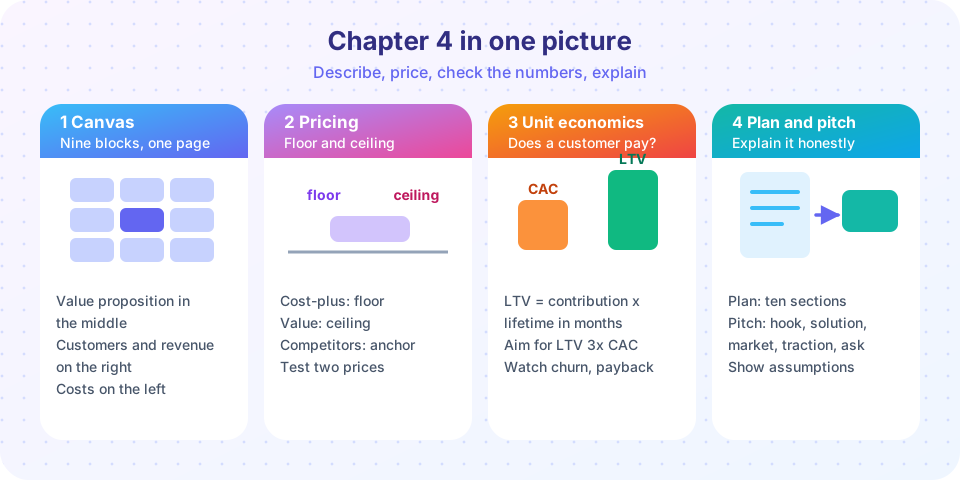
The chapter in one table
| Idea | Core point | Lesson |
|---|---|---|
| Business model | How a venture creates, delivers and captures value | Chapter overview |
| Canvas | Nine blocks on one page; value proposition links customers and operations | Canvas |
| Revenue models | One-time, subscription, freemium, marketplace, advertising, licensing, usage | Pricing |
| Pricing methods | Cost-plus floor, value-based ceiling, competitors as reference | Pricing |
| Contribution margin | Price minus variable cost per unit | Unit economics |
| CAC and LTV | Cost to win a customer versus contribution they bring | Unit economics |
| Plan | Ten practical sections; length matched to audience | Plan and pitch |
| Pitch | Hook, solution, market and model, traction and team, the ask | Plan and pitch |
Formulas to remember
- Contribution margin = price - variable cost
- Break-even units = fixed costs / contribution margin per unit
- Price from target gross margin = unit cost / (1 - margin)
- CAC = acquisition spending / new customers
- LTV = monthly contribution x lifetime in months (lifetime ~ 1 / monthly churn)
- Payback months = CAC / monthly contribution
A worked pass through the chapter
Follow a fictional founder, Ines, who plans an online course teaching spreadsheet skills to small-shop owners. Canvas. Her segment is shop owners with fewer than ten staff; the value proposition is learning to track stock and sales in an afternoon; channels are short videos and shop-owner groups; revenue is a subscription; key costs are her time, video tools and hosting.
Pricing. Hosting and fees cost about 9 dollars per customer per month, so the floor for a decent margin is well above that. Shop owners tell her they lose several hours a month to messy records, so the value ceiling is far higher than competitors' price of about 40. She tests two prices, 49 and 69 dollars, on separate landing pages and finds that 49 converts better but 69 earns more per visitor.
Unit economics. She spends 2,400 dollars on ads to win 80 customers, so CAC is 30 dollars. With a contribution of 51 dollars per month and churn of 12 percent, LTV is about 425 dollars, a ratio near 14. That looks excellent, but she remembers it depends on churn she has measured for only two months, so she plans to check it again when she has six months of data.
Plan and pitch. She writes a five-page plan for a small loan: problem, solution, market, model, marketing, team, finances with assumptions and risks. Her pitch has five parts and ends with a precise ask: 8,000 dollars for video equipment and three months of ads. The numbers are invented, but the process is the one real founders use.
Common mistakes to avoid
Four mistakes recur in business models. Treating revenue as profit hides losses. Copying a competitor's price without checking your costs can leave you with no margin. Using revenue instead of contribution in an LTV calculation overstates value. And writing a long plan before testing the model wastes time on guesses. Keep plans short, mark assumptions and let evidence update them.
Try it
The first tool strings the chapter's formulas into one model for a fictional online course. Edit the inputs and see whether the venture can survive.
Press Run (or Ctrl + Enter) to see the result here.
Program input · what you'd type while the program runs
Type the answers before you press Run, one per line. Each time the program reads a line (with input()), it gets the next line from this box.
The second tool simulates the customer count month by month with a constant number of new customers and monthly churn. It shows how the base levels off at new customers divided by churn, and when it passes break-even.
Press Run (or Ctrl + Enter) to see the result here.
Program input · what you'd type while the program runs
Type the answers before you press Run, one per line. Each time the program reads a line (with input()), it gets the next line from this box.
Check your understanding
Quick check · 10 questions
of 10 answered You scored / 10 · perfect!
-
1. Which three jobs does a business model describe?
A model explains how value is created for customers, delivered and captured as revenue. -
2. Which canvas block links the customer side to the operations side?
The value proposition sits in the center and joins what customers want with what the left side builds. -
3. Unit cost is 6 dollars and you want a 50% gross margin. What price do you need?
Price = cost / (1 - margin) = 6 / 0.5 = 12 dollars. -
4. Which method gives the ceiling for a price?
Customers will not pay more than the value they receive. -
5. Fixed costs are 4,200 and contribution is 51 per customer per month. Break-even customers?
4,200 / 51 is about 82.4, so you need 83 customers to cover fixed costs. -
6. What does LTV to CAC of 1.0 tell you?
At 1.0 the contribution only covers the cost of winning the customer. -
7. Why is revenue not the same as profit?
Many ventures with high revenue lose money. -
8. Which is the best use of a one-page canvas?
The canvas organizes hypotheses that tests then confirm or change. -
9. Which is NOT part of the five-part pitch structure?
A pitch is short; detail belongs in the plan. -
10. Monthly churn rises from 10% to 20%. What happens to expected lifetime?
Lifetime is about 1 / churn: from 10 months to 5 months.
Summary
- A business model describes how value is created, delivered and captured; the canvas puts it on one page.
- Price between the cost floor and the value ceiling, using competitors as a reference and testing with customers.
- Unit economics (contribution, CAC, LTV, payback) shows whether growth will help or hurt.
- Plans clarify thinking and pitches persuade; both depend on honest evidence.
- Chapter 5 turns to reaching customers: marketing and sales.
Next: Chapter 5 begins the second half of the course; see the course page for the full list of lessons.
Track your progress
Create a free account to tick off lessons and pick up where you left off on any device.
of Entrepreneurship lessons completed