


















Lesson 17 of 49 · Business Models and Plans
Chapter 4 overview: business models and plans
An overview of how a venture creates, delivers and captures value, and a preview of the business model canvas, pricing, unit economics and business plan lessons.
A validated problem and a promising test are not yet a business. A business needs a way of operating that turns value for customers into money for the venture, repeatedly, and for long enough to pay everyone involved. That way of operating is called a business model. It answers a deceptively short list of questions: who are the customers, what do we offer, how do we reach them, how do we earn, what does it cost and what do we need to deliver it?
Chapter 4 teaches you to describe a business model on one page, choose a price with reasons, check that each sale makes money and write the idea down as a plan and a pitch. The skills are practical: you will end the chapter with numbers that either support your idea or show you what to change.
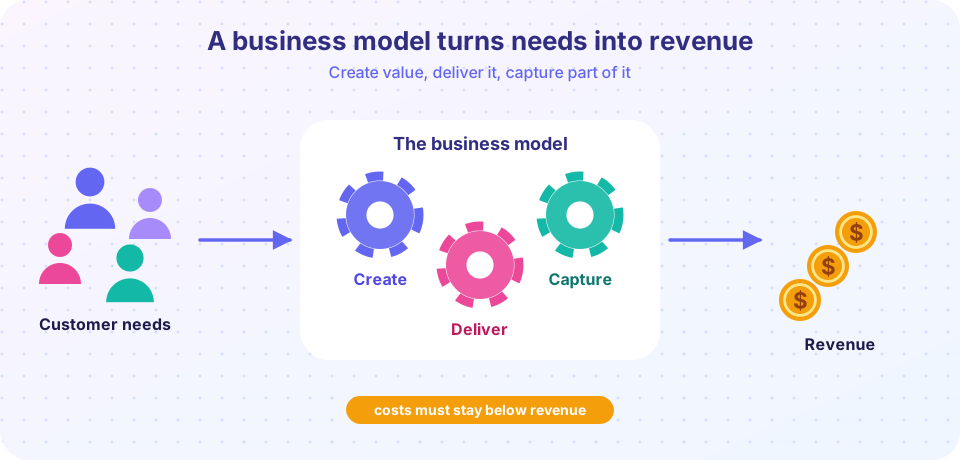
Value: create, deliver, capture
A useful way to think about any business model is as three linked jobs. Value creation: what do you offer that solves the customer's problem better than the alternatives? Value delivery: how does it reach the customer, through which channels and with which relationships? Value capture: how does the venture earn money from the value it creates, and how much of the value does it keep after costs?
Many weak ventures succeed at the first job and fail at the third. They solve a real problem, customers love the result, and yet the venture cannot charge enough, or it costs too much to deliver. Studying the model before scaling reveals these gaps early.
What a business model answers
The chapter in four steps
Keep it testable
What the chapter covers
- The business model canvas introduces Alexander Osterwalder's nine-block tool for describing a model on one page, with a full worked example.
- Pricing and revenue models compares ways to earn (one-time sale, subscription, freemium, marketplace, advertising, licensing) and methods to set a price (cost-plus, competitor-based and value-based).
- Unit economics shows contribution margin, customer acquisition cost and lifetime value, so you can tell whether growing will help or hurt.
- Business plan and pitch explains what a useful plan contains, how long it should be and how to turn it into a short pitch.
- Chapter 4 review summarizes the chapter and quizzes you.
Models are hypotheses
A business model on paper is a set of assumptions: that these customers exist, that they will pay this much, that you can reach them this way. The lessons in Chapter 3 gave you methods for testing such assumptions. In this chapter you will express them clearly enough to test. A model is not a prediction; it is a map that you redraw as you learn.
Common misconceptions
"A business plan must be a 50-page document." For most early ventures, a one-page canvas and a few pages of numbers are more useful than a long plan nobody updates. Length is not quality.
"Revenue is the same as profit." Revenue is what customers pay; profit is what remains after all costs. Many ventures with high revenue lose money.
"Choose a price at the end." Price shapes the customers you attract, the margin you earn and the way you must market. Test it early.
Try it
The first tool is a model completeness check. List the nine canvas blocks and mark which ones you have written down for your own idea; it reports the empty ones so you know where to work.
Press Run (or Ctrl + Enter) to see the result here.
Program input · what you'd type while the program runs
Type the answers before you press Run, one per line. Each time the program reads a line (with input()), it gets the next line from this box.
The second tool shows the gap between revenue and profit for a fictional venture across several months. Notice how a venture can show growing revenue while still losing money.
Press Run (or Ctrl + Enter) to see the result here.
Program input · what you'd type while the program runs
Type the answers before you press Run, one per line. Each time the program reads a line (with input()), it gets the next line from this box.
Check your understanding
Quick check · 4 questions
of 4 answered You scored / 4 · perfect!
-
1. Which three jobs make up a business model in this chapter?
A model describes how value is created for customers, delivered to them and captured as revenue. -
2. A venture has rising revenue but falling cash. What is the most likely explanation?
Revenue is not profit; growing sales can still lose money if costs are higher. -
3. How should you treat a business model on paper?
A model is a map of assumptions that you update as you learn. -
4. Why test your price early?
Price shapes the whole business, so it is a core assumption to check.
Summary
- A business model explains how a venture creates, delivers and captures value.
- Many ventures fail at capture: they solve a problem but cannot earn enough from it.
- The chapter covers the canvas, pricing, unit economics, and the plan and pitch.
- Treat the model as a set of testable hypotheses, not a prediction.
- Revenue is not profit: always check what remains after costs.
Track your progress
Create a free account to tick off lessons and pick up where you left off on any device.
of Entrepreneurship lessons completed