


















Lesson 40 of 49 · Growth, Ethics and Exit
Ethics and responsibility
Learn how founders decide when the law is silent: ethical frameworks, stakeholders, dark patterns, data privacy, externalities and a practical decision checklist.
Every company faces moments where the profitable choice and the right choice point in different directions. A competitor is cutting corners, a metric is slipping, an investor wants faster growth, and the law has nothing to say about the thing you are about to do. What then?
The honest answer is that nobody has a formula, and thoughtful people disagree about many cases. But founders are not helpless. There are frameworks for thinking, patterns to avoid, and habits that make good decisions more likely under pressure. This lesson presents them with both sides of the arguments that remain open, because the point is for you to make your own reasoned choices, not to memorize a verdict.
What you will learn
- Three ways to think about right and wrong in business
- The debate between shareholder primacy and stakeholder approaches
- How to recognize dark patterns, misleading claims and risky data practices
- What externalities are and how they distort decisions
- A practical checklist for decisions under pressure
Key terms
Ethics: the study of what people ought to do, beyond what is required by law.
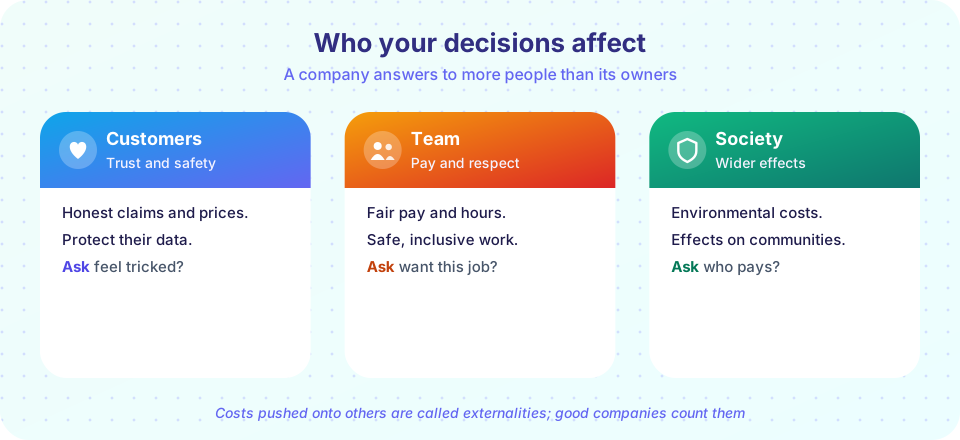
Stakeholder: any person or group affected by a company's actions, including customers, employees, suppliers and communities.
Dark pattern: a design that tricks users into actions they did not intend, such as hidden charges or a cancellation maze.
Externality: a cost or benefit of an activity that falls on people who are not part of the transaction.
Data minimization: collecting only the personal data you need for a clear purpose.
Why law is not enough
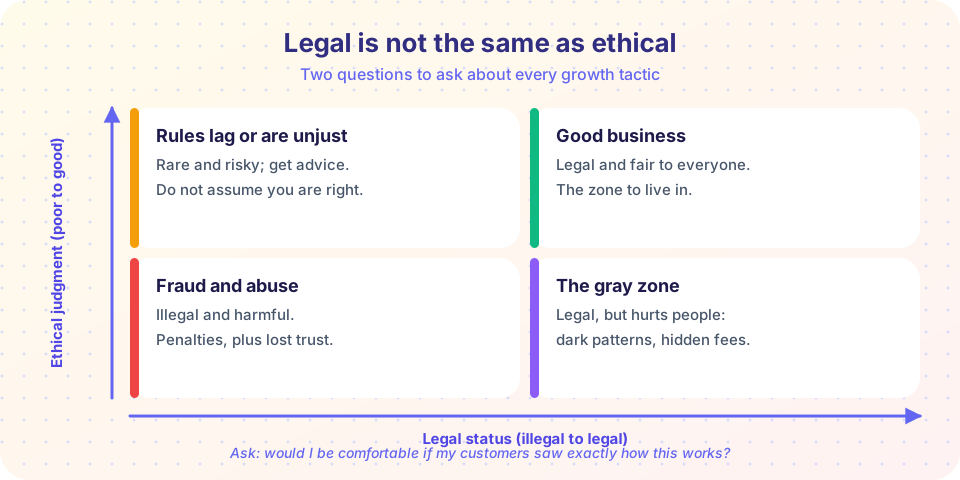
Law is a floor, written slowly and enforced unevenly. It lags behind technology and varies by country. Many harmful behaviors are legal: a subscription that is easy to start and hard to cancel, a price that is technically disclosed in a tiny footnote, a feature designed to keep a person scrolling long after they want to stop. Meanwhile some laws are themselves contested, and rarely there are situations where following a rule would cause harm.
Ethics matters for business as well as for conscience. Customers who feel tricked leave and tell others, employees who are asked to mislead customers leave, regulators write new rules in response to abuses, and trust, once lost, is very expensive to rebuild. There are cases where unethical companies prosper for a long time, so do not promise yourself that doing right always pays. The better argument is that you will live with the company you build, and so will the people who work in it.
Three ways to think
Philosophers have developed several traditions for reasoning about right and wrong. Each gives you a different question to ask.
Consequences (utilitarian thinking). Choose the action that produces the best overall outcomes for everyone affected. The question: who benefits, who is harmed, and by how much? Its strength is that it makes you count harms to people outside the room. Its weakness is that outcomes are hard to predict and measure, and it can be used to justify harming a minority for the benefit of many.
Duties and rights (deontological thinking). Some actions are wrong whatever the outcome: lying, breaking promises, using people merely as a means. The question: would I be comfortable if everyone acted this way, and does this respect people's rights? Its strength is that it protects individuals; its weakness is that duties can conflict.
Character (virtue ethics). Ask what a person of good character, honest, fair, courageous, would do. The question: what kind of company am I becoming through this choice? Its strength is that it focuses on habits; its weakness is that "good character" can be vague in a hard case.
You do not need to choose one. When all three point the same way, you can be confident. When they diverge, you are facing a real dilemma and deserve to slow down and consult others.
Whose interests count?
In 1970, economist Milton Friedman argued in an essay that a business's social responsibility is to increase its profits within the rules of the game, and that executives who spend owners' money on other goals are imposing their own values on others. In 1984, R. Edward Freeman's Strategic Management: A Stakeholder Approach argued that firms must consider all groups affected, such as employees, customers, suppliers and communities, because the company's success depends on their cooperation.
The two positions are closer than the slogans suggest. Most stakeholder advocates accept that a company must be profitable to survive, and many shareholder advocates accept that treating customers and staff badly destroys long-term value. Where they disagree is on how much weight non-owner interests should have when they conflict with profit, and who should decide. Reasonable people still disagree, and corporate forms vary: some countries let companies adopt a legal purpose beyond profit (for example, "benefit corporations" in some US states). In 1994 John Elkington proposed a "triple bottom line" that reports on people, planet and profit.
Patterns to avoid
Misleading claims. Statements that are literally true but built to deceive, fake scarcity ("only 2 left!" when stock is plentiful), invented testimonials, undisclosed paid endorsements, and claims about health, safety or environmental benefits that you cannot prove. Many countries have advertising and consumer-protection laws that cover these, with real penalties.
Dark patterns. Designer Harry Brignull coined the term in 2010 for interfaces that trick users: pre-ticked boxes that sign people up to extras, "confirmshaming" (a decline button that reads "No thanks, I don't like saving money"), hidden fees revealed at the last step, and cancellation flows that need a phone call during office hours when signup took one click. They often lift short-term conversion. They also raise refunds, complaints and regulatory attention, and they damage the trust on which repeat business depends. A good test is symmetry: if signing up takes one click, canceling should take about the same.
Careless data practices. Collect only what you need (data minimization), tell people clearly what you do with it, secure it, and delete it when you no longer need it. Many jurisdictions have data protection laws, such as the GDPR in the European Union, with significant fines. A data breach harms real people and the company's reputation.
Treating people as costs. Unrealistic deadlines, unpaid overtime, unsafe conditions or hiding behind "contractor" status to avoid obligations may save money for a quarter but cost you your best people and sometimes a lawsuit.
Ignoring supplier practices. If your product depends on a supply chain, you share responsibility for how its workers are treated. Ask suppliers questions and visit or audit where you can.
Externalities
Suppose a factory makes a product for which customers pay $20, with production costs of $15, so the company earns $5 profit per unit. But the factory also emits pollution that costs neighbors $7 per unit in health and cleaning expenses. The company sees a $5 profit; society sees a net loss of $2 per unit. The $7 is an externality: a cost borne by people who were not in the transaction.
Externalities explain why profitable activities can be harmful. They also explain why governments tax or regulate pollution: to push companies to account for costs they otherwise ignore. As a founder you can choose to count them voluntarily: estimate the effect of your product on others, reduce it where you can, and be honest about what remains. Positive externalities exist too (a vaccine protects people beyond the buyer), and companies that create them deserve to say so, accurately.
Press Run (or Ctrl + Enter) to see the console output here.
No output.
A decision toolkit
When a hard choice appears, run through a short sequence.
- Name the stakeholders. List everyone affected, including people who will not be in the meeting.
- State the facts. What do we actually know, and what are we assuming?
- Apply tests.
- Daylight test: would we be comfortable if customers, employees and a journalist saw exactly how this works?
- Symmetry test: would we accept this if we were on the receiving end?
- Reversibility: can the harm be undone? Prefer reversible choices.
- Look for a third option. Many dilemmas are false: there may be a way to meet the goal without the harm.
- Decide and record why. Write the reasoning down. If you are wrong, you will learn why.
- Create a way to speak up. People close to the work see problems first, so make it safe to raise a concern without punishment.
Tough decisions are easier when values are set before pressure arrives. Write two or three lines you will not cross, such as "we will not mislead customers about price or results" and "we will not ship a product we believe is unsafe", and share them with your team and investors.
Press Run (or Ctrl + Enter) to see the result here.
Program input · what you'd type while the program runs
Type the answers before you press Run, one per line. Each time the program reads a line (with input()), it gets the next line from this box.
The "hide the cancel button" option scores lowest here, but try giving revenue most of the weight: its total climbs while the veto still removes it, because a score of 1 on trust or legal risk is a line you chose not to cross. Veto rules stop a high score on one criterion from buying off a serious harm on another.
The last demo is a quick red-flag screen. It is a prompt for discussion, not a legal or moral verdict.
When doing right is costly
Sometimes the ethical path costs real money or a competitive edge. A small company can feel unable to afford better materials, higher wages or a slower launch. There is no neat answer. Some options: charge more and explain why, find customers who value the difference, change the product so that the harm disappears, or decide that this market is not for you. Talk openly with co-founders and investors about where your lines are before a crisis. If you are asked by someone in authority to do something illegal or seriously harmful, you may have a duty, and in some countries a legal right, to refuse or report it; seek independent advice.
Common misconceptions
"If it is legal, it is fine." Legal compliance is necessary but not sufficient. Many harmful practices are legal, and law varies by country.
"Ethics is a luxury for big companies." Early habits become culture. A five-person company that misleads customers will not suddenly become honest at fifty.
"Doing right always pays." Often it does over time, but not always, and not always quickly. Choose it because of who you want to be as well as for the business case.
Check your understanding
Quick check · 5 questions
of 5 answered You scored / 5 · perfect!
-
1. Which approach to ethics asks who benefits and who is harmed, and by how much?
Utilitarian thinking weighs outcomes for everyone affected. -
2. What is a dark pattern?
Examples include pre-ticked extras, hidden fees and cancellation mazes. -
3. A product earns $4 profit per unit and creates $6 of costs for neighbors. What is the net value to society per unit?
4 - 6 = -2: the company profits, but society loses overall because others pay the external cost. -
4. Why does a veto rule in a decision matrix help?
Vetoes set lines you will not cross whatever the weighted total says. -
5. What is the 'symmetry test' for a tactic?
If you would not accept a tactic as a customer, treat that as a strong warning.
Summary
- Law is the minimum; ethics asks what you owe customers, staff, suppliers and society.
- Consequences, duties and character give three useful questions; when they agree, act with confidence.
- Shareholder and stakeholder views overlap, and reasonable people still disagree on the weights.
- Avoid misleading claims, dark patterns, careless data practices and unfair treatment of people.
- Externalities are costs that others bear; count them voluntarily.
- Use stakeholder lists, the daylight and symmetry tests, vetoes and written values before pressure arrives.
Next: Exits
Track your progress
Create a free account to tick off lessons and pick up where you left off on any device.
of Entrepreneurship lessons completed